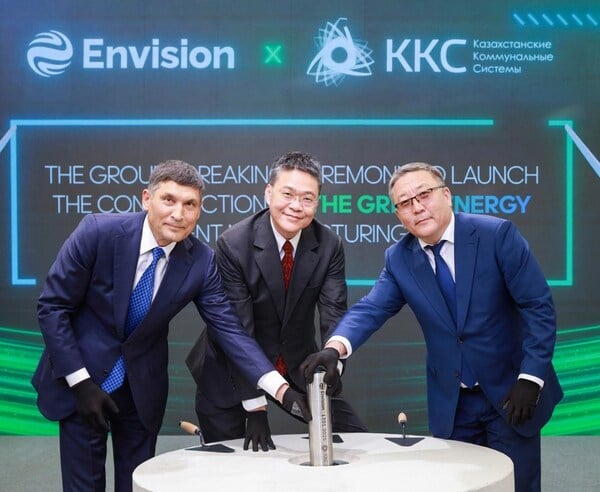
Chinese renewable energy tech company Envision has begun building a factory for wind turbines and energy storage systems (ESS) in Kazakhstan.
The Shanghai-headquartered multinational said earlier this week that it celebrated the groundbreaking at the site in the Central Asian country on 17 January, around a month after signing an agreement with local partner Kazakhstan Utility Systems.
Envision specialises in ‘comprehensive net zero solutions’ from wind turbines and energy management system (EMS) software to ESS, green hydrogen and net zero industrial park development.
Representing a total investment of US$40 million, the plant will have an annual production capacity for 2GW of wind turbines and 1GWh of battery energy storage system (BESS) solutions.
Try Premium for just $1
- Full premium access for the first month at only $1
- Converts to an annual rate after 30 days unless cancelled
- Cancel anytime during the trial period
Premium Benefits
- Expert industry analysis and interviews
- Digital access to PV Tech Power journal
- Exclusive event discounts
Or get the full Premium subscription right away
Or continue reading this article for free
That equates to around 250 units of 8MW wind turbines per year and around 100 BESS units at 10MWh per unit, the company said. More than 3,000 jobs will be created including about 300 core production roles. The factory is due to begin operations in Q3 2026.
According to Envision, 60% of the equipment produced at the plant will be delivered to clean energy and grid enhancement projects within Kazakhstan. The remaining 40% will be exported to other countries in Central Asia and the Caucasus.
In addition to setting up the factory, through its local partnership Envision—which has recently expanded its global energy storage sector presence with recent deals in other markets, including India and South Africa—will provide technical support throughout the lifecycles of clean energy projects in Kazakhstan.
That technical support, encompassing design, production and operation of renewables and storage systems, is aimed at helping optimise the integration of wind energy and ESS in the country.
Kazakhstan: Wind energy potential
According to the Eurasian Research Institute at Kazakhstan’s Akhmet Yassawi Institute, Kazakhstan, which is fossil fuel-rich, also has great potential for wind energy development.
Large regions of the country have wind corridors that experience wind speeds above 5m/s, which the institute identifies as ‘essential for the operation of wind turbines.’ Kazakhstan’s first large-scale wind farm was built in 2011, and the government approved the first tariffs for electricity from wind in 2014.
As of 2023, around 87% of Kazakhstan’s electricity came from fossil fuels, according to energy transition think tank Ember. Hydroelectric was the biggest source of renewable power at 8%, with wind and solar accounting for a combined 5% that year.
Ember noted that renewable energy generation had increased significantly since 2015 when it made a near-zero contribution but remained well below the global average of 13% and a similar benchmark across Asia. Over the past two decades both electricity demand and power sector emissions had more than doubled, the think tank said.
Central Asia comprises five countries: Uzbekistan, Kazakhstan, Kyrgyzstan, Tajikistan and Turkmenistan. The region is strategically important for factors that include its proximity to China, Russia, the Caucasus, Southern Europe and the Middle East.
At COP29 climate talks in November, the government of Uzbekistan, Kazakhstan’s neighbour and the largest Central Asian country by population, signed an implementation agreement for battery storage systems with Saudi Arabian energy and infrastructure solutions developer ACWA Power.
This followed partnership agreements signed in March 2023 between ACWA Power and the Uzbek government for solar PV and 1.2GW of BESS development, as well as between ACWA Power and a Kazakh sovereign wealth fund for 1GW of wind and battery storage, as reported by Energy-Storage.news.
The Envision groundbreaking event last week was attended by dignitaries including Kazakhstan’s vice minister for energy Sungat Yesimkhanov, and vice minister for industry and construction Olzhas Saparbekov and counsellor for the Chinese consulate general in the country Lu Anqi.