
Earlier this month in Hefei, China, Sungrow held its inaugural Global Energy Pioneer Summit, bringing together installers and distributors from around the globe.
Sungrow has solidified its place as a leader in the utility-scale market and ranks AAA in our Battery StorageTech Bankability Ratings Report, delivering large global projects, including Europe’s largest operational BESS at around 1.2GWh. It is now ramping up its activity the residential and commercial & industrial (C&I) segments too.
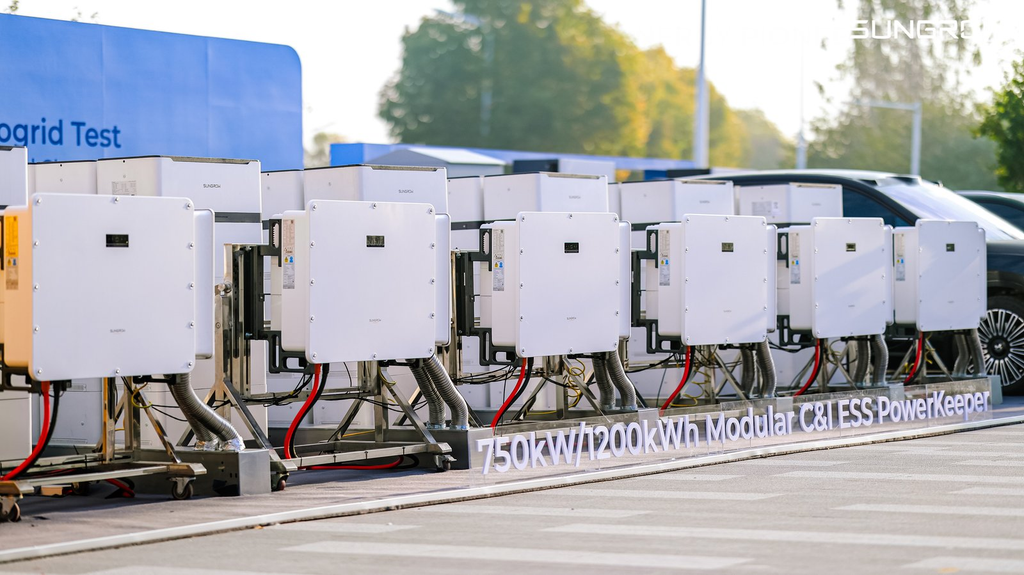
The event in Hefei saw the launch of the company’s new commercial & industrial (C&I) battery energy storage system (BESS) product line, the PowerKeeper. It aims to simplify installation with the solutions’ modular design and flexible configuration options, while meeting a wide variety of applications with a capacity range of 50-1000 kWh and compatibility with both the company’s new hybrid inverter series and the newly upgraded SH30/40/50CX-P2 series. This can enable full-scenario grid adaptability with seamless on/off grid switching.
The next-generation PowerStack 3.0 C&I BESS was also unveiled, building on the theme of flexibility and application-designed solutions with a multi-scenario dock. The four modules of PCS, solar, charging, and microgrid allow for configurations tailored to specific needs, and the simplified architecture could aid in more efficient deployment. With 684Ah cells, an energy density of up to 256 kWh/m2, and flexible installation layouts, the PowerStack 3.0 also improves upon the previous generation by reducing the required project footprint.
Try Premium for just $1
- Full premium access for the first month at only $1
- Converts to an annual rate after 30 days unless cancelled
- Cancel anytime during the trial period
Premium Benefits
- Expert industry analysis and interviews
- Digital access to PV Tech Power journal
- Exclusive event discounts
Or get the full Premium subscription right away
Or continue reading this article for free
These new launches follow the release of the residential PowerHarbour and PowerHarbour Pro energy storage systems earlier this year. This comes at a time when energy storage suppliers are increasingly expanding their portfolios to cover a wider range of applications; however, this has primarily been from residential to C&I and larger-scale.
In the first half of 2026, the company had already shipped 25GWh (up 28% yoy). The increased focus on smaller-scale products could indicate that the company sees strong potential for future growth in these markets, while emphasising Sungrow’s ambition to become a leader across all battery storage avenues.
Residential market opportunities
In Europe, one of Sungrow’s main markets for residential batteries, newly added storage capacity is set to be dominated by the utility-scale market. This is driven by increasing renewable energy penetration, the need for grid stability, and supportive government policies. However, the stronger global attention on renewable energy in recent years has extended into individual households with a rise in domestic solar installations and electric vehicles. Creating a unified ecosystem that marries these separate components has therefore become increasingly appealing to consumers, and is what Sungrow hopes to provide with its PowerHarbour product.
Despite the slowdown in the European residential battery market last year, the industry is poised for a new wave of growth. New subsidy programs are expected to provide a strong tailwind. Hungary opened applications for a 100 billion HUF (US$300 million) residential battery support program this year, with subsidies up to 80% of the total system cost and a cap of 2.5 million HUF per household. Poland recently launched a 1 billion PLN (US$250 million) scheme for residential batteries and heat storage, supporting systems connecting to existing PV installations and targeting over 200,000 battery storage systems by the end of 2027. In Romania, the first dedicated residential battery storage scheme was also announced this year, providing up to 75% of project costs for prosumers.
Higher electricity prices triggered by global conflicts have also led to an uptick in interest in domestic batteries. The expansion of virtual power platforms (VPPs) across Europe, providing new revenue streams for solar and battery owners, could also boost adoption.
Australia, another of Sungrow’s main household battery markets, has already seen its residential battery support program drive up demand. With new distribution deals totalling 1.5GW of PV and 4GWh of BESS, the company is actively furthering its footprint in the country.
New product innovation
The growth of the energy storage market has led to more companies entering the business and battery prices falling amidst high competition, resulting in squeezed margins. However, there has been a shift toward valuing more than just price. The growth of the market has led to more diverse applications and varying needs for different deployment scenarios. The boom in installations in the Middle East, for example, has led to a greater emphasis on battery performance at high temperatures.
Energy storage suppliers have increasingly focused on software solutions and providing tangible benefits beyond the hardware itself. The use of AI has become increasingly prevalent in BESS solutions, and Sungrow’s new products are no exception, with the new AI assistant Bubbly. This tool will be implemented in both select C&I and residential solutions and can help boost returns through optimised trading and dispatch, as well as simplify battery monitoring.
Grid-forming inverters are becoming increasingly important, as more countries, such as Portugal, require them in large-scale BESS. Sungrow’s SHCX hybrid inverters not only meet this requirement, but feature Virtual Synchronous Generator technology, which enables seamless grid switching and load sharing with diesel generators. The rise in diesel prices experienced this year could lead to increased implementation of batteries alongside these traditional generators, particularly in microgrids, and the new PowerKeeper series is primed to meet this demand.
With more competition, suppliers are increasingly innovating their lineups to differentiate themselves from the crowd by offering distinct advantages. Time will tell which products become market leaders.
