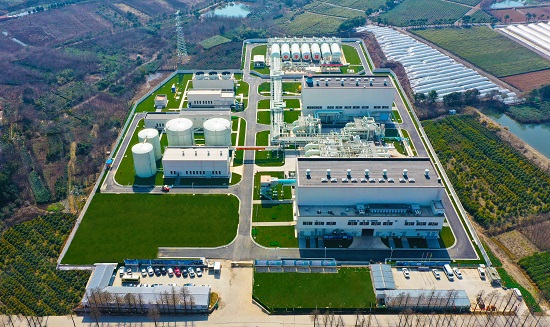
A 300MWh compressed air energy storage system capacity has been connected to the grid in Jiangsu, China, while a compressed air storage startup in the country has raised nearly US$50 million in a funding round.
Chinese state media reported a few days ago that the large-scale project in Jiangsu Province’s Changzhou City has become operational and connected to the grid last week on 26 May.
The system stores air compressed using electricity in vast salt caverns a kilometre below ground level. When power is needed, the air is released to drive turbines.
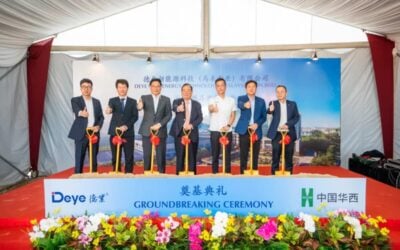
The project has been co-developed by China National Salt Industry Group, electricity generation company China Huaneng Group and Tsinghua University.
Try Premium for just $1
- Full premium access for the first month at only $1
- Converts to an annual rate after 30 days unless cancelled
- Cancel anytime during the trial period
Premium Benefits
- Expert industry analysis and interviews
- Digital access to PV Tech Power journal
- Exclusive event discounts
Or get the full Premium subscription right away
Or continue reading this article for free
Officially named Jiangsu Jintan Salt Cavern Compressed Air Energy Storage Project, the system can provide 60MW of peak shaving energy for the local grid and its roundtrip efficiency is more than 60%, China Huaneng Group said. It could be expanded considerably in future.
China Huaneng Group’s Jiangsu branch was responsible for construction and commissioning and now takes on operations and maintenance (O&M) duties. The company described the project as a significant milestone in taking compressed air from demonstration and pilot projects to scale, as well as a milestone in China’s energy storage development trajectory.
“Compressed air technology could support the construction of new type power system with new energy as the main body, which can help the country achieve peak carbon emissions and carbon neutrality,” Zhou Ting, Changzhou branch deputy director for State Grid Corporation said of the project.
China is targeting net zero emissions from its economy by 2060 and has a target for 50% of electricity generation in the country to come from renewables by 2025.
To pursue these aims it also has a target in place to deploy 30GW of non-pumped hydro energy storage by 2025 – as well as 120GW of pumped hydro by 2030.
While the country is a leader in both production and installation of lithium-ion batteries already, its energy sector is viewing a range of energy storage technologies as having the potential to contribute to decarbonising while maintaining reliability of the electric system. A number of different long-duration storage technologies are being looked at alongside compressed air.
This includes a number of very large vanadium redox flow battery (VRFB) projects around the country, which have made slow progress but when completed would each number in the hundreds of megawatt-hours.
In January, a partnership between Shanghai Power Equipment Research Institute (SPERI) and Sumitomo SHI FW began exploring the potential of liquid air energy storage (LAES) technology developed and commercialised by UK company Highview Power for Chinese projects.
Novel gravity storage startup Energy Vault has said that construction has begun on its first project in China – and indeed its first non-demonstration project anywhere in the world – with a 25MW/100MWh system being built adjacent to a wind farm in Rudong, Jiangsu Province.
Meanwhile, large-scale compressed air storage company Zhongchu Guoneng Technology has just recently closed a RMB320 million (US$48 million) funding round.
The company, which described itself as a pioneer and leader in the compressed air market, uses technology developed at the Institute of Engineering Thermophysics, Chinese Academy of Sciences.
The Institute of Engineering Thermophysics inaugurated a 100MW/400MWh compressed air storage project in 2017 while Zhongchu Guoneng Technology holds more than 20 international patents, and claims to have a pipeline of 2,070MW in planning or construction. Its funding round was led by Beijing-headquartered private equity investment group Tsinghua Holdings Capital with investors including venture capital group CASSTAR and China Three Gorges Renewables Group.