
FERC States of the Markets 2021: battery storage nearly equalled gas capacity additions
The Federal Energy Regulatory Commission recently released its State of the Markets 2021 report. Overall, battery energy storage additions in 2021 nearly equalled new natural gas capacity additions, the report said.
Batteries were the fourth-largest category behind gas, wind and solar (in ascending order). Some 3.1GW of battery storage was added versus just 0.5GW during the same period last year.
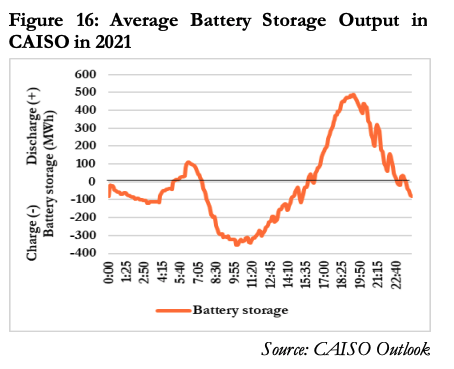
Unsurprisingly, California ISO (CAISO) is leading the way with battery storage now representing 3.2% of its 70GW generating capacity. It accounted for just under 60% of the 3.1GW in new BESS capacity in 2021, or around 1.8GW, though this figure contradicts CAISO’s own figure of around 2.4GW. ERCOT was the next-largest at just under 20% of the total or around 600MW.
The report added that in CAISO, batteries currently serve only around 4% of increased demand between 12.30pm and 10pm. But, as Energy-storage.news wrote recently having interviewed CAISO, that is well over 10% in some five-minute intervals. This graph shows batteries’ average charge and discharge hours over 2021.
Try Premium for just $1
- Full premium access for the first month at only $1
- Converts to an annual rate after 30 days unless cancelled
- Cancel anytime during the trial period
Premium Benefits
- Expert industry analysis and interviews
- Digital access to PV Tech Power journal
- Exclusive event discounts
Or get the full Premium subscription right away
Or continue reading this article for free
10MW BESS goes online in Germany
A 10MW battery energy storage system (BESS) in Germany, delivered by system integrator ECO STOR for Austria-based electricity provider Verbund is live.
The BESS facility in the town of Eisenach in Thuringia, central Germany, went into operation at the beginning of April. ECO STOR said it is made up of three battery stations totalling 10MW of power.
It will provide both grid-related services as well as load shifting to accommodate the increase in wind and solar on the German grid. The press release said operators of flexible resources receive remuneration from the grid operator because of the “significant contribution to the stability of the electricity grid.”
It is the second BESS that Verbund has turned live this year in Germany, one of 20 international markets it operates in. At the beginning of the year, it commissioned a 20MW BESS in Breitenworbis, near to Eisenach.
The German BESS market is currently dominated by the residential and commercial & industrial sector as Energy-Storage.news wrote recently. However, the utility-scale segment is picking up and has seen the recent entry of UK BESS project developers and investors like Anesco and Gore Street Capital.
Energy Vault begins construction of 100MWh system in China
Gravity-based energy storage company Energy Vault has announced the start of construction of its 10MWh EVx storage system, as previously forecasted by the company.
Energy Vault, Houston-based Atlas Renewable and China Tianying are building the project adjacent to a wind farm and national grid site in Rudong, Jiangsu Province near Shanghai. It will help deliver renewable energy to the State Grid Corporation of China (SGCC).
Its technology involves mechanically lifting and lowering large weights to release potential energy.
The press release claimed it is the first utility scale gravity-based storage deployment between a US and Chinese company. Energy Vault and Atlas recently signed a $50 million licensing agreement for the use of the Swiss-American startup’s proprietary gravity-based energy storage technology and accompanying optimisation software suite in the Chinese power market.
Energy Vault raised US$235 million in a SPAC merger listing on the New York Stock Exchange (NYSE) in February, which listed the company at US$1.1 billion.
The company says its technology is scalable and uses low-cost materials although some sources have voiced scepticism about its reliance on moving parts and ability to effectively store and dispatch energy as required.