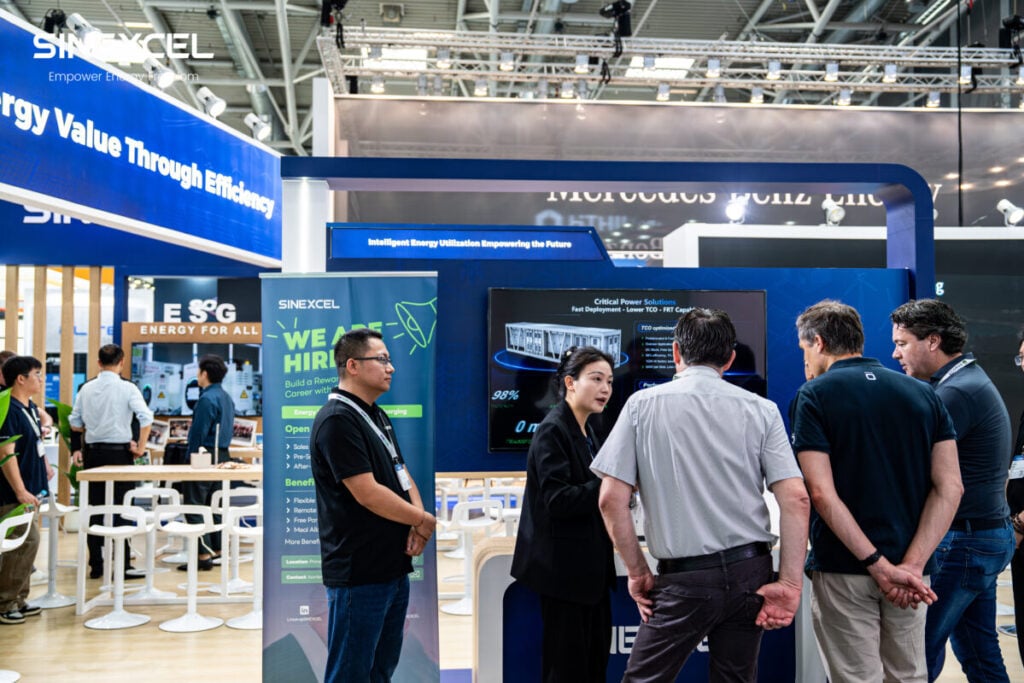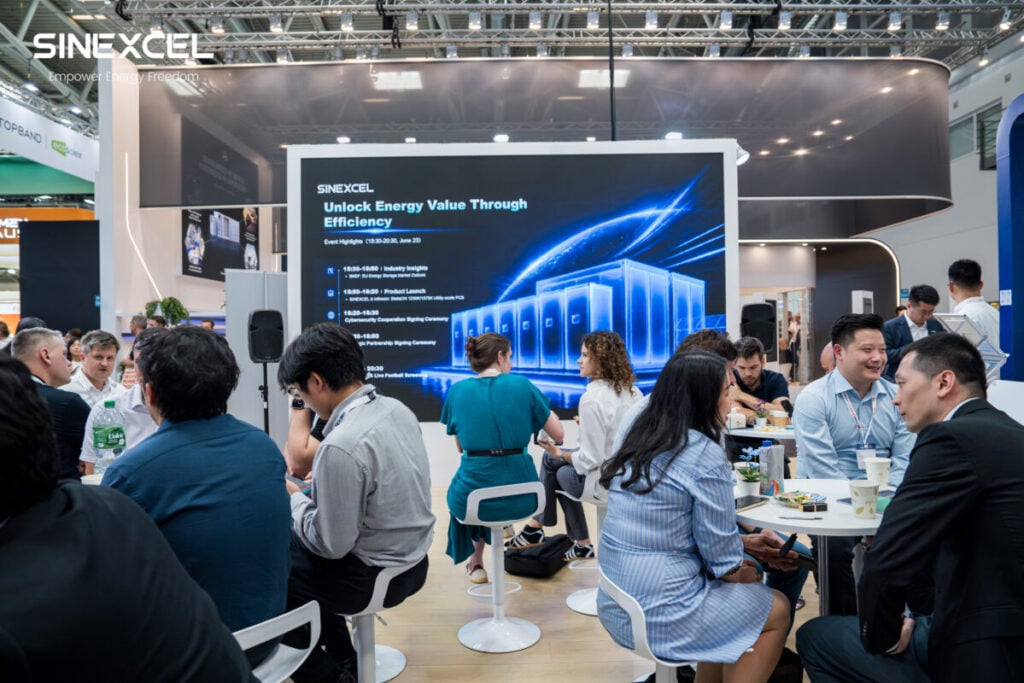
SINEXCEL’s Luke Lu discusses grid-forming power conversion systems, noise constraints and O&M as the company builds its presence in Europe.
As Europe’s power systems move rapidly towards very high penetrations of renewables, the technical and commercial demands on utility-scale energy storage are intensifying.
At this year’s Intersolar Europe exhibition in Munich, Germany, Energy-Storage.news sat down with Luke Lu, product line technical director at SINEXCEL, to discuss the company’s new StellaON 1250K/1575K power conversion system (PCS), its grid-forming capabilities and what the company is learning from early deployments across Europe.
Energy Storage News: What is SINEXCEL showcasing at Intersolar this year, and where does StellaON fit in?
Try Premium for just $1
- Full premium access for the first month at only $1
- Converts to an annual rate after 30 days unless cancelled
- Cancel anytime during the trial period
Premium Benefits
- Expert industry analysis and interviews
- Digital access to PV Tech Power journal
- Exclusive event discounts
Or get the full Premium subscription right away
Or continue reading this article for free
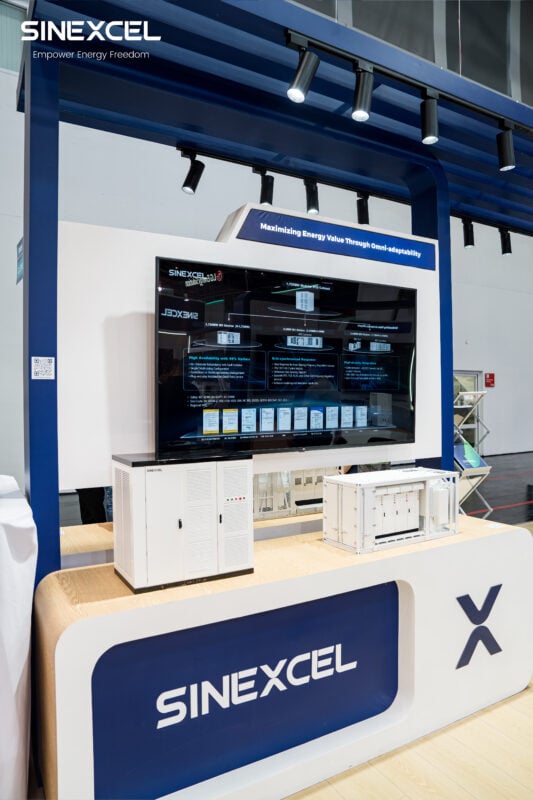
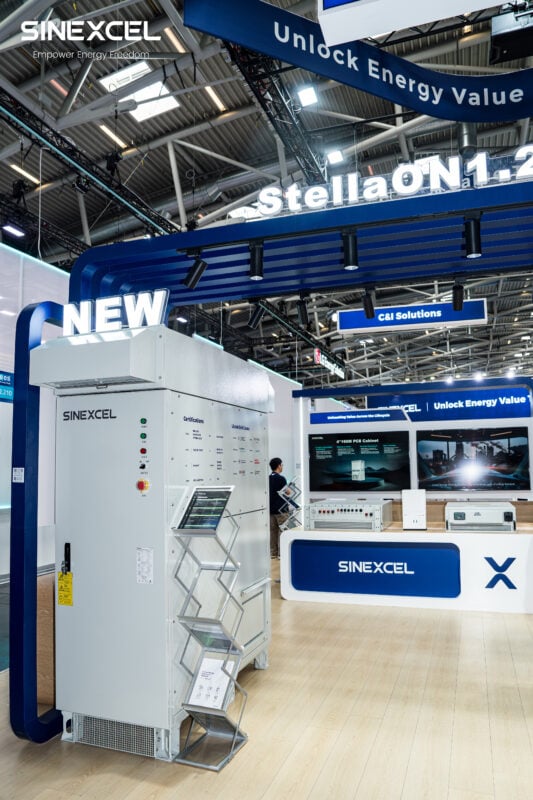
Luke Lu: For this Intersolar exhibition, our focus is utility-scale. We’re bringing our utility-scale flagship product StellaON, and with that, we are aiming at GW-level utility-scale projects.
Today, the trend is that batteries are getting bigger, and the scale of projects is getting bigger. So we use a centralised power conversion system – each unit can be up to 1.5MW, and you can put four or eight in parallel, so you can go to 10MW or 12MW per block.
Grid-forming (GFM) capability is another big topic in Europe. Why is it so important, and how have you designed StellaON with that in mind?
We have been talking about grid-forming for a long time, but now it is moving from a topic of discussion to, I would say, a ticket for energy storage to enter utility-scale. In China, the government has already published a GB standard for grid-forming, and in Europe we have emerging requirements like NC RfG 2.0 [published by the association of transmission system operators, ENTSO-E]. Across Latin America and Japan, you also see new regulations. So it’s no longer just an idea; it’s becoming a formal requirement.
We can regard grid-forming as an upgrade from traditional grid-following operation. You still keep functions like frequency regulation and market trading, but now the PCS has to support the grid, not just inject power. There are three key differences we designed for:
- Overload capability. You need to handle inrush currents and short-term surges. For StellaON we did a lot of redundancy design at the component level, so the PCS can withstand at least 1.5 times rated current for 60 seconds. That kind of overload performance is essential for stability under faults and dynamic events. Whereas the industry can only do 1.2x times for 60 seconds. For project owners, this helps improve fault ride-through performance and system resilience. Instead of disconnecting immediately during a disturbance, the PCS can continue supporting the grid during critical transient conditions.
- Virtual synchronous generator (VSG) behaviour. We simulate how traditional synchronous generators, like diesel gensets, behave – they rotate and provide inertia and voltage support. We implemented VSG functions in the PCS, and this is built on experience from thousands of commercial and industrial (C&I) and microgrid projects where customers combine diesel, PV and batteries to supply a whole village or industrial park. That experience directly feeds into our grid-forming control algorithms for utility-scale.
- Black start: After the blackouts in Spain in 2025, there was a lot of concern about large-scale outages in Europe. Black start capability becomes essential: imagine GW-scale storage that must restore power to a city. We have tested scenarios where a 1MW PCS starts a 10MW transformer – a 1:10 ratio – demonstrating that storage can support massive-scale restart of the grid.
We have already fully tested StellaON under the Chinese GB grid-forming standard, so we feel quite confident in meeting the new requirements that are coming in Europe as well.
The new platform comes in 1250K and 1575K variants. What’s the thinking behind those ratings?
We set two power levels: 1250 and 1575. The explanation is about matching battery evolution.
Right now, the mainstream market size of a battery block is about 5MWh, so that’s why we set 1250K – if we put two in parallel, we can easily assemble a simple 2-hour system. But the next stage of the battery will go above 6MWh and beyond, so the 1575K is prepared for the future, while the 1250K is for now.
For utility-scale, you also care about footprint, so our turnkey solution offers 5MW in a 20-foot container and 12.5MW in a 40-foot container. That compactness lets customers better use valuable land and simplify installation and commissioning – all of which helps save costs.
This is closely linked to project economics. Everyone cares about better IRR, better returns. They use batteries with higher energy and power density; that’s the trend on both capex and lifecycle cost. We designed these power levels around those economic and technical trends.
One issue we hear a lot about in Europe is noise. How does StellaON address increasingly strict acoustic regulations?
Before, noise was something manufacturers didn’t really care about, but now, because of regulations in Europe, it’s become really important.
In Europe, and especially in countries like Germany, you have very strict noiserequirements. We’ve seen cases in Germany where storage projects faced fines or restrictions on nighttime operation because their noise levels exceeded local regulations. So for developers, EPCs and investors, noise is now a critical issue.
That’s why with StellaON we put a lot of emphasis on acoustic engineering. Our laboratory testing shows that its operating noise can be as low as 65dB under specified test conditions. Our goal isn’t simply to build a quieter PCS—it’s to help customers reduce acoustic mitigation costs, simplify permitting and maximise project availability.
Beyond noise, thermal derating is another factor that can erode project profitability. Many conventional PCS products begin to derate as temperatures rise, leading to power loss and forcing developers to oversize equipment.
StellaON 1250K/1575K delivers continuous output at 55-10°C above the industry average, eliminating 15-20% power derating while reducing oversizing costs by up to 20%, ultimately improving overall project economics.
How far along are you with deployments of StellaON, particularly in Europe, and what have you learned so far?
For StellaON, we have already delivered around 15 projects across Europe, Asia-Pacific, and Africa, while order intake reached 500MW in the first half of 2026. It has been successfully grid-connected in Vietnam this March, operating reliably under high-temperature and high-humidity conditions and demonstrating its adaptability in demanding environments.
It is certified for Germany, Poland, the Netherlands, Belgium, and Romania, with Spain and the US approvals expected soon.
So far, we see the strongest utility-scale demand in Eastern Europe. Those markets are growing really fast for utility-scale storage. In Western Europe, we still see a lot of what we call “big C&I” – larger factories and commercial parks using 2–5MWh systems at medium voltage. StellaON is being used in both kinds of applications, and those projects are where we continuously refine our grid-forming, overload and noise performance based on real operating data.
As you grow your installed base in Europe, what does SINEXCEL’s O&M and localisation strategy look like – and why is that so critical?
We have a European office in Düsseldorf, which is our business hub for Europe covering sales, aftersales, and technical support, but behind that we have 20 or more service centres and partners around the globe, including Europe, North America, Latin America and APAC.
We have built these service centres to provide fast response times for on-site issues, local spare parts stock, so we can deliver parts within about a week if a project needs a replacement and on-site commissioning support for every project, with our own SINEXCEL team.
At Intersolar, we have also signed several partnerships with after-sales service companies as long-term partners for Europe. That extends our coverage and ensures customers have robust, long-term O&M support.
For energy storage, time is money. If a system shuts down for one hour, two hours, or even one month, how much money will be wasted just waiting for maintenance? That’s why we have dozens of maintenance people based around Europe, travelling from site to site for regular maintenance and troubleshooting.
Finally, how do you see SINEXCEL’s role in Europe over the next few years?
Europe will be one of SINEXCEL’s most important markets over the next three to five years.
As the market moves toward utility-scale storage, the role of the PCS is also changing. It is no longer simply a power conversion device. Its grid-support and grid-forming capabilities and reliability increasingly determine whether a project can capture market revenues and operate reliably over its lifetime.
With StellaON, SINEXCEL aims to combine advanced grid-forming technology, proven power electronics expertise and stronger local service capabilities. Our goal is to help developers, EPCs and asset owners turn utility-scale storage into a reliable, revenue-generating part of Europe’s power system.
Learn more about SINEXCEL’s products and solutions, including StellaON.