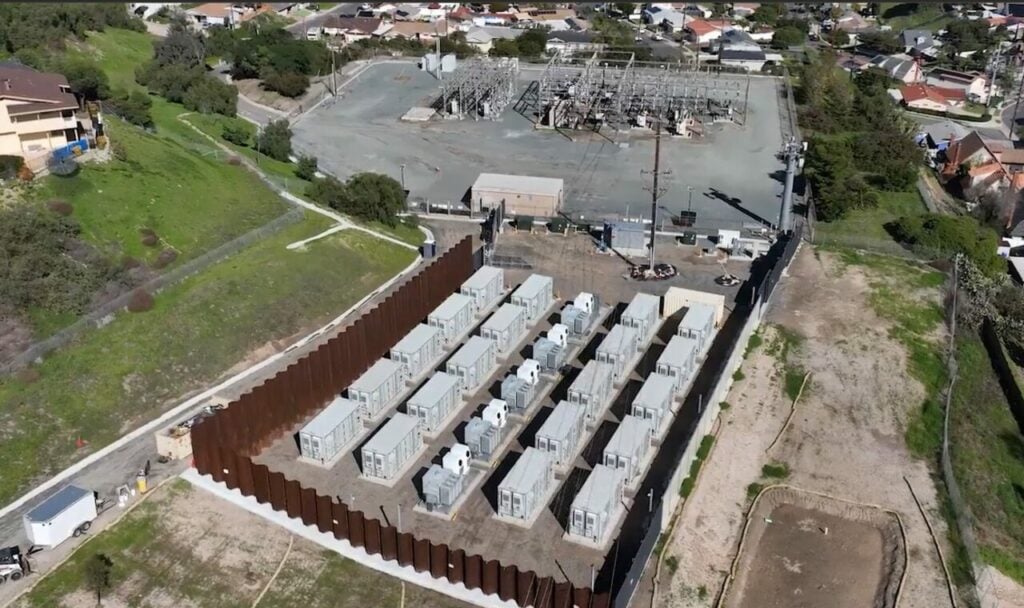
San Diego Gas & Electric (SDG&E), one of California’s main investor-owned utilities (IOUs), has brought online a portfolio of four ‘advanced’ microgrids equipped with 180MWh of battery storage.
The self-contained energy systems are aimed at giving greater resilience to disruptions in electricity supply for four communities in the San Diego area of the US West Coast state, as well as enabling them to make greater use of local solar PV generation.
At 39MW output to their combined 180MWh energy capacity, the batteries’ average duration at the sites is around 4.6-hour, with each deployed at a different utility substation serving communities in Clairemont, Tierra Santa, Paradise, and Boulevard.
They are among dozens of microgrid projects aimed at enhancing energy security and reliability planned in construction or operation in California, which has a grid that suffers from many challenges, including wildfires and increasing peak loads during summer heatwaves.
Try Premium for just $1
- Full premium access for the first month at only $1
- Converts to an annual rate after 30 days unless cancelled
- Cancel anytime during the trial period
Premium Benefits
- Expert industry analysis and interviews
- Digital access to PV Tech Power journal
- Exclusive event discounts
Or get the full Premium subscription right away
Or continue reading this article for free
While California’s fleet of around 7GW of deployed large-scale storage is helping to combat the latter issue at a system-wide level, distributed microgrids are being seen as the answer to help individual communities, often on the end of distribution feeder lines, to stay resilient.
The new SDG&E portfolio’s development directly sprang from an August 2021 Emergency Proclamation issued by California governor Gavin Newsom as the state faced imminent heatwaves that summer.
In declaring that State of Emergency, Newsom said it was “necessary to take immediate action to reduce the strain on the energy infrastructure, increase energy capacity, and make energy supply more resilient,” to protect Californians’ health and safety.
In addition to more immediate actions to be taken then such as expediting large-scale battery energy storage system (BESS) projects and implementing demand response programmes, SDG&E and the other IOUs, Pacific Gas & Electric (PG&E), and Southern California Edison (SCE) received approvals for microgrids to be constructed over a longer timeframe.
‘Key to a more resilient grid’
“For communities like mine that often experience outages during power emergencies, we welcome infrastructure that will help keep our lights on and our refrigerators running during difficult times,” Nora Vargas, chairwoman of the San Diego County Board of Supervisors said of the new projects.
The microgrids can be remotely operated by SDG&E and function as independent and islanded energy systems or remain connected to the grid. SDG&E did not disclose the technology providers’ names in a release today but said the systems use lithium iron phosphate (LFP) battery cells and have enhanced safety and fire prevention features.
The ability for remote operation also means the microgrids can be monitored in real-time, respond faster to grid events and optimise their performance, including easier management of the BESS assets’ operation.
“Storage and microgrids are key to helping build a more resilient electric grid that can extend the availability of cleaner energy and help our communities better manage through grid emergencies like the extreme heat experienced in recent summers,” SDG&E CEO Caroline Winn said.
“These microgrids will actively dispatch clean energy to the grid when needed and help improve energy resiliency for critical facilities like fire stations, schools, and cooling centers in San Diego.”
In addition to the lithium-ion battery microgrids being deployed across California, the state is also trying out a number of similar installations using different energy storage technologies, most commonly flow batteries. These offer the potential to provide longer durations of storage at a lower operating cost – albeit at a higher initial Capex spend.
It isn’t just California where the high resiliency and renewables integration value of microgrids is becoming more and more important. In October last year, the US government announced its “biggest-ever investment in the grid,” pledging US$10.5 billion towards projects that included 400 separate microgrids and 35GW of new renewable energy.
Energy-Storage.news’ publisher Solar Media will host the 6th Energy Storage Summit USA, 19-20 March 2024 in Austin, Texas. Featuring a packed programme of panels, presentations and fireside chats from industry leaders focusing on accelerating the market for energy storage across the country. For more information, go to the website.