
BESS operators should be planning their projects against different locational price and charging regimes of the future rather than solely against the current revenue opportunities.
That’s according to Dan Moore, head of battery energy storage system (BESS) asset management for UK developer-operator Root Power.
Moore was speaking to Energy-Storage.news ahead of the Battery Asset Management Summit UK & Ireland 2026, which runs in London next week (13-14 October). He will be on the ‘Predictive Maintenance and Fault Diagnostics: Moving Beyond Reactive Operations’ panel discussion on Day Two of the event.
In this Q&A, he discusses how to integrate future reforms into planning projects, balancing battery health and revenue generation, augmentation and the revenue stack in the UK.
Try Premium for just $1
- Full premium access for the first month at only $1
- Converts to an annual rate after 30 days unless cancelled
- Cancel anytime during the trial period
Premium Benefits
- Expert industry analysis and interviews
- Digital access to PV Tech Power journal
- Exclusive event discounts
Or get the full Premium subscription right away
Or continue reading this article for free
Energy-Storage.news: What are the key policy, regulation and market design changes you need to keep track of when it comes to formulating your BESS asset management strategy?
Dan Moore: I believe it is wholesale market design as well as pricing, particularly with the UK’s reformed national pricing programme that was published under (previous Prime Minister) Starmer’s government.
For any BESS manager this can change the value of charging/discharge in particular locations, the value of being behind a transmission constraint (particularly important in the balancing mechanism), the intraday versus day-ahead economics and the relative value of different BESS sites.
We shouldn’t be prioritising a battery against today’s price curves, instead we should build a future energy systems (sorry to coin this term) scenario for different locational price and charging regimes. There are other factors such as BM reform, network charging (TNUoS, DuoS, BSUoS etc)
How do you balance profitable market participation with preserving battery cell health, and what role do optimisation technologies play in this decision-making process?
Deep insight BESS analytics have an important role to play here: how well do we really understand the performance of our BESS system from an OEM’s SCADA system alone? I’d argue not much, as you’re largely given a packaged product with a select set of signals, all the ‘juicy’ ones will be kept for the OEM’s own in-house performance monitoring.
SoC (state of charge) correction for example has been spoken about quite a bit this year and even some of last year, being able to unlock an additional value per discharge/charge by having a better picture and representation of the BESS at any point in that optimisation cycle.
We can make better decisions and therefore have better optimisation strategies, and having a level of flexibility in your warranty is also equally as important here.
What is your approach to BESS project augmentation?
I’d like to believe our strategy is largely the same as every other ‘plan for the future, rather than the present’ developer/operator, which is ensuring our projects are designed from the outset for a level of future expansion in the future, by doing all the planning consents, front-end engineering etc at the start, to be better prepared in the future for when that time comes.
Of course, policy, planning and even technology will continue to evolve over the life of the project and I don’t believe anyone has a crystal ball that can accurately predict what that might look like, but at least having something in place can put you in a better position than having nothing at all.
How has the revenue stack evolved in the UK?
The market has moved away from a once predominantly ancillary services driven strategy, and has in recent years moved further into wholesale opportunities now taking the lion’s share of the revenue stack. The older GB assets <1hr still tending to follow an ancillary services approach.
The Battery Asset Management Summit UK & Ireland is now in its third year. Taking place 13-14 October at Leonardo Royal Hotel St Paul’s, London, UK, this year’s event features two dedicated streams across two days: Technical Asset Management and Commercial & Financial. ESN readers can use the code ESN20 at checkout for a 20% ticket discount. Visit the website for more details.
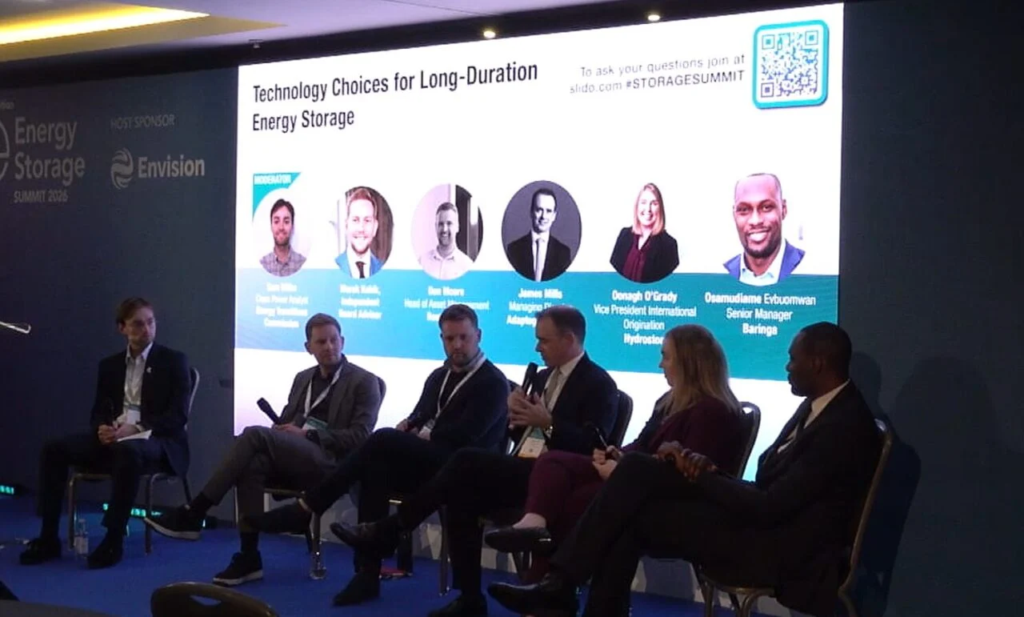
Moore has been a regular at Solar Media events. At this year’s Energy Storage Summit in London, he spoke on panels on long-duration energy storage (LDES) and energy price volatility (you can watch both recordings with a subscription to ESN Premium).
Last week we heard from Moore’s peer at BESS platform Varco Energy, Elliot Squire, who discussed the big trends and challenges in asset management today.
