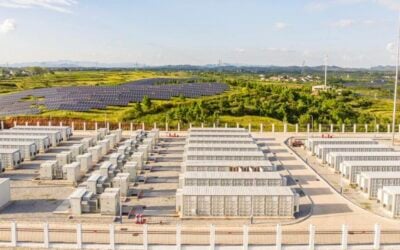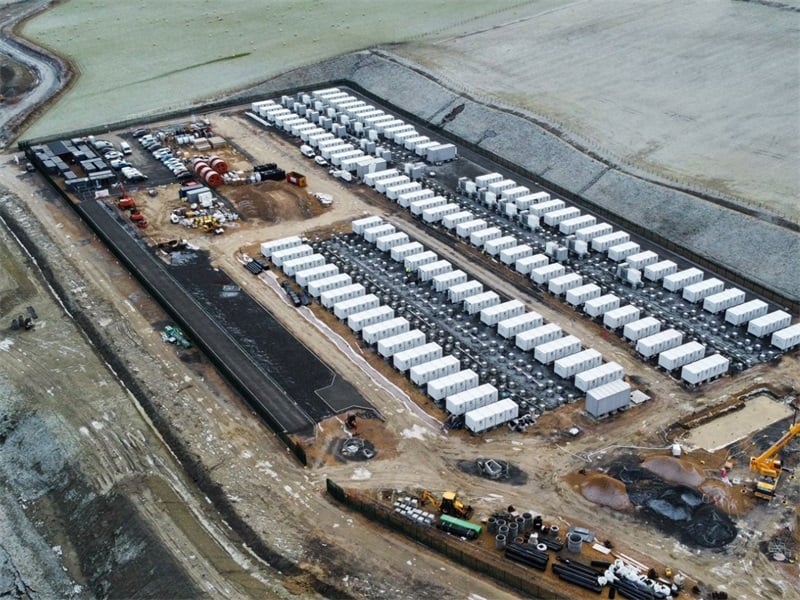
The noise of battery energy storage system (BESS) technology has “exploded” as a concern in the last six months, an executive from system integrator Wartsila ES&O said.
BESS units primarily emit noise from their cooling systems, but balance of system (BOS) components like inverters and transformers also produce noise emissions. Growing deployments mean projects are being built nearer to populations and in more population-dense regions, creating potential problems for local acceptance.
“I’d say that in the last six months noise has exploded as a concern. One of our team just toured a dozen customers in Europe and every single one brought up concerns about noise, and what we are doing to mitigate it. A year ago, nobody asked,” said Darrell Furlong, director of product management and hardware for Wartsila ES&O (energy storage & optimisation).
Sound is bound to be more of a concern for population-dense Europe compared with places like the US, but Furlong said that he first noticed it for projects in Australia, where land is also far more plentiful than Europe.
Try Premium for just $1
- Full premium access for the first month at only $1
- Converts to an annual rate after 30 days unless cancelled
- Cancel anytime during the trial period
Premium Benefits
- Expert industry analysis and interviews
- Digital access to PV Tech Power journal
- Exclusive event discounts
Or get the full Premium subscription right away
Or continue reading this article for free
“The first customers I recall bringing it up were in Australia, but now it’s a global thing – everyone is focusing on it,” Furlong added, talking to Energy-Storage.news at the recent Energy Storage Summit USA in Austin, Texas.
BESS solutions are getting more energy-dense which requires additional cooling. Wartsila itself just launched a new product which has an energy density of 4MWh per 20-foot unit, versus 1.6MWh prior, and it comes with additional noise suppression systems.
Many China-based companies have 5MWh systems in the same space, and Western system integrators like Wartsila and Powin are subsequently responding.
More sophisticated cooling systems mean that the noise emissions are not necessarily growing with the increased energy density, however. Inverter and BESS firm Sungrow pointed out to Energy-Storage.news in a recent interview that its latest generation product increased the energy-per-container from 2.5MWh to 5MWh but the max noise emissions went from 79dB to 75dB.
Energy-Storage.news’ publisher Solar Media will host the 2nd Energy Storage Summit Asia, 9-10 July 2024 in Singapore. The event will help give clarity on this nascent, yet quickly growing market, bringing together a community of credible independent generators, policymakers, banks, funds, off-takers and technology providers. For more information, go to the website.
Energy-Storage.news’ publisher Solar Media will then host the 1st Energy Storage Summit Australia, on 21-22 May 2024 in Sydney, NSW. Featuring a packed programme of panels, presentations and fireside chats from industry leaders focusing on accelerating the market for energy storage across the country. For more information, go to the website.