
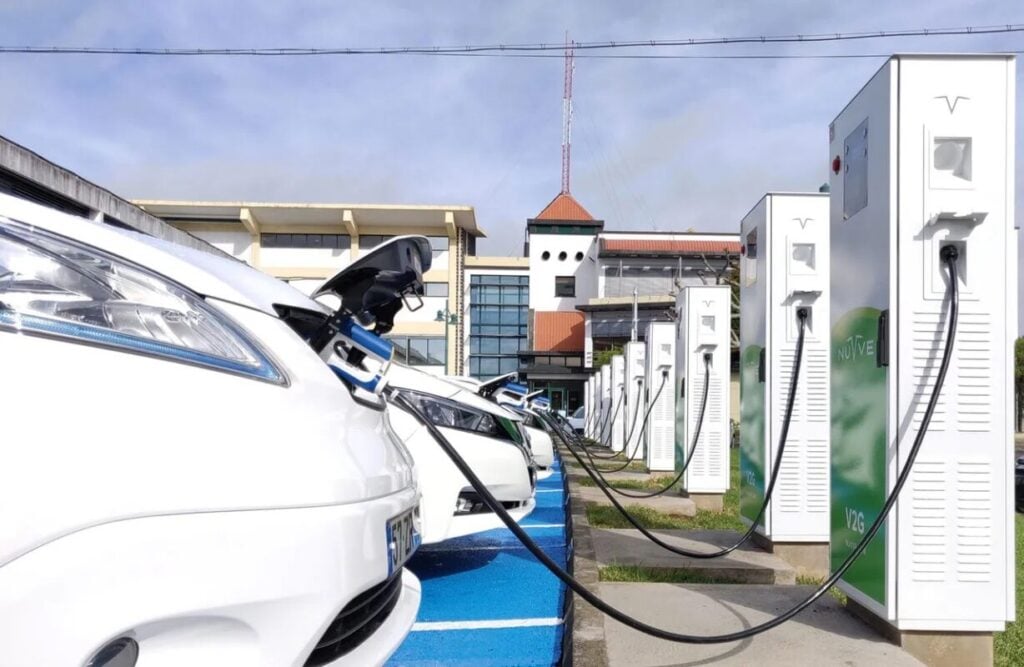
Grid connections are now the biggest brake on rapid EV charging. Here’s how battery storage lets charging sites deliver more power from a smaller connection, and when it pays to add it.
Why EV charging sites need battery storage
The adoption of battery storage for EV charging is making both electrified transport and grid management more sustainable. The number of EV charging stations being installed is growing, and the number of charging ports at individual sites is also growing to meet the increased charging demands due to there being more and more EVs on the road.
Aside from the number of chargers growing, the charging speed of the charging stations continues to get faster, meaning that they draw power from the grid a lot quicker than slower chargers. Many chargers currently being installed in Europe and the US are 350kW DC fast chargers, with some planned for up to 750kW, while in China, megawatt-level chargers are starting to become common.
With such large, localised, and intermittent loads on the grid, it’s becoming increasingly important to install BESS for EV charging stations—especially as more charging points, and faster charging points, on a station increases the size of these loads, which can cause grid constraints during EV charging and affect the stability of the local grid.
Try Premium for just $1
- Full premium access for the first month at only $1
- Converts to an annual rate after 30 days unless cancelled
- Cancel anytime during the trial period
Premium Benefits
- Expert industry analysis and interviews
- Digital access to PV Tech Power journal
- Exclusive event discounts
Or get the full Premium subscription right away
Or continue reading this article for free
There are many reasons why site owners are now integrating battery storage for their EV charging. On one hand it improves the reliability of EV charging, can reduce carbon footprint of the charging site, reduces the cost associated with grid demand charges as less power can be drawn from the grid, allows on-site renewables to store energy during high generation and low demand scenarios, and improves the overall stability of the EV charging infrastructure.
On the other hand, it acts as a buffer against EV charging grid constraints and helps to overcome some of the current issues with grid connection timelines—as long grid connection timelines are an issue in many parts of the world. BESS can support times of high demand by acting as a secondary source of energy to supply the chargers, meaning that the grid doesn’t draw such drastic intermittent loads—especially when a lot of vehicles are charging at the same time—meaning that BESS makes the local grid a lot more stable if there are a lot of charging points (which is becoming common in many places). It also means that charging points are less likely to be throttled on the grid side (but throttling can still occur from the EV but that’s a different factor altogether).
So, by installing BESS, it enables EV charging site operators to deliver more power from a smaller connection—meaning that it’s more likely that charging sites will get approval if they are not likely to be drawing regular unstable loads. Smaller grid connections are also cheaper, as the costs scale non-linearly and high voltage grid connections will incur a lot more costs than lower voltage connections.
Even though BESS can be beneficial for EV charging stations, they still need to be properly matched to the individual site. If the BESS is not sized correctly, it can deplete quicker than expected (not providing as much of a buffer as planned) and will lose out on demand charge savings. However, for BESS that are appropriately sized for the charging site, they can cut the grid capacity needed by 50–80% compared to a grid-only station, without affecting the charging experience.
How BESS for EV charging works: system design options
There are two main approaches to using battery storage on an EV charging site: battery-integrated chargers and site-level BESS. Battery-integrated chargers (often called battery-buffered chargers) have a battery directly installed inside the charging unit instead of a centralised site-level BESS. This approach is simpler as the chargers come ready with battery storage and are cheaper and quicker to install than site-level BESS, but they are not suitable for all charging stations. The main limitation is that each charging unit has a fixed storage capacity. This makes capacity expansion more difficult and less flexible if the demands for the site increase over time—and if demand increases so much it would lead to BESS needing to be installed down the line anyway.
| Battery-integrated chargers | Site-level BESS | |
| Where the battery sits | Inside each charging unit | Centralised on the charging site |
| Storage capacity | Fixed per unit | Can be scaled as demand grows |
| Cost and installation | Cheaper and quicker to install | More expensive and more complex |
| Solar and grid services | Limited | Can integrate on-site renewables and grid services |
| Best suited to | Smaller sites and quick deployments | Large hubs, fleet depots and sites expected to grow |
Site-level BESS is the most flexible, but more expensive, approach with the ability to scale capacity as needed. BESS installations on EV charging stations, on a design level, come with the battery modules, power conversion system (PCS), battery management system (BMS), energy management system (EMS), thermal management systems, internal sensing and monitoring equipment and site-level safety systems. BESS can either be AC-coupled or DC-coupled when co-located with the charging infrastructure and on-site renewable energy systems, and some sites are even using second-life EV batteries for their storage.
The PCS manages the energy flow between the site-level BESS, the grid and the charging infrastructure, while the BMS monitors the voltage, current, temperature, state of charge (SOC), and state of health (SOH) of the BESS. The EMS is responsible for when the cells charge, discharge and how the EV charging site responds to energy tariffs, charging demand, and grid limits. Smart EMS today now use AI to optimise charging patterns and predict energy demand while balancing the energy flow between the grid and all the on-site assets.
When EV charging sites have solar plus storage integrated on-site, the EMS will also control the solar output between sending it directly to the charging points or charging up the BESS (depending on the ratio of generation to charging demand). For sites that are expected to have a high charging demand, solar plus storage helps to meet higher demand while keeping energy costs lower. However, even the most robust EMS cannot save the BESS from underperforming if the sizing basics are not right, so regardless of the ancillary equipment, BESS sizing is the biggest design factor when choosing the site-level BESS route at an EV charging station.
As a general rule of thumb, BESS sizing for EV charging comes down to two things: the power the BESS can deliver (in kW) and the energy it can store (in kWh). US guidance calculates the energy needed as roughly 150kWh of peak-hour charging per port, multiplied by the number of ports, minus the energy supplied by the grid in one hour. Keeping the grid connection as small as possible (for it to be cheaper) is what keeps demand charges down and gets the most value out of the BESS.
So, assuming that a charging site has installed 4 DC fast chargers at 350kW on a 100kW grid connection, this means that the total peak power (if all 4 chargers are running at peak power) is 1.4MW. Taking away the 100kW from the grid, the on-site BESS would need a power rating of around 1.3MW to meet all charging needs at peak, and at least 500kWh of usable energy (150kWh x 4, minus 100kWh) to get through the busiest hour. This is just a representative example, and most charging sites are much larger, and there’s always the option to overbuild just in case peak loads are suddenly drawn from the charging station and the cells are not at full capacity.
What battery storage does for a charging site
As noted above, having a BESS on site at EV charging stations can help owners to reduce their demand charges (or capacity charges in the UK and Europe) while stabilising the local grid and ensuring a consistent charging performance. This includes using the stored energy to load shift to cheap grid or solar energy (when there is an excess), provide resilience if there is a grid outage, peak shaving to keep the power drawn from the grid below a set level, and taking part in grid services such as frequency response. BESS integration can also support load balancing so that the stored energy is distributed across all chargers drawing power, which reduces peak loads being drawn from the grid into single chargers, making the grid more reliable (and helps prevent demand charges).
On the economic side, installing BESS not only reduces demand charges but it also allows cheaper electricity to be stored from the off-peak electricity or when renewable generation is high (if using solar plus storage). This includes the BESS owners taking part in energy trading when the price of energy is high to maximise the profit on the stored energy (if it is not needed on the charging site), or pooling assets into virtual power plants. This way, BESS allows charging services to be reliable while controlling energy costs and supporting the grid.
If batteries can be used to keep grid demand and demand charges down, which is based on suitable BESS sizing, then it can defer grid upgrades as many DNO/DSOs have to now approve, and potentially upgrade, the local grid if there is a large cluster of level 3 DC fast chargers being installed on a site—as it can cause significant power drain from the grid. By using BESS, these grid upgrades may not be necessary (as InstaVolt has found at some of its UK sites) and the chance of being connected quicker becomes a lot more likely (but that can be country-dependent depending on the priority queue for grid connections). In terms of the potential grid connection difference, research from Delft University of Technology has stated that adding BESS to a fast charging EV station can reduce the grid connection size by up to 80%.
Additionally, for high throughput charging stations—such as those which regularly charge fleets—the BESS can increase the charging capacity of a large EV charging station beyond what would be possible from solely taking power from the grid (as peak power loads on all chargers in some large EV charging stations would destabilise the local grid and cause power surges that could damage the charging stations and the EVs). This also means that BESS improves the charging availability for charging stations to accept more vehicles at any one time without risk to the grid, which could potentially increase the revenue for charging station owners with higher throughputs. This ultimately means that BESS, if installed properly, can improve local electrified transport networks for both public and fleet EV owners and can scale as charging stations expand.
Challenges of adding BESS to EV charging
While there are many benefits of installing BESS at EV charging sites, it’s not without its challenges. The cost of battery storage for EV charging stations can be a barrier because there is a large CAPEX required. Moreover, extra revenue streams for the BESS (beyond providing grid/charger support) are based on achieving a high utilisation rate with a favourable electricity pricing structure, and the business case can change with local grid rules. There is also the undersizing risk as noted before that would render any BESS installation insufficient and lead to unexpected demand charges.
Sufficient space is also required around the charging station to install the BESS and as most charging stations are located in urban areas or built-up areas, and space can sometimes be at a premium. So, site owners need to physically have the space, and any site also needs to be able to pass local fire safety and permitting requirements.
There are also the technical challenges to deal with. Unlike a lot of BESS that are situated away from populations, charging station BESS being nearby urban environments makes safety more paramount. While sodium-ion BESS are starting to be commercialised that are safer, BESS today use Li-ion cells, most commonly LFP. While LFP is a safer and more stable Li-ion chemistry, it can still undergo thermal runaway that could pose a threat to EV owners and the local population if a fire, explosion, and/or toxic off-gassing occur. So, EV charging stations that use BESS have to go through a rigorous permitting review that requires strict compliance with fire safety standards such as UL 9540 and UL 9540A and local fire code requirements. Additionally, it means that robust fire safety suppression systems are needed at a cell, BESS, and site level.
The cells in the BESS are also going to be cycled a lot more rapidly than BESS used in other on-site storage applications such as LDES. This means that there will be a quicker battery degradation under high cycling that will cause cells to be replaced more frequently than in other BESS use cases. This can affect the overall ROI of a BESS over time.
When does BESS make sense for an EV charging site?
One of the biggest questions is do EV chargers need battery storage? On-site BESS is not a solution for every EV charging station, but there are situations where it is beneficial to install BESS. As a general rule of thumb, BESS is best installed at locations where the charging demand is high, it’s expensive to upgrade the grid and/or there is limited local grid capacity, or it can be guaranteed that favourable returns from grid services is possible.
The most common choice to install BESS is at public fast charging hubs where there are a lot of DC fast chargers that have high peak power requirements and unpredictable load demands—as this combination can cause grid instability. For similar reasons, BESS is also beneficial at fleet depots where there is going to be a regular throughput of vehicles and the fleet owner can take part in grid services, as well as not worry about fleet downtime due to grid constraints. Additionally, any site that intends to add solar will benefit from storage to maximise the energy harvesting gains by storing it during high generation and low demand periods, and any EV charging stations in remote locations or locations with a weak grid will benefit from on-site BESS.
| Type of site | Why BESS helps |
| Public fast charging hubs | Covers high peak power and unpredictable demand from multiple DC fast chargers |
| Fleet depots | Supports regular vehicle throughput, opens up grid services and avoids downtime from grid constraints |
| Sites with on-site solar | Stores solar generation for when charging demand is high |
| Remote or weak-grid sites | Supplies power the local grid can’t provide |
| Sites waiting on a grid upgrade | Acts as a stopgap until a bigger connection is in place |
In terms of the adoption of BESS to date, it was reported in an earlier EV Infrastructure News article that around 1GWh of BESS has been paired with EV charging stations across China, France, the US and the UK. China is soon set to deploy an extra 10GWh BESS capacity at EV charging stations, while elsewhere, 1.5GWh is planned for Europe, 365MWh is planned for the UK, and 45MWh is planned for the US.