The new edition of the UL9540A fire safety standard for battery energy storage systems (BESS) “establishes a new precedent in the testing and certification ecosystem.”
UL Standards & Solutions recently published (13 March) the 6th edition of the key standard, or the ‘Test method for evaluating thermal runaway fire propagation in BESS,’ to give its full title.
UL9540A is widely recognised in the industry for assessing the safety of electrochemical energy storage systems (ESS), including, but not limited to, lithium-ion (Li-ion) BESS. It is considered the benchmark for evaluating safety, particularly in assessing thermal runaway and propagation risks and therefore critical to the bankability of energy storage technologies.
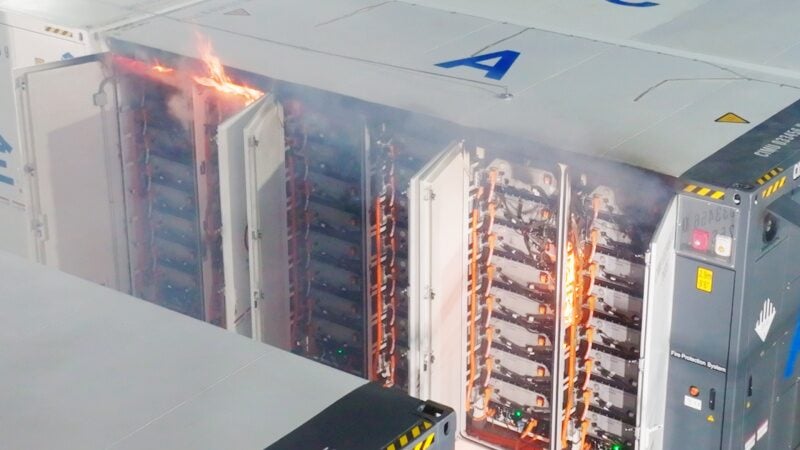
The new edition adds requirements for large-scale fire testing (LSFT) alongside cell and module level tests, perhaps aimed at overcoming a perceived limitation in previous versions by adding focus on system-level safety. In large-scale fire testing, a single BESS unit is set on fire with all its fire suppression and detection systems disengaged and the results observed, typically with other BESS units placed nearby to assess propagation risk.
Try Premium for just $1
- Full premium access for the first month at only $1
- Converts to an annual rate after 30 days unless cancelled
- Cancel anytime during the trial period
Premium Benefits
- Expert industry analysis and interviews
- Digital access to PV Tech Power journal
- Exclusive event discounts
Or get the full Premium subscription right away
Or continue reading this article for free
Commenting for Energy-Storage.news, Dana Parmenter, commercial VP of industrial at testing and certification provider CSA Group, said that the release of the 6th edition “establishes a new precedent in the energy storage system (ESS) testing and certification ecosystem.”
“This change will raise many questions for manufacturers around enforcement timelines, jurisdictional adoption, and how updated requirements may be interpreted by authorities having jurisdiction (AHJs),” Parmenter said.
“This edition expands testing expectations and introduces LSFT requirements within the certification process. Section 10 requires LSFT to demonstrate that fire will not propagate between ESS units. This change is part of a larger trend across ESS standards, placing greater emphasis on LSFT as it relates to system-level safety.”
Large-scale fire testing mandatory in NFPA 855 2026
Indeed, the growing emphasis on large-scale fire testing has been industry-wide. Many manufacturers and system integrators have been conducting LSFT on a voluntary basis as part of the adoption of best practices for the past year or so.
Since then, LSFT has become mandatory in the new 2026 edition of the US National Fire Protection Association’s BESS safety standard NFPA 855, as explained in a January 2026 Energy-Storage.news article.
Parmenter’s company, CSA Group, developed a technical specification protocol for LSFT, as a companion to UL9540A.
Parmenter said that while UL9540A now addresses NFPA 855’s safety testing requirements, AHJs often request additional performance-based data to support site-specific evaluations of projects.
“NFPA 855 Section 9.2.1.2.1 requires large-scale fire testing to characterise gas composition and demonstrate non-propagation between ESS units, which inherently involves gas analysis and calorimetric data such as heat release rate (HRR). Previous editions of UL 9540A did not explicitly incorporate large-scale fire testing. The 6th Edition now addresses spacing and fire propagation as safety considerations within the certification framework,” Parmenter said.
CSA Group’s CSA/ANSI C800:25 consensus-based standard to evaluate ESS reliability includes many of the measurements of metrics required by NFPA 855, Parmenter said, including the interpretation of test results by a registered fire protection engineer.
Many of those registered engineers “strongly recommend HRR and other measurements” included in CSA/ANSI C800:25 to support their analysis, Parmenter claimed, adding that the standard can be used alongside and as an extension of UL9540A because it provides additional performance and engineering-based data, such as HRR, gas composition, detection response, and BMS data to support site specific installation requirements, engineering approvals, and AHJ review.
“UL 9540A and CSA/ANSI C800:25 now serve more distinct, yet complementary, roles within the ESS testing and approvals process. Looking ahead, both standards may be applied to support the demonstration of alignment with NFPA 855. UL’s recent revisions to UL 9540A expand the scope of safety-focused requirements by incorporating certain performance-based considerations, such as those informing spacing and propagation mitigation, into the certification framework,” Dana Parmenter said.
“While this approach reflects an increased emphasis on system-level safety, CSA/ANSI C800:25 continues to provide additional performance and engineering-based characterisation, including data elements that remain optional or out of scope under UL 9540A.”