Reports of Eos’ aqueous zinc battery being paired with small modular nuclear reactors (SMNRs) in a joint venture (JV) with Holtec appear to have been greatly exaggerated, according to an Eos representative.
Eos formed the joint venture, called HI-POWER, with Holtec International and officially launched it in September. Using Eos’ proprietary battery manufacturing design automation and leveraging Holtec’s scale and three decades of manufacturing experience, a “state-of-the-art manufacturing facility” has been promised in Pittsburgh. An Eos press release referred to a “multi-gigawatt” JV being created.
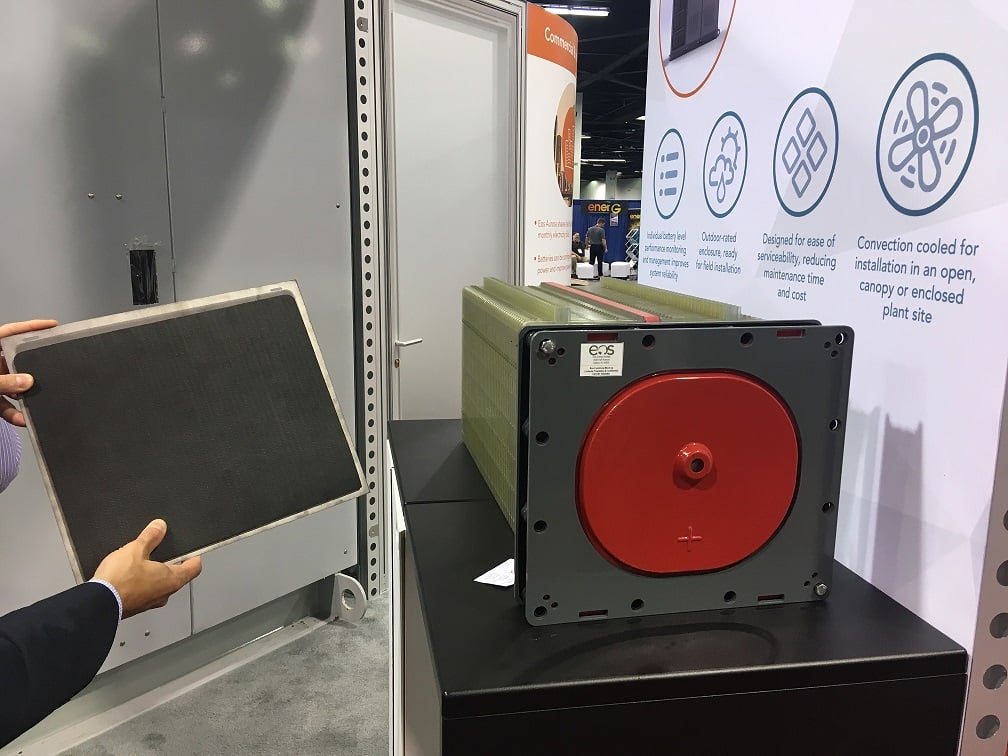
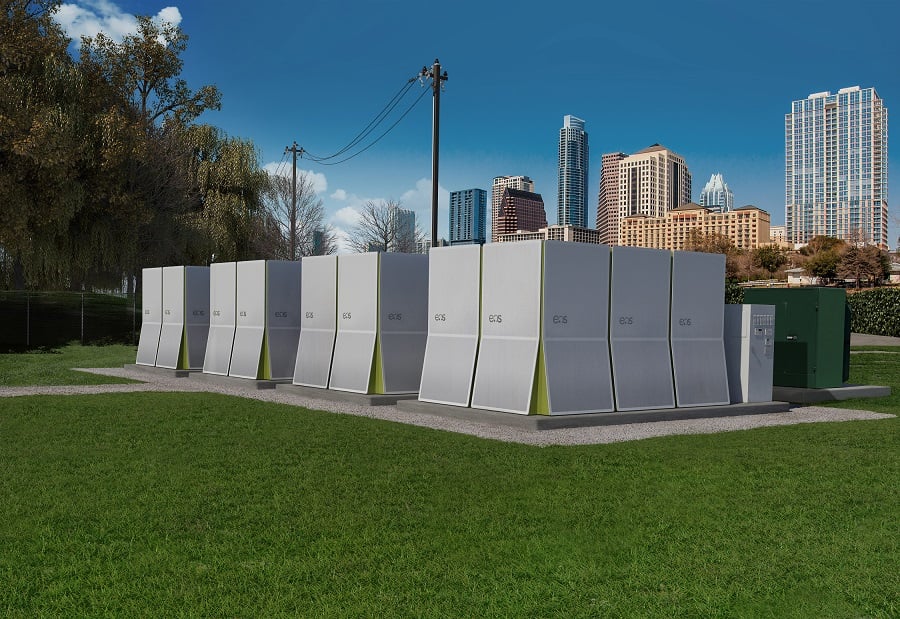
As previously reported by Energy-Storage.news, Eos’ novel zinc hybrid cathode battery technology is priced into a system at US$160 per kWh for a 1MW / 4MWh grid-scale modular unit. Various test facilities have been deployed, including a 30kW / 120kWh DC-coupled system at utility Duke Energy’s McAlpine test facility in North Carolina.
“We are very much an energy battery, a longer duration, 4-6 hours is kind of our sweet spot, but we have flexibility to do higher power and we can always derate the power to do longer run-time,” Eos VP of sales, Phillipe Bouchard, told us at Solar Power International / Energy Storage International in Salt Lake City. The company also attracted former First Solar CEO Jim Hughes onto the board of directors in 2016.
Try Premium for just $1
- Full premium access for the first month at only $1
- Converts to an annual rate after 30 days unless cancelled
- Cancel anytime during the trial period
Premium Benefits
- Expert industry analysis and interviews
- Digital access to PV Tech Power journal
- Exclusive event discounts
Or get the full Premium subscription right away
Or continue reading this article for free
“We started this partnership with Holtec over a year ago. We actually manufactured our 2.0 products out of their facility in Camden, New Jersey. So we were taking the dry battery, filling it with electrolyte, integrating it into a system, then shipping it out to our customers.
“With the gen 2.0 design, we deployed nine systems on four continents, anywhere from 1MWh-scale project and in that size range, including one in Brazil with ENGIE, which is a solar-storage-wind project with 1MWh of battery [storage].”
From here on in, Bouchard said, the JV is about “testing the product in our target use cases and in our target markets, generating really valuable data and kind of setting the stage for scale-up into much larger commercial projects.”
The Eos representative referred to a few planned multi-megawatt scale projects, including a large microgrid in the southern US on which he said further details will be revealed in the coming weeks. According to Bouchard, the aqueous zinc, non-flow technology mechanically “more closely resembles a lead acid battery, but we’re plating and replating zinc as we charge and discharge the system.”
SMNR reports: too soon?
However, when the Holtec deal was first made public, a number of online publications managed to misinterpreted the initial press release to mean that storage-plus-SMNRs will be manufactured imminently in Pittsburgh. Many of those reports appear to have since been withdrawn from public view, but Energy-Storage.news felt it pertinent to ask the Eos representative for comment.
While unable to speak on behalf of Eos’ JV partner in HI-POWER, Bouchard did add some context:
“Holtec’s core business is actually in the dry containment of the spent nuclear fuel rods. So one of their core products, if you literally imagine a large cylindrical vessel in which the spent nuclear rods are stored,” Bouchard said.
“So today, they’re doing a lot of decommissioning work, helping to bring nuclear power plants offline and safely and environmentally-friendly manner, decommission those plants so that that capacity, that grid interconnection can be used, presumably for other purposes, including potentially, solar-plus-storage, wind-plus-storage, or anything else.”
As a battery provider, Eos remains agnostic to the power source, meaning that “if there’s a value proposition to combine our batteries with a modular, small modular reactor, then by all means, we’ll allow the market to sort that out,” but that in his understanding of the situation at present, SMNRs are a fair distance from reaching commercialisation.
Yet in the meantime, the “more obvious and logical fit in our commercial environment today is pairing it with renewables,” due to the pressing need to solve variable generation output from solar and wind, providing a firm capacity, Bouchard said.