A 50MW / 75MWh battery energy storage system (BESS) project in Western Sydney, Australia, will receive AU$21.5 million (US$15.35 million) in assistance from the federal and state governments towards its total cost of AU$61.9 million.
Transmission system operator TransGrid said it will trial the use of the battery system to provide services that help keep its network stable, namely fast frequency response and synthetic inertia, which TransGrid said are becoming “increasingly important as more renewable generation joins the grid”.
The large-scale lithium-ion BESS will be installed at TransGrid’s Wallgrove substation in Western Sydney, New South Wales (NSW) taking up a footprint of about 115 metres by 40 metres. Eva Hanly, the transmission operator’s executive manager for strategy, innovation and technology said the project will be the first battery system to pilot synthetic inertia as a network service in NSW.
The federal government will provide up to AU$11.5 million of funding, through the Australian Renewable Energy Agency (ARENA) and its ‘Advancing Renewables Program,’ while the NSW government is offering up to AU$10 million through its ‘Emerging Energy Program’.
Try Premium for just $1
- Full premium access for the first month at only $1
- Converts to an annual rate after 30 days unless cancelled
- Cancel anytime during the trial period
Premium Benefits
- Expert industry analysis and interviews
- Digital access to PV Tech Power journal
- Exclusive event discounts
Or get the full Premium subscription right away
Or continue reading this article for free
Federal Minister for Energy and Emissions Reduction, Angus Taylor, highlighted in a statement this morning that energy storage is “one of the priority technologies” under his government’s Technology Investment Roadmap, but said that “for battery to play a role we must bring down the cost”.
The project aims to determine whether, as expected, batteries can be a “much cheaper technical solution” to controlling grid frequency – which needs to be kept within strict boundaries to maintain system stability – than traditional technologies.
The Wallgrove Grid Battery project will also be used to provide technical information on how often the battery system will be called on to provide those services, how much electricity it can store and dispatch under changing conditions, and other aspects of operation.
TransGrid said detailed design work will take place from November this year until February 2021, with construction set to begin that month. The BESS is then scheduled to start commercial operations in October 2021, with full construction work set to finish by November, before a two-year testing programme is conducted from Q4 2021 until the final quarter of 2023.
Economic modelling shows benefit should far outweigh cost of project
“It’s a step forward for the NSW grid and the National Electricity Market. This innovation will help accelerate the industry’s transformation to a low-carbon energy system, at a lower cost to customers,” TransGrid’s Eva Hanly said.
Inertia is currently provided to the grid by assets including spinning turbines inside coal, gas and hydroelectric power stations, but with coal assets being retired and more and more renewable energy sources connecting to the grid, alternative sources of inertia need to be found, TransGrid said in a statement.
Economic consultancy HoustonKemp has assessed that the trial could offer direct benefits in a range of AU$93 million to AU$135 million to NSW’s electric bill-payers, while TransGrid said batteries offer the potential to stabilise the network at a “fraction of the cost” of those traditional resources. Following the trial, since the transmission system operator will be better informed on the costs and benefits associated, TransGrid will also be able to better assess offers to provide BESS onto the system by third-party providers, the company said.
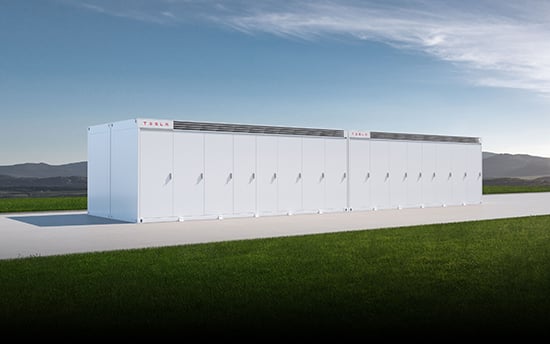
As with Australia’s largest battery system to date, the Hornsdale Power Reserve in South Australia, the Wallgrove project will be built using Tesla’s battery storage systems. A report into the first periods of operation of the Hornsdale battery show that it has been successful in helping to balance the region’s electricity network while also being an economic success. Similarly, a report published a couple of months ago into the first 12 months of operation of two large-scale battery storage sytems in the Australian state of Victoria showed that both have performed as expected, or better, in that time.
The Wallgrove battery system will also be operated in energy arbitrage markets as well as frequency control ancillary services (FCAS) markets by renewable energy developer and asset operator Infigen Energy. TransGrid said Infigen’s use of the battery system will be done in complement to the vital network services and mean that the BESS will be used optimally to provide a number of stacked revenue streams, offering the greatest opportunity to lower costs for consumers.
Read a January 2018 Energy-Storage.news blog explaining how energy storage systems can provide inertia to the grid while substantially reducing emissions, from Marek Kubik, market director at BESS technology provider and integrator Fluence, ‘Digital inertia’: Energy storage can stabilise grid with 1/10 the capacity of thermal generation’.