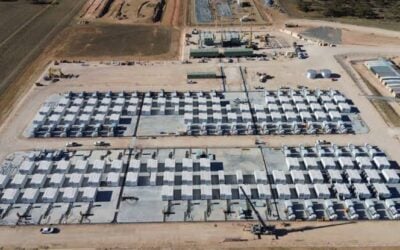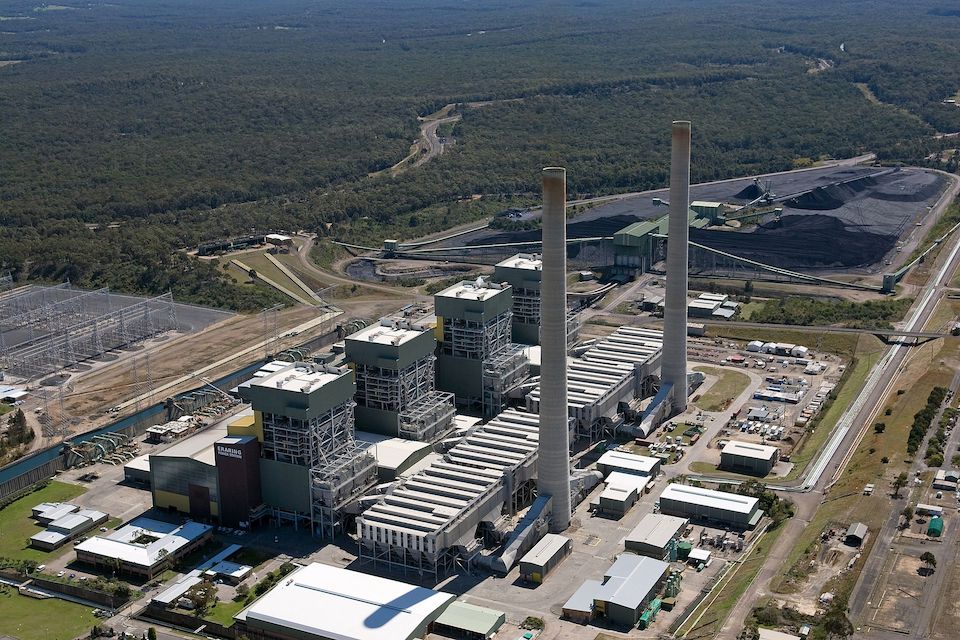
Australian utility Origin Energy revealed today (25 July) that it has approved the second stage of the Eraring battery energy storage project in New South Wales, Australia.
This stage will see the construction of an additional 240MW/1030MWh grid-forming battery energy storage system (BESS). This brings the overall capacity to over 2GWh with the new 4-hour duration BESS.
This will complement Origin’s existing 460MW/1073MWh 2-hour duration BESS currently under construction as part of Stage 1 of the overall project.
Stage 1 of the Eraring project is expected to cost around AU$600 million (US$392 million) and be delivered by Wärtsilä, a Finnish marine and energy technology company, via an engineering equipment delivery (EED) contract with Origin. It is expected to come online at the end of 2025.
Try Premium for just $1
- Full premium access for the first month at only $1
- Converts to an annual rate after 30 days unless cancelled
- Cancel anytime during the trial period
Premium Benefits
- Expert industry analysis and interviews
- Digital access to PV Tech Power journal
- Exclusive event discounts
Or get the full Premium subscription right away
Or continue reading this article for free
Origin has already signed equipment supply and construction agreements for Stage 2 of the project. Wärtsilä has again been employed to deliver the battery equipment, with Enerven Energy Infrastructure providing design and construction services. Construction will begin in early 2025 and be completed in Q1 of 2027.
Wärtsilä revealed that the BESS will operate in virtual synchronous machine (VISMA) mode. This will enable short-circuit current capabilities, such as reactive current, droop control, and synthetic inertia, to support grid stability and security. This will be achieved via Wärtsilä’s energy management system, GEMS Digital Energy Platform.
According to Greg Jarvis, head of energy and supply at Origin Energy, the project affirms the company’s belief that “storage will play an important role in the changing grid by helping to firm up variable supply from wind and solar”.
“The second stage of the Eraring battery will be over 4-hours duration and it will be capable of absorbing excess solar generation during the day to support reliable energy supply when needed, such as through the evening peak,” he added.
Project significant in withdrawing Australia’s biggest coal-fired power plant
Readers of Energy-Storage.news may be aware that the Eraring battery energy storage project is part of Origin’s plans to withdraw Australia’s largest coal-fired power station from service and instead contribute to the uptake of variable renewable energy generation technologies, such as wind and solar.
Located on the shores of Lake Macquarie, southwest of Newcastle, the black coal power plant provides 2,880MW to the National Electricity Market (NEM). In early 2022, Origin said it would be retiring the coal-fired power plant in 2025, yet in May 2024, the New South Wales government controversially extended this by an additional two years to “guarantee a maximum of electricity supply”. The new expected closure date is scheduled for August 2027.
This was in light of the Australian Energy Market Operator (AEMO) stating that, without Eraring, New South Wales would face energy reliability risks from 2025. As such, the state government is subsidising the power station to ensure it can remain operational.
Although the decision remains controversial, global market research organisation Cornwall Insight revealed that extending Eraring’s service will cut New South Wales’ power prices by 44%, dropping from a predicted AU$153/MWh to AU$86/MWh in 2026. However, question marks remain over the power station’s use and impact on New South Wales and Australia’s climate goals.
Roadblocks in delivering infrastructure to transition from coal
The extension of the Eraring coal-fired power station could have been avoided had infrastructure been scaled sufficiently in the state, yet despite an appetite to scale this from a developer perspective, “roadblocks” remain, Stephanie Bashir, CEO of energy policy and regulation specialist Nexa Advisory, said at Solar Media’s Energy Storage Summit Australia in Sydney earlier this year.
“These types of roadblocks are fairly and squarely in the hands of government to expedite and then make sure that we’re not just building to the timeline to close power stations (which we’re failing miserably as a result) but also to have a bit more ambition to be the energy superpower we actually can be.”
The good news is that Australia has the policy mechanisms in place and the technologies available to achieve that more ambitious goal.
“We just need to get on with it,” Bashir said.
Equis secures grid approval for 200MW BESS
In other Australian news, Equis Australia, the regional subsidiary for Asia-Pacific market infrastructure developer Equis, has secured grid approval for its 200MW/800MWh Lower Wonga BESS in Queensland.
Based around 0.8km southwest of the Woolooga Substation, around 100km northwest of Sunshine Coast, the 4-hour duration BESS was granted development approval in July 2023.
According to the project’s website, construction will commence in 2024 and be operational in 2026. Once construction begins, the BESS project will create up to 115 regional jobs.
Earlier this year, Equis Australia, alongside the State Electricity Commission (SEC) for Victoria, secured AU$400 million in financing for their Melbourne Renewable Energy Hub (MREH) battery storage project. The project will comprise three BESS assets with a total output of 600MW and a capacity of 1.6GWh.