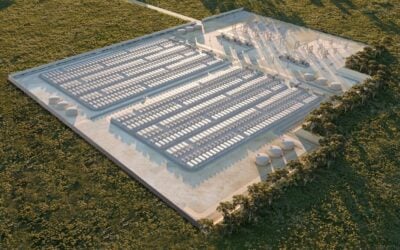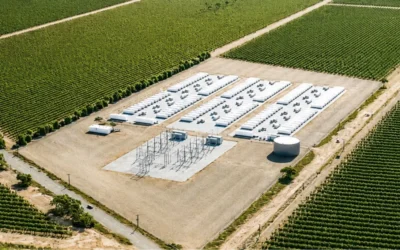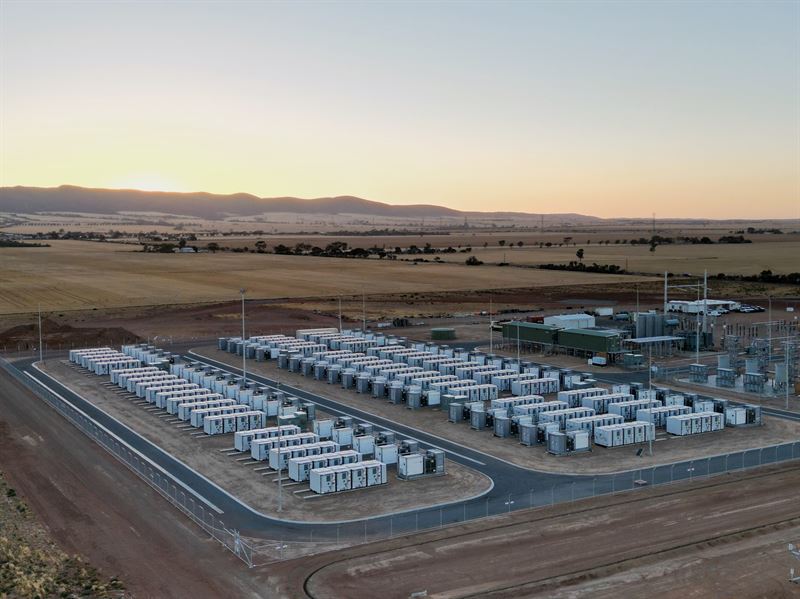
Wärtsilä has brought the 150MW/300MWh Bungama battery energy storage system (BESS) online in South Australia, confirming commercial operations on 30 June 2026 for owner and operator Revera Energy.
The standalone Bungama BESS is located in Port Pirie’s industrial corridor on the Spencer Gulf in South Australia’s Mid North region, connected to ElectraNet’s transmission network.
The project completed AEMO’s mandatory Hold Point Tests, a sequenced commissioning approval process that allows new assets to progress from limited operation to full commercial output in stages, ahead of schedule, with each of the three tests completed in quick succession.
The system uses Wärtsilä’s GridSolve Quantum High Energy technology, an advanced safety architecture with high energy density, and is operated via Wärtsilä’s GEMS platform, which provides real-time optimisation and millisecond-level frequency response.
Try Premium for just $1
- Full premium access for the first month at only $1
- Converts to an annual rate after 30 days unless cancelled
- Cancel anytime during the trial period
Premium Benefits
- Expert industry analysis and interviews
- Digital access to PV Tech Power journal
- Exclusive event discounts
Or get the full Premium subscription right away
Or continue reading this article for free
A long-term service agreement (LTSA) between Wärtsilä and Revera Energy covers performance support across the asset’s lifecycle.
The facility will provide frequency control ancillary services, fast frequency response and energy arbitrage in the National Electricity Market (NEM), with ElectraNet as the transmission network service provider and Enerven as the balance of plant contractor.
Wärtsilä’s total operational energy storage portfolio in Australia now exceeds 6GWh across four projects.
Don Lee, vice-president of global operations at Wärtsilä Energy Storage, said the project illustrates the pace at which storage can be deployed in markets with high renewable energy penetration.
“Delivering the first stage of the Bungama energy storage system in one of the world’s most dynamic renewable energy markets demonstrates what advanced technology and deep system collaboration can achieve,” Lee said.
Last month, the Finnish power solutions company announced it would wrap its energy storage business into a 50:50 joint venture with German solar manufacturer RCT Solutions, effectively divesting a 50% stake in the unit.
RCT Solutions CEO Peter Fath will head up the JV entity, taking over from Tamara de Gruyter, who led it since the company parted ways with industry veteran Andy Tang in 2025 (Tang then joined Chinese lithium-ion OEM and BESS integrator Rept Battero).
In an interview with ESN Premium, Timo Heinonen, an equity analyst covering the company at Handelsbanken, noted that the move reflects the “limited synergies” and profitability challenges the energy storage division faced within Wärtsilä’s broader group, which generates the majority of its revenue from marine power solutions and wider energy systems where the storage business had limited overlap.
Wärtsilä will retain a 50% stake in the joint venture and continue to service existing customers, including Revera Energy, meaning the Bungama BESS’s long-term service agreement remains in place through the transition, though the entity delivering that service will operate under new ownership and leadership structure from 2026 onwards.
South Australia as a test case for storage performance
South Australia is the NEM region that has tested the limits of battery storage most consistently under pressure.
The state regularly operates with some of the highest levels of variable renewable energy generation of any connected grid in the world, with wind and solar routinely exceeding 100% of instantaneous demand during daylight hours, creating the price volatility that gives battery storage its commercial case.
The Bungama BESS entered commercial operations days after a major price cap event, during which several battery storage systems capitalised.
As the SA1 price cap event on 21 June 2026 showcased, South Australia’s AU$20,300/MWh (US$14,045/MWh) price cap was reached twice in a single evening, with NEMPulse recording an estimated AU$324,000 in fleet revenue across the event.
The NEMPulse data confirmed that Bungama was among the battery storage systems that remained idle through the event, with an available capacity of 40.9MW but an average dispatch of just 0.4MW, generating an estimated AU$4,050 in revenue for the period, a result that reflected the state-of-charge and dispatch conditions at the time rather than the system’s maximum capability.
Speaking exclusively to ESN Premium, OptiGrid CEO Sahand Karimi noted that the state of charge at the start of a price cap event is a primary driver of outcome, but that state of charge itself reflects earlier forecasting and bid optimisation decisions.
“Some decisions look obvious after the event. They rarely are in real time,” Karimi said.
The 21 June event and the spread of outcomes it produced across the fifteen BESS tracked is precisely the kind of market environment the Bungama BESS has been built to participate in, with its GridSolve and GEMS combination designed for fast-response dispatch in conditions of high renewable energy variability.
Multi-stage programme and broader South Australia storage context
The 150MW/300MWh system, which reached commercial operations on 30 June, is described as the first stage of a multi-stage development programme at the Bungama site, indicating that additional capacity is planned.
Revera has not disclosed the full scale of the planned programme, but framing it as a staged development is consistent with how several other South Australian battery developers have approached capacity growth at existing sites, adding successive tranches as the commercial case, grid connection agreements, and revenue contracts support expansion.
South Australia’s storage pipeline has been expanding on multiple fronts. The state was one of four NEM jurisdictions to receive projects under the Capacity Investment Scheme (CIS) Tender 8 results announced in late June 2026, with Potentia Energy securing contracts for two South Australian projects, the 125MW/508MWh Blanche BESS in Compton and the 225MW/900MWh Emeroo BESS in Wami Kata.
Meanwhile, the SA Firm Energy Reliability Mechanism (FERM) Tender 1 awarded contracts to six battery projects totalling 1,334MW earlier in 2026, with all six required to be operational by November 2028 or 2029.
Together, these procurement instruments are building a South Australian storage fleet substantial enough that its collective dispatch behaviour during price events is becoming a material driver of wholesale market outcomes.
The start of commercial activities at the Bungama BESS also arrives at a moment of structural change for Wärtsilä’s energy storage activities.
Our publisher, Solar Media (part of Informa Group), will host the Battery Asset Management Summit Australia 2026 on 25-26 August at Amora Hotel Jamison in Sydney. You can find out more about the Summit on the official website.