
With ees Europe taking place in Munich, Germany, this week alongside Intersolar Europe and Smarter E, Energy-Storage.news takes a look at some expo highlights.
Perhaps the biggest launch, in terms of media and audience attention, at least, was CATL’s unveiling of its 30MWh+ sodium-ion block, which was covered separately from a live launch event and media Q&A session.
Alongside that foray into a new era of non-lithium battery energy storage system (BESS) technology, big players and startups alike showcased products and solutions spanning a broad range of applications and project configurations.
As you can see, some of the themes and trends that stood out, with many products combining two or more of these within one integrated solution, included:
Try Premium for just $1
- Full premium access for the first month at only $1
- Converts to an annual rate after 30 days unless cancelled
- Cancel anytime during the trial period
Premium Benefits
- Expert industry analysis and interviews
- Digital access to PV Tech Power journal
- Exclusive event discounts
Or get the full Premium subscription right away
Or continue reading this article for free
- DC-coupling
- Inverters and power conversion systems (PCS)
- Grid-forming (GFM) inverters and PCS
- US companies coming to Europe, many for the first time
- Long-duration energy storage (LDES) solutions
- Commercial and industrial (C&I) energy storage solutions
Of course, there were hundreds of exhibitors, many with great products. For this article, we’ve focused on those announcements that represented first-time launches, European debuts and the occasional deal signed on the expo floor.
As a further caveat, even Energy-Storage.news couldn’t possibly cover everything, so we apologise in advance if you don’t see your favourite technology providers and their innovations mentioned below: do message us at [email protected] with any feedback.
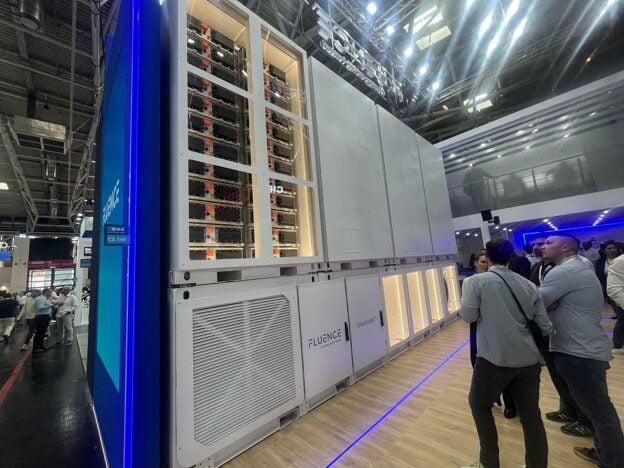
Fluence Smartstack 10MWh: higher density, same footprint as existing platform
Fluence, US-based energy storage and optimisation software company, showcases its new Smartstack 10MWh product at Intersolar Europe 2026, the latest addition to its modular Smartstack platform, joining the existing 7.5MWh system.
The new product achieves a site-level energy density of approximately 680MWh per acre (168kWh per square metre) through an evolved pod design that increases capacity without expanding the physical footprint, and balance-of-plant costs are reduced by up to 40% compared to standard DC blocks.
The system has completed Large-Scale Fire Testing (LSFT) and is available in 2-, 4-, 6- and 8-hour durations. Crucially, it maintains the same electrical architecture, footprint and deployment model as the existing Smartstack platform, meaning customers can adopt the higher-capacity unit without redesigning projects from the ground up.
SVP and chief product and supply chain officer Peter Williams said: “As battery technology, supply chains, and local content requirements continue to evolve, customers need storage systems that can adapt without redesigning projects from the ground up.”
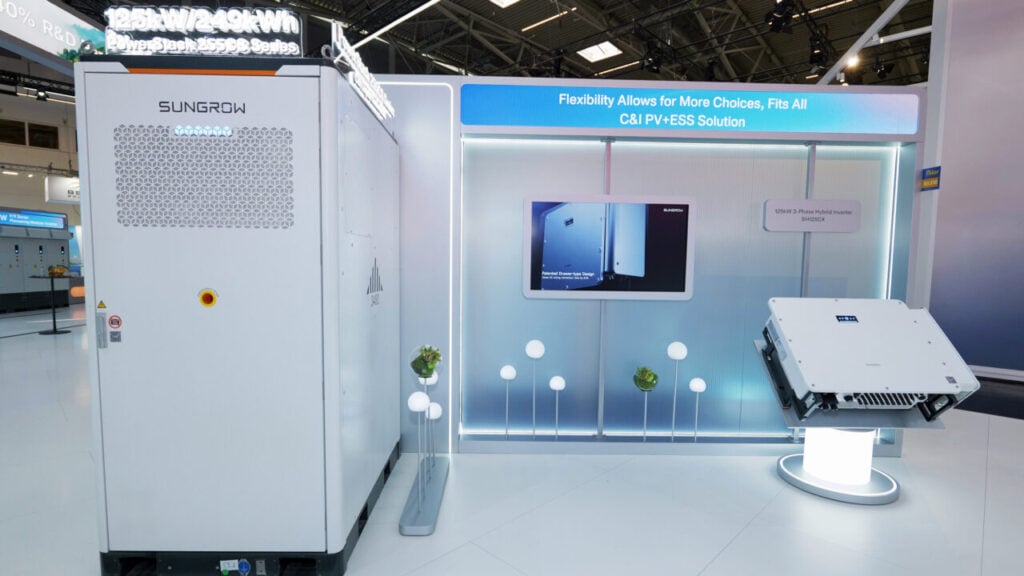
Sungrow PowerStack 255CS: on-grid and off-grid C&I solution launched at ees Europe
Chinese PV inverter and energy storage system (ESS) integrator Sungrow company, used ees Europe 2026 to formally launch its C&I PowerStack On&Off-Grid Solar-Storage solution for the European market.
The solution is built around the PowerStack 255CS, a liquid-cooled C&I storage system using LFP cells with a PCS rated at 125kW and a battery capacity of 257kWh per unit (2-hours) or 514kWh (4-hours), scalable to 6MWh by connecting up to 24 units in parallel.
It is available in both AC-coupled and DC-coupled configurations. The DC-coupled version pairs the ST255CS with Sungrow’s SH125CX 125kW hybrid inverter, which supports up to 10 MPPT channels and is designed for new-build C&I solar-plus-storage projects.
The AC-coupled version is aimed at retrofitting existing installations. The system supports VPP, demand control, VSG, backup power, seamless switching and black-start operation modes, and is certified under UL9540 and NFPA855 standards.
Sungrow cited deployments ranging from a fully off-grid sawmill in South Australia to weak-grid applications in Cambodia as evidence of the solution’s versatility across operating environments.
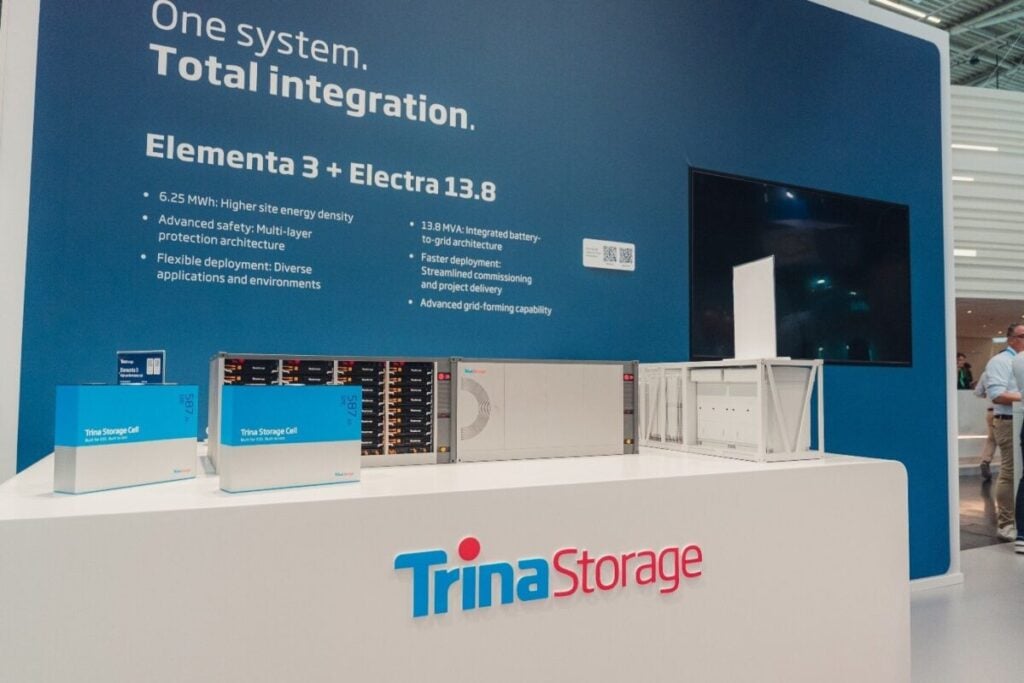
Trina Storage Elementa + Electra 13.8MVA/25MWh: integrated DC+AC utility-scale system
Trina Storage, the storage business unit of Trinasolar, launched its Elementa + Electra 13.8MVA/25MWh integrated DC+AC solution at Intersolar Europe 2026, combining the company’s latest Elementa storage system with an upgraded 13.8MVA Electra AC platform in a single containerised architecture.
The system delivers 25MWh of storage and 13.8MVA of AC output. Its three-tier liquid-cooling architecture maintains a cell temperature difference below 2.5°C, while the Electra platform supports a 10ms full-power response time with grid-forming and black-start capabilities.
Both DC and AC components support containerised transport, and factory-level testing is said to reduce on-site commissioning time by up to 50%. An integrated auxiliary transformer further reduces footprint requirements.
Trina Storage also showcased its 587Ah cell at the show, the same cell used in the Elementa 3 system, which was selected as a finalist in The Smarter E AWARD 2026 Energy Storage category.
The first Elementa + Electra deployment in Europe is already underway: a 40MW/160.48MWh project in Izvoarele, Romania for LSG, with commissioning targeted for Q3 2026.
Shawn Deng, head of global product and system integration at Trina Storage, said: “Customers increasingly expect storage systems to deliver not only higher performance, but also greater reliability, simplified deployment and stronger project economics.”
Ahead of its launch, Trinasolar Europe president Gonzalo de la Vina spoke about Elementa 3 and the Electra MV skid at Energy Storage Summit 2026 in London for a video interview with Energy-Storage.news, recorded in February:
Nidec Conversion: high-density PCS for LDES applications
Nidec Conversion, the Italy-headquartered subsidiary of Japanese electric motor company Nidec, debuted a high-density PCS for utility-scale battery storage and renewables applications.
The UniQube PCS is designed to handle long-duration energy storage (LDES) applications requiring up to 8-hour duration, built on a liquid-cooled insulated-gate bipolar transistor (IGBT) architecture. The product is manufactured in Europe and is 2000V-ready in anticipation of future market opportunities.
Nidec Conversion also showcased the latest iteration of its AC block lithium iron phosphate (LFP) BESS solution, ACBOX V4, which has integrated grid-forming (GFM) capabilities. The company claimed the high-density UniQube and design-optimised ACBOX V4 both allow for a reduced project footprint.
Power Electronics: DC/DC converter for hybrid solutions
Spanish inverter and PCS manufacturer Power Electronics showcased its Freesun DC/DC converter hybrid solution for DC-coupled systems. It supports grid-forming applications and direct solar-plus-storage hybridisation i.e., solar charging of the batteries. The company said it has already gained experience with grid-forming in Australia and is bringing this know-how to Europe.
Freesun DC/DC was displayed alongside Power Electronics’ PCSM and Multi-PCSM battery inverters for utility-scale BESS projects, which enable direct connection to medium-voltage networks. The company also brought AIPCS, a medium-voltage-to-800VDC power supply for data centres, the HEM Solar turnkey solar PV inverter, and Freemaq DC/DC, a solar plant controller compatible with battery technologies.
SMA: integrated DC-coupled solution for hybrid projects
SMA launched an integrated solution for solar PV, BESS and grid-forming inverters, Stability Enhanced DC Coupled Hybrid Solution.
It combines the SMA Medium Voltage Power Station (MVPS)—comprising the grid-forming Sunny Central UP-S battery inverter and Sunny Central FLEX DCDC Skid. It can also be equipped with the SMA Power Plant Manager power plant controller (PPC).
Both the inverter and skid feature advanced silicon carbide (SiC) MOSFET semiconductor technology. The MOSFET semiconductor enables up to 99.5% conversion efficiency while reducing thermal loads and enabling boosted operation during extreme grid disturbances, SMA claimed.
SMA will begin quoting customer pricing for the hybrid solution at the end of July, with availability in Germany, the UK, and Australia first.
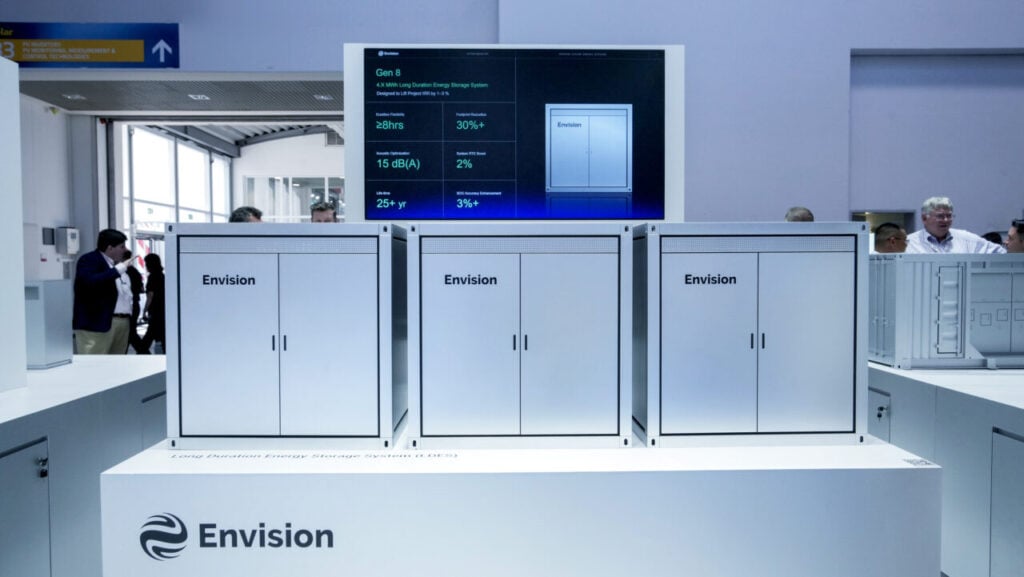
Envision: European debuts for AIDC solution, LDES BESS
Chinese wind turbine, integrated BESS and energy software company Envision gave European debuts to an AI Power System for AI data centres (AIDCs), its LDES-specific energy storage system and a full-stack hybrid wind-solar-battery inverter and PCS solution.
AI Power System is designed to coordinate power generation, energy storage, grid interaction and computing loads. These can include grid-connected wind-solar-battery hybrid systems, MV station-level grid-forming BESS and 800VDC power architecture that integrates a compact 2.5MW LFP energy storage system with 2.5MW solid-state transformer (SST) technology.
It also integrates sodium-ion (Na-ion) batteries for handling the rapid power smoothing and AI fast load fluctuations of AIDCs.
The Gen 8 4.X MWh LDES system, meanwhile, is purpose-built for 8-hour to 16-hour applications. It also uses Envision’s in-house SiC-string PCS technology, which provides 250% overload capability in grid-forming applications. The company claimed it supports up to 91% round-trip efficiency (RTE), provides high state-of-charge (SoC) estimation accuracy, maintains low noise levels, and can handle a wide range of operating temperatures.
PVFARM: US renewables workflow platform gets BESS upgrade
US project planning software platform provider PVFARM made its European debut at the show this year, including a BESS and hybrid or co-located solar-plus-storage-specific update to RE PILOT, its workflow decision-making platform for renewable energy projects.
PVFARM claimed RE PILOT helps project planners in battery sizing, facility location, project economics and grid constraints. While these critical decisions are often considered separately, the platform aims to put them all into a single united workflow.
The new capabilities for its renewable energy platform will be released in Q3 2026. Its development follows conversations with experts at over 60 stakeholder organisations over more than 150 hours.
“One theme came up repeatedly,” from these conversations, PVFARM CTO Maksim Markevich said: “teams need to evaluate energy, economics, and reliability together. Whether they’re developing a solar and storage facility or a standalone storage project, decisions around battery sizing, facility location, and grid constraints are deeply connected. Yet they’re often evaluated in separate tools and spreadsheets. RE PILOT brings these decisions together so teams can explore alternatives, understand trade-offs, and identify practical solutions earlier.”
FranklinWH System: integrated residential storage platform targeting European launch in 2027
Another US company making its European trade show debut was FranklinWH Energy Storage, a San Francisco Bay Area-based manufacturer of home energy management and battery storage systems. The company unveiled the FranklinWH System at Intersolar Europe 2026 ahead of a planned 2027 European market entry.
The FranklinWH System uses lithium iron phosphate (LFP) chemistry and integrates battery storage, solar, EV charging and energy management into a single residential platform.
It scales from 15-225kWh per aGate intelligent controller and supports backup power, solar self-consumption and energy cost management. The all-in-one design is intended to simplify installation while enabling homeowners to optimise charging and discharging based on consumption patterns, electricity prices and weather conditions.
FranklinWH chief commercial officer Vincent Ambrose said: “European homeowners want lower energy bills and utilities want flexible resources they can count on. Those are not separate challenges, they are the same opportunity viewed from different sides of the meter.”
Hithium battery systems power 366MWh AI-enabled industrial storage platform across Europe
Vertically integrated Chinese battery energy storage manufacturer Hithium, announced at ees Europe 2026 that its battery systems have been deployed as part of a 366MWh AI-enabled project across 15 industrial facilities belonging to a major European ceramic manufacturing group.
The deployment pairs Hithium’s battery storage hardware with Turbo Energy’s proprietary AI-driven optimisation platform, which coordinates solar generation, storage and industrial energy consumption in real time across multiple sites.
More than 130MWh has already been installed as part of the Pamesa Net Zero initiative. The project marks the first industrial-scale deployment combining Hithium’s storage systems with Turbo Energy’s AI software platform.
The announcement was one of several C&I-focused developments at ees Europe 2026.
Commercial and industrial storage remains the smallest of the three main battery storage market segments globally, but it attracted a notable concentration of product launches at this year’s show.
With Sungrow, FranklinWH and others all bringing dedicated C&I offerings to Munich, there is growing recognition that rising electricity costs and corporate decarbonisation targets are turning C&I customers into an increasingly active procurement market.
