Recharge Power, a Taiwanese battery energy storage system (BESS) developer and integrator, has partnered with Australian renewable energy developer Energy Decarb to establish a joint venture targeting the Australian solar PV and battery storage market.
The joint venture brings together Recharge Power’s proprietary energy management system (EMS) software and system integration capabilities spanning project engineering, construction, and long-term operations and maintenance, with Energy Decarb’s local project development proficiency, electricity market knowledge and trading capabilities.
The two companies have already assembled an active project pipeline totalling 128MW/292MWh in Australia, expected to be delivered progressively over the next two years. Specific details on these battery storage projects have not been disclosed.
Energy Decarb leverages the resources and project financing depth of anchor investor St Baker Capital. The group is backed by Trevor St Baker AO, founder of ERM Power, which was formerly Australia’s fourth-largest electricity retailer before Shell Energy Australia acquired it.
Try Premium for just $1
- Full premium access for the first month at only $1
- Converts to an annual rate after 30 days unless cancelled
- Cancel anytime during the trial period
Premium Benefits
- Expert industry analysis and interviews
- Digital access to PV Tech Power journal
- Exclusive event discounts
Or get the full Premium subscription right away
Or continue reading this article for free
The joint venture will offer integrated solar and BESS engineering, procurement and construction services alongside energy service company offerings, targeting commercial and industrial customers seeking to reduce electricity costs.
Recharge Power CEO Spencer Feng said the company intends to replicate the commercial model it has applied in its home market and in Japan.
“We intend to replicate the proven success we achieved in Taiwan and Japan, gaining swift local traction and then scaling rapidly,” Feng said.
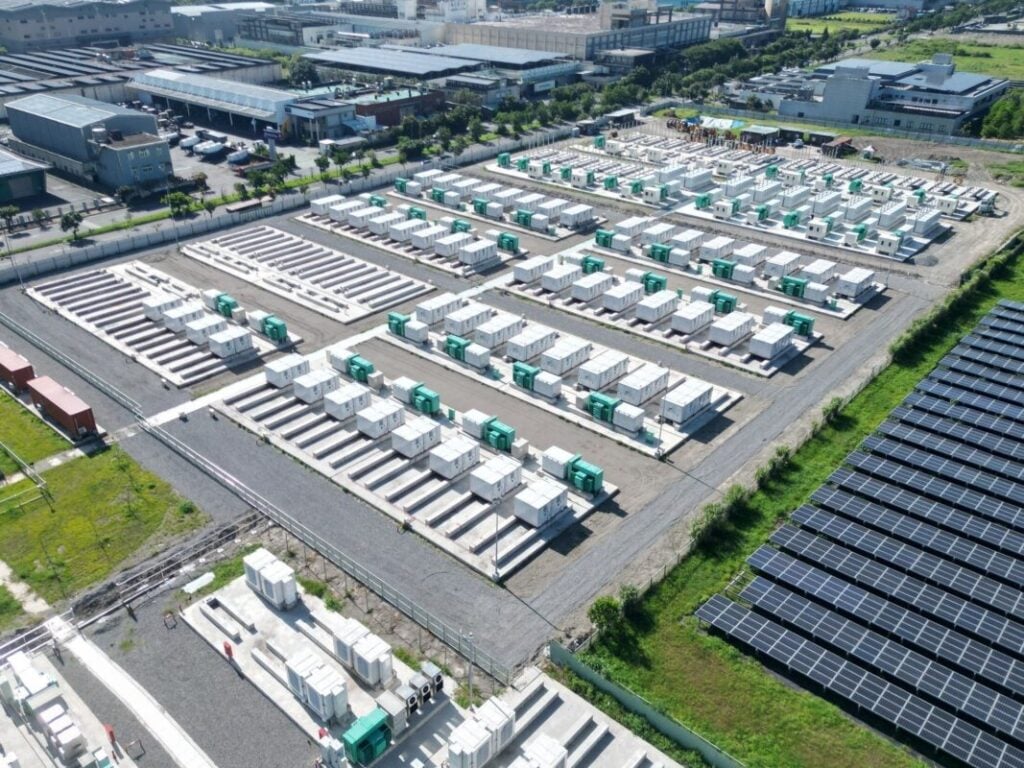
Recharge Power has surpassed 1GWh in cumulative deployment capacity in Taiwan. It claims to hold a series of domestic firsts, including Taiwan’s first automatic frequency control project, Taiwan’s first solar-plus-storage project and Taiwan Power Company’s first self-owned substation BESS project.
Australia’s ‘booming’ battery storage market
Australia recently became the world’s third-largest utility-scale battery storage market, with 4.3GW of large-scale battery storage reaching financial close in 2025, according to the Clean Energy Council’s Clean Energy Australia Report 2026, placing it behind only the United States and China in terms of annual deployment volume.
Battery storage set prices in 32% of NEM trading intervals during Q1 2026, overtaking hydro as the most frequent price-setting technology, a structural shift that has made market participation an increasingly material revenue stream for storage operators.
Queensland, where much of Australia’s recent storage buildout has concentrated, shows what that market participation can look like at scale.
The state became the first in the NEM to discharge over 100GWh from battery storage in a single month in April 2026, with intraday price spreads collapsing as the installed battery fleet ramped up, and the average two-hour spread falling below AU$110/MWh (US$78/MWh) across all NEM states except South Australia.
The same dynamics that compress arbitrage spreads over time also reward operators with sophisticated EMS software and trading capability, precisely the combination the joint venture is aiming to deliver.
State-level procurement programmes are also opening new entry points for mid-scale storage developers.
Yesterday, Energy-Storage.news reported that Queensland’s AU$200 million North West Energy Fund has opened a formal call for proposals targeting generation and storage projects in the North West Minerals Province, a programme structured to attract private capital into a region currently reliant on islanded diesel and gas generation.
Projects of this scale in the joint venture’s existing 128MW/292MWh pipeline would be well matched to the fund’s commercial and construction-ready criteria.
Interested in Australia? Read Energy-Storage.news’ Energy Storage Summit Australia coverage and related content.