There’s been progress on several large-scale BESS projects in the UK, with Matrix Renewables securing financing for its Eccles project and BW ESS enlisting EDF to optimise its Hams Hall one; plus smaller announcements.
Matrix Renewables secures £245 million for 1GWh Scotland BESS
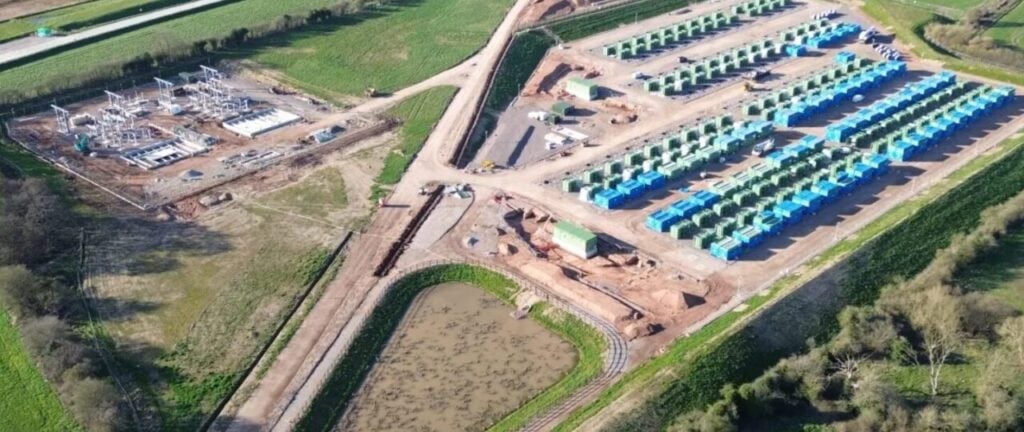
Independent power producer (IPP) Matrix Renewables has closed £245 million in project financing to back a 500MW/1,000MWh two-hour duration battery energy storage system (BESS) in Scotland.
The non-recourse project financing will support the construction of the BESS in Eccles-Leitholm, southern Scotland, which began in November 2025. Commercial operations are expected in the third quarter of 2027.
Matrix Renewables has secured optimisation and route-to-market services for the project from power firm EDF and has enlisted Tesla as the engineering, procurement and construction (EPC) contractor for the BESS.
Try Premium for just $1
- Full premium access for the first month at only $1
- Converts to an annual rate after 30 days unless cancelled
- Cancel anytime during the trial period
Premium Benefits
- Expert industry analysis and interviews
- Digital access to PV Tech Power journal
- Exclusive event discounts
Or get the full Premium subscription right away
Or continue reading this article for free
MUFG Bank, the London branch of CIBC and NatWest underwrote the financing. Nicolás Navas, CFO of Madrid-headquartered Matrix, said the deal “reflects the strong and growing demand for high-quality battery storage assets and reinforces the strength of our UK platform.”
See the full original version of this article on Solar Power Portal.
EDF to optimise BW ESS’s 350MW/1,243MWh Hams Hall BESS project in North Warwickshire
EDF has also partnered with energy storage developer BW ESS on the first phase of the Hams Hall battery energy storage system (BESS) in North Warwickshire.
Through its PowerShift platform, EDF will optimise the 350MW/1,243MWh BESS plant, under a 10-year floor agreement. This will enable the battery to deliver flexibility to the grid by balancing supply and demand, supporting grid stability and helping the integration of new renewable energy generation.
Currently under construction, the project is expected to reach commercial operations in the fourth quarter of 2026, with a second phase expected to add 50MW/210MWh capacity at a later date. Hams Hall is a key project from BW ESS’s UK portfolio and is co-owned with energy investor AIP Management, which acquired a 49% stake in the project and other UK assets in September 2025.
Once operational, the project will be BW ESS’s largest capacity project globally, increasing by four-fold the Bramley BESS project (100MW/331MWh), which was at the time the UK’s largest operational BESS plant, according to the company.
See the full original version of this article on Solar Power Portal.
L&G NTR Clean Power Fund acquires Nottinghamshire solar BESS project
L&G NTR Clean Power (Europe) Fund has announced the acquisition of Fair Oaks Renewable Energy Park, a ready-to-build solar and BES project in Nottinghamshire, England.
The Fair Oaks project is made up of a 75.4MWp solar PV array and a 49.9MW/99.8MWh battery energy storage system (BESS), and was developed by Ridge Clean Energy Ltd. Through the transaction, the Fund will collaborate with Ridge to deliver the project.
The news comes as NESO announces more Gate 2 connection offers, following delays to the body’s initial timeline.
Launched in 2025 as an Article 9 fund under the European Union’s Sustainable Finance Disclosure Regulation (SFDR), the Fund is a joint initiative between asset manager Legal & General Investment Management (LGIM) and European renewable energy business NTR.
The transaction with Fair Oaks was completed by NTR on behalf of the Fund, marking a new relationship between NTR and Ridge. Fair Oaks already has a grid connection offer and planning consent, as well as a secured Contract for Difference, allowing construction to most likely begin in 2026. The anticipated commercial operation date is earmarked for early 2028.
See the full original version of this article on Solar Power Portal.
SmartestEnergy and AGR sign CfD-backed PPAs for four solar and storage projects
Business-facing utility SmartestEnergy has agreed power purchase agreements (PPA) for four UK solar and storage projects with developer AGR Renewables, all backed by Contracts for Difference (CfD).
The four CfD-backed PPAs cover the solar portions of AGR’s Eaton Socon, Little Hale, Priory Generation and Wymondley projects, located across Cambridgeshire, Lincolnshire and Hertfordshire, which total 192MW of solar PV capacity.
The projects also include an undisclosed amount of battery energy storage system (BESS) capacity, though this is not covered by the PPAs.
They are the four projects that were awarded under the UK Government’s CfD Allocation Round 7 (AR7). AGR said then that the CfDs covered 146.1MW of capacity at a strike price of £65.23/MWh. CfDs provide renewable projects in the UK with a minimum guaranteed revenue backed by the government.
The agreements with SmartestEnergy provide AGR with a route-to-market for its projects from commissioning to end of CfD tenor. The announcement didn’t clarify when the projects would come online: only Wymondley is listed on AGR’s site, and it doesn’t have a commissioning target date. Eaton Socon meanwhile was acquired last year from Cambridge Power and should already be under construction.
See the full original version of this article on Solar Power Portal.