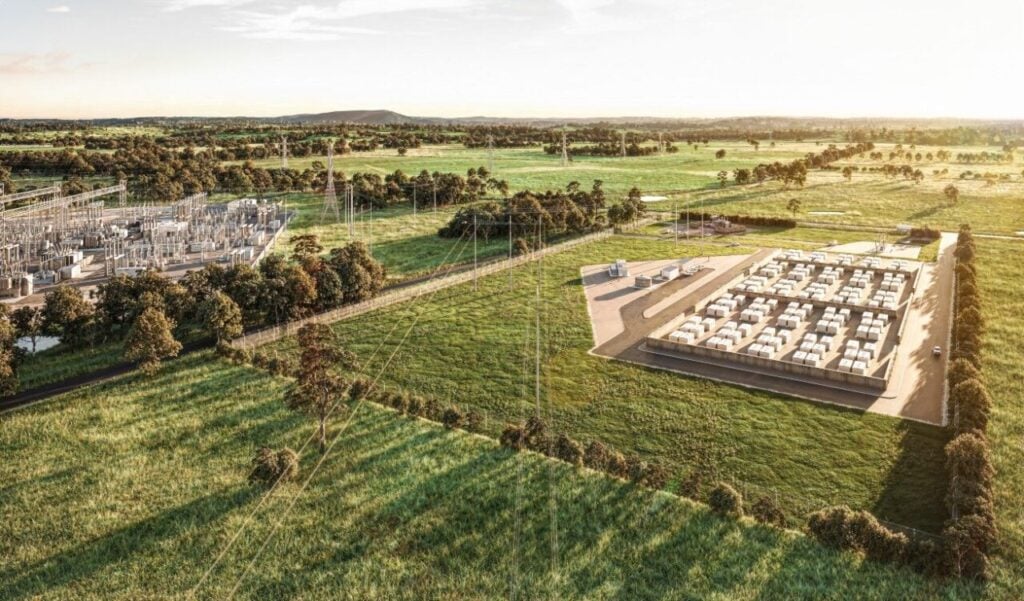
Valent Energy has received development approval from the New South Wales government and satisfied AEMO grid compliance requirements under clause 5.3.4a for its 150MW/437MWh Armidale Battery Energy Storage System (BESS).
Valent Energy is a joint venture between Hong Kong-based private equity firm Gaw Capital Partners and Singapore-headquartered BW Group, established to develop utility-scale battery storage projects across Australia.
The company has assembled a portfolio comprising over 1.6GW of battery storage projects across various development stages throughout the country.
The utility-scale battery storage system is situated about 5km east of Armidale, which is recognised as Australia’s highest city, sitting nearly 3,300 feet above sea level, in the New England region of New South Wales. This system will connect to the nearby 330kV Armidale transmission substation.
Try Premium for just $1
- Full premium access for the first month at only $1
- Converts to an annual rate after 30 days unless cancelled
- Cancel anytime during the trial period
Premium Benefits
- Expert industry analysis and interviews
- Digital access to PV Tech Power journal
- Exclusive event discounts
Or get the full Premium subscription right away
Or continue reading this article for free
The project is scheduled for completion by 2027, with the system expected to provide grid benefits by 2028.
New South Wales Department of Planning and Environment granted development approval under a State Significant Development application in December 2025.
It cited the project’s capacity to enable renewable energy storage and dispatch during peak demand periods while supporting grid stability and energy security during the state’s transition from coal and gas-fired power to renewable energy.
The AEMO 5.3.4a compliance letter confirms the project meets technical requirements for grid connection under the National Electricity Market (NEM) framework.
This approval represents the final technical milestone in the Generator Performance Standards (GPS) process, which requires extensive grid modelling studies and performance testing to ensure battery systems can operate safely within the NEM’s operational parameters. The GPS registration process has been described as perhaps the most stringent and demanding in the world.
GPS approval gives a developer the regulatory authorisation to connect their generating system to Australia’s electricity grid. It provides legal certainty that their project meets the technical requirements, enables them to finalise transmission connection agreements, and allows them to commence commercial negotiations for power purchase agreements (PPAs) with customers.
Planning approval conditions require Valent Energy to provide AU$2.55 million (US$1.78 million) in community benefits to Armidale Regional Council. This includes a AU$1.275 million lump sum through a Voluntary Planning Agreement and an additional AU$1.275 million distributed over the project’s operational life.
The developer has also committed AU$400,000 annually over 20 years for maintenance and enhancement of the New England Rail Trail.
Construction is expected to create 100 jobs during the build phase. The project underwent design modifications during the approval process, including road upgrades and noise wall installations around the battery system and transformers within the on-site substation.
It should also be noted that the capacity specification was amended from the initially proposed 150MW/300MWh to 150MW/437MWh during the planning process, addressing what the Department of Planning described as a “clerical error” in the initial application.
Another utility-scale BESS being developed by Valent Energy, the 240MW/480MWh Mornington BESS located on Victoria’s Mornington Peninsula, commenced commissioning activities in October last year.
The system utilises CATL battery technology and Power Electronics inverters, with ACLE Services serving as the facility’s EPBC contractor.
The Energy Storage Summit Australia 2026 will be returning to Sydney on 18-19 March. It features keynote speeches and panel discussions on topics such as the Capacity Investment Scheme, long-duration energy storage, and BESS revenue streams. ESN Premium subscribers receive an exclusive discount on ticket prices.
To secure your tickets and learn more about the event, please visit the official website.