Flow battery developer XL Batteries has partnered with data centre developer Prometheus Hyperscale to deploy its batteries on-site at data centres.
The companies have made a multi-year agreement to use XL’s organic long-duration energy storage (LDES) flow battery technology.
Phase one of this partnership will see XL commission a 333kW demonstration-scale battery system at a Prometheus facility in 2027.
Next, Prometheus plans to purchase a 12.5MW/125MWh commercial-scale system in 2028 followed by another 12.5MW/125MWh system in 2029.
Try Premium for just $1
- Full premium access for the first month at only $1
- Converts to an annual rate after 30 days unless cancelled
- Cancel anytime during the trial period
Premium Benefits
- Expert industry analysis and interviews
- Digital access to PV Tech Power journal
- Exclusive event discounts
Or get the full Premium subscription right away
Or continue reading this article for free
Both companies say they are aligned for long-term deployments of XL’s technology at Prometheus data centres.
The companies also note that, according to a report from Goldman Sachs, global power demand from data centres is forecasted to increase by as much as 165% by 2030.
They say on-site energy storage will be pivotal in helping data centre operators maintain operations, and that XL’s non-lithium technology will further ensure site safety.
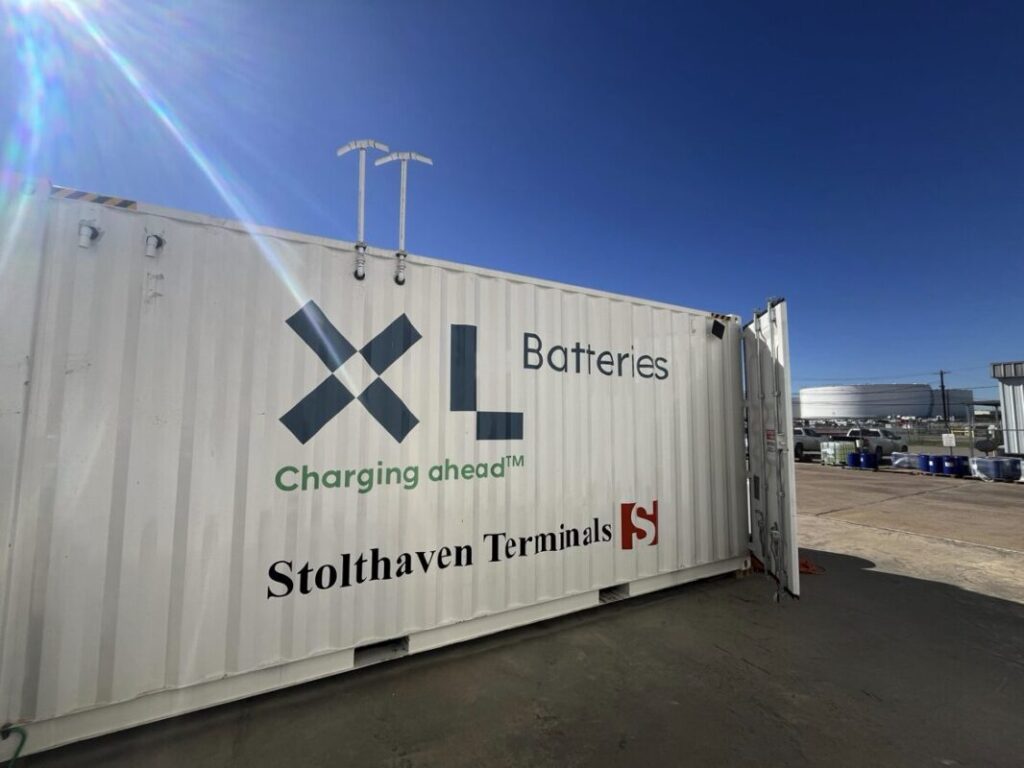
In April, XL commissioned its first organic flow battery in a pilot project with global storage terminals provider Stolthaven Terminals, at Stolthaven’s Houston, Texas facility.
XL Batteries co-founder and CEO Dr. Thomas Sisto said the goal of that deployment was to generate operational data to compare the company’s systems against vanadium-based flow batteries.
As the co-founder and CEO recently explained in an interview with ESN Premium, XL Batteries employs a pH-neutral chemistry discovered during experiments with a red paint’s energy storage capabilities.
Sisto elaborated that the company’s technology functions similarly to a vanadium redox flow battery (VRFB); however, instead of dissolving vanadium in sulfuric acid, it utilises organic molecules and pH-neutral water.
The company asserts that the easy access to its materials will render the systems significantly more affordable than a VRFB or other flow battery types.
In the interview, Sisto claimed that near-term costs are expected to be less than US$200/kWh for long durations.
Trenton Thornock, founder and CEO at Prometheus Hyperscale said of XL:
“We need batteries that offer performance at or above lithium, without risk of overheating, to deploy at our data halls.”