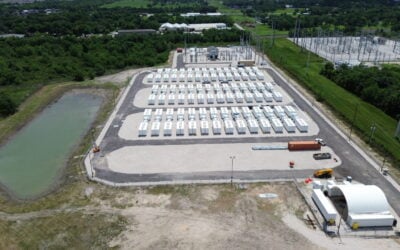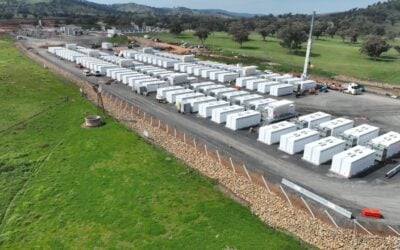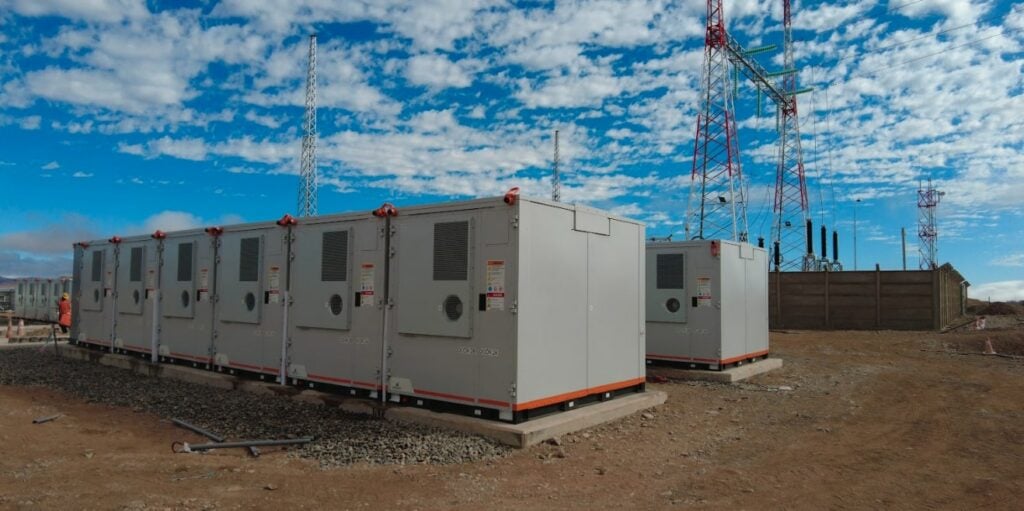
Finnish energy technology company Wärtsilä’s battery energy storage system (BESS) product GridSolv Quantum has achieved the “best possible outcome” in UL9540A testing.
Wärtsilä said earlier this week that its fully integrated, modular platform, using lithium iron phosphate (LFP) cells from manufacturer CATL, had met all of the fire safety tests requirements for Outdoor Ground Mounted BESS equipment.
UL9540A, created by UL Standards & Engagement in conjunction with the US-based National Fire Protection Association (NFPA) and many other organisations, tests for fire hazards associated with electrochemical energy storage systems when a cell goes into thermal runaway.
It focuses especially on the risk of propagation – thermal runaway causing heat and then fire to spread from one cell to another – which if unchecked or uncontained can lead to more serious fires or explosions.
Try Premium for just $1
- Full premium access for the first month at only $1
- Converts to an annual rate after 30 days unless cancelled
- Cancel anytime during the trial period
Premium Benefits
- Expert industry analysis and interviews
- Digital access to PV Tech Power journal
- Exclusive event discounts
Or get the full Premium subscription right away
Or continue reading this article for free
In a recent webinar presented by Energy-Storage.news with system integrator IHI Terrasun, battery and BESS safety experts from DNV discussed UL9540 codes and standards for battery storage, including an overview of the UL9540A tests: what their intention is, as well as examining some typical test data and what it showed.
As DNV energy storage safety lead Carrie Kaplan explained in the webinar, UL9540A determines a system’s cells capability of going into thermal runaway, as well as evaluating a system’s fire and explosion hazard characteristics. It is part of key certifications required by many authorities having jurisdiction (AHJs) in the US, such as NFPA 855 code and IFC 2021, and is required for most large-scale projects to get financing and approvals.
The test can inform better BESS design, as well as the requirements for spacing between units to prevent spread of fire. Kaplan said it is important to note that UL9540A is not a ‘pass/fail’ test, but instead has four outlined levels of testing with corresponding performance criteria.
These are: cell level, module level, unit level and installation level, and a BESS needs to go through each one to meet those performance criteria.
It was proven that if a cell in Wärtsilä’s GridSolv Quantum went into thermal runaway, it would not propagate to adjacent modules or units, while the Lower Explosive Limit of the equipment at system level is below 25%, without risk of deflagration.
The product exhibited no explosion risk, and no flaming occured. Wärtsilä touted that the results mean GridSolv Quantum units can be installed within 4 inches of each other and 10ft of a building and stay in line with relevant fire codes and standards.
‘Scenario did not become hazardous’
Noah Ryder, a managing partner at Fire & Risk Alliance, one of the parties overseeing the testing, said Wärtsilä had “achieved the best possible outcome from the tests”.
“There was no external flaming observed, the concentration of gases was manageable and the scenario did not become hazardous. This is as good as it gets from a results standpoint,” Ryder said.
Nick Warner of Energy Safety Response Group, one of the other overseeing parties, recently co-wrote a Guest Blog on the critical importance of energy storage fire safety for Energy-Storage.news with Wärtsilä energy storage director of product management and hardware, Darrell Furlong.
Warner and Furlong said that while industry fire codes require testing to be done as per UL9540A, “safety conscious manufacturers have expanded their testing to go beyond the focus on thermal runaway”, with some also seeking to validate explosion protection systems using full-scale testing.
Fluence also completed UL9540A tests for its Fluence Cube BESS product a few weeks ago, while Wärtsilä’s battery supplier CATL recently got accredited to carry out its own UL9540A tests through a partnership with UL Solutions.
This article has been amended from its original form to reflect that UL9540A was developed by UL Standards & Engagement, not UL Solutions in collaboration with the NFPA and many other organisations. Some portions describing the test results have also been amended for accuracy.