State-owned energy company Synergy has submitted a hybrid renewable energy project in Western Australia for federal environmental assessment, featuring up to 1,000MW of wind generation capacity, 500MW of solar, and a 500MW battery energy storage system (BESS).
The Tathra Wind Farm, which has been submitted to the Environment Protection and Biodiversity Conservation (EPBC) Act and is located approximately 15km east of Eneabba in Western Australia’s Mid West region, would occupy a 15,847-hectare development envelope.
It would sit on predominantly cleared agricultural land within the Shire of Carnamah, with the proponent holding legal access through option-to-lease agreements with landowners across 14 freehold lots.
The proposal encompasses up to 140 wind turbine generators with towers reaching 160 metres in height and blades extending up to 90 metres, creating a maximum tip height of 250 metres.
Try Premium for just $1
- Full premium access for the first month at only $1
- Converts to an annual rate after 30 days unless cancelled
- Cancel anytime during the trial period
Premium Benefits
- Expert industry analysis and interviews
- Digital access to PV Tech Power journal
- Exclusive event discounts
Or get the full Premium subscription right away
Or continue reading this article for free
Meanwhile, the solar component would comprise up to one million solar PV modules deployed across multiple arrays within the project area, while the battery storage would be distributed across up to three separate facilities.
Little is known about the battery storage system beyond the 500MW power output. The system’s duration has not been disclosed.
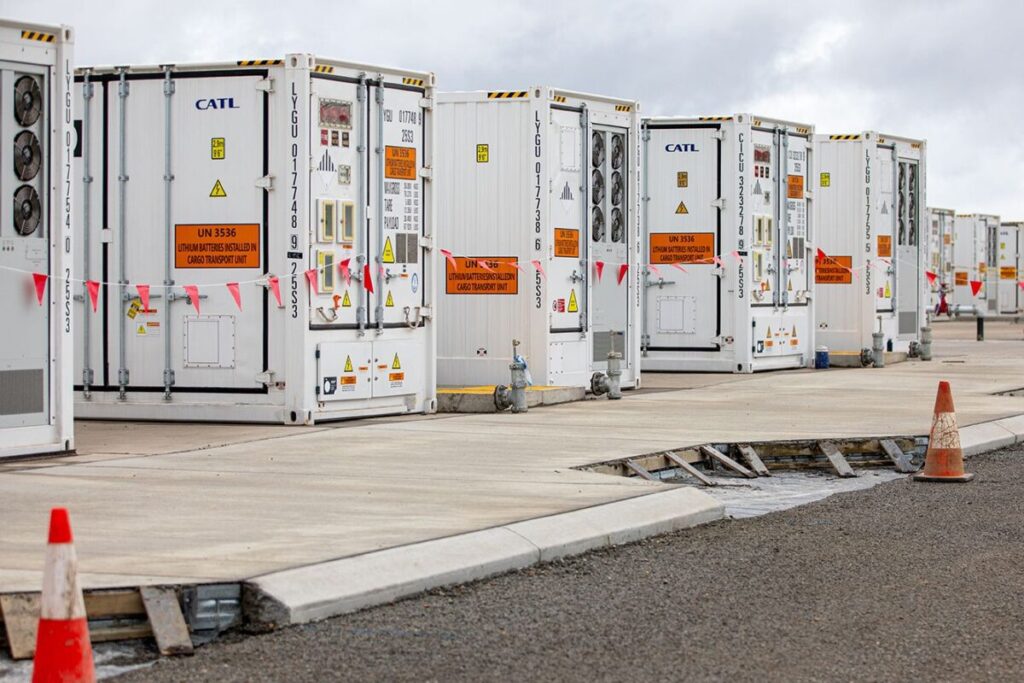
However, it is worth noting that Synergy has previously partnered with the world’s biggest lithium battery manufacturer, China-headquartered CATL, on several utility-scale battery storage projects in the state.
According to the application, Synergy has designed the project to minimise environmental impact, with the total disturbance footprint limited to 1,595 hectares despite the substantial development envelope.
Critically, the proposal would clear no more than 3.44 hectares of remnant native vegetation and less than one hectare of moderate to high-quality foraging habitat for black cockatoos.
The proponent has established a clearing exclusion area of approximately 1,054 hectares to protect significant patches of native vegetation and habitat for fauna, including avoiding known nesting trees for the vulnerable Carnaby’s Cockatoo.
Synergy has a track record in developing battery storage projects in Western Australia. The organisation is currently operating the largest project in Australia by megawatt-hour capacity, the 500MW/2,400MWh Collie Battery Energy Storage System (CBESS). The largest in megawatt output is Akaysha Energy’s Waratah Super Battery in New South Wales, at 850MW (1680MWh capacity). That said, Waratah Super Battery is currently only partially operational, pending a transformer replacement, which is due to be completed in Q3 this year.
The CBESS utilises 640 battery containers and 160 inverter units, enabling flexible operation to support grid stability and renewable energy integration.
Synergy owns another two utility-scale BESS projects in Western Australia. These are the Kwinana BESS 1, a 100MW/200MWh 2-hour duration system at the existing gas-fired Kwinana Power Station, and the 200MW/800MWh Kwinana BESS 2.
Combined with the Collie installation, Synergy’s battery storage portfolio exceeds 3,500MWh of energy storage capacity across Western Australia’s South West Interconnected System (SWIS).
Growing pipeline of battery storage projects in Australia’s EPBC Act
The Tathra submission adds to a swelling pipeline of large-scale battery storage projects progressing through Australia’s federal environmental assessment process.
Energy-Storage.news recently reported that three BESS projects had been added to Australia’s EPBC Act, totalling 5.5GWh, across three states.
Earlier this year, Neoen Australia submitted its 3.2GWh Bondo wind-plus-storage project to the EPBC Act.
Meanwhile, standalone battery projects continue to advance, with Private Energy Partners submitting a 780MW battery storage project to the EPBC Act as developers respond to market signals favouring large-scale storage capacity.
The Tathra project would connect directly into Western Australia’s SWIS through the existing 330kV transmission line that intersects the development envelope, requiring approximately 10km of new 330kV transmission infrastructure to link three proposed substations to the network.
Interested in Australia? Read Energy-Storage.news’ Energy Storage Summit Australia coverage and related content.