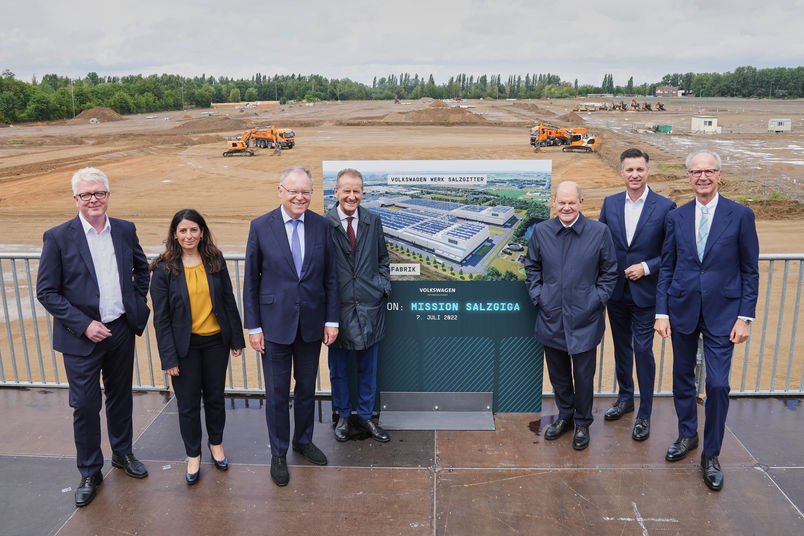
Volkswagen has started construction of its 40GWh battery cell gigafactory in Salzgitter, Germany, and the company plans to dedicate capacity to grid-scale energy storage in future.
The automative group announced the start at a ground breaking ceremony yesterday (7 July). The facility it set to open in 2025 and will produce battery cells for electric vehicles (EVs).
It is part of “battery offensive” by the company which has started with the creation of a new subsidiary, PowerCo, under which all of the company’s global battery business will go. Volkswagen said that PowerCo plans to produce products for the grid-scale energy storage sector in future.
A total of €20 billion (US$20.3 billion) will be invested in the battery business to generate annual sales in excess of €20 billion and to employ up to 20,000 people in Europe alone.
Try Premium for just $1
- Full premium access for the first month at only $1
- Converts to an annual rate after 30 days unless cancelled
- Cancel anytime during the trial period
Premium Benefits
- Expert industry analysis and interviews
- Digital access to PV Tech Power journal
- Exclusive event discounts
Or get the full Premium subscription right away
Or continue reading this article for free
Salzgitter, where PowerCo will be headquartered, is the first of several gigafactories Volkswagen has planned. The next one will be established in Valencia and sites are currently being identified for three further gigafactories in Europe. PowerCo is also exploring the possibility of further gigafactories in North America.
By 2030, the Volkswagen Group intends to operate six cell factories with a total volume of 240GWh throughout Europe.
German Chancellor Olaf Scholz commented on the start of construction: “Today is a good day for the automotive industry in Germany and Europe. Volkswagen is showing how the future of sustainable, climate-compatible mobility could look. Together, we are laying the foundation for shaping this future to a significant extent in Salzgitter.”
Each factory PowerCo launches will be operated entirely from renewable energy resources and will be designed for future closed-loop recycling, the company said.
It added that its prismatic unified cell allows the flexible use of different cell chemistries and will be used in up to 80% of all Volkswagen group EV models. The cell “harnesses synergy effects” and will reduce battery costs by up to 50%.
The Salzgitter gigafactory was initially launched through a JV with European gigafactory group Northvolt, called Northvolt Zwei, before Northvolt sold its share in the JV to Volkswagen in March 2021. But Volkswagen has invested in Northvolt and the JV share sale coincided with a US$14 billion order of battery cells from the former to the latter.
Energy-Storage.news recently reported that some gigafactory projects in Europe are quietly revising plans and may not open at all, according to an advisor. A handful of major gigafactory projects are set to start production of battery cells this year.