
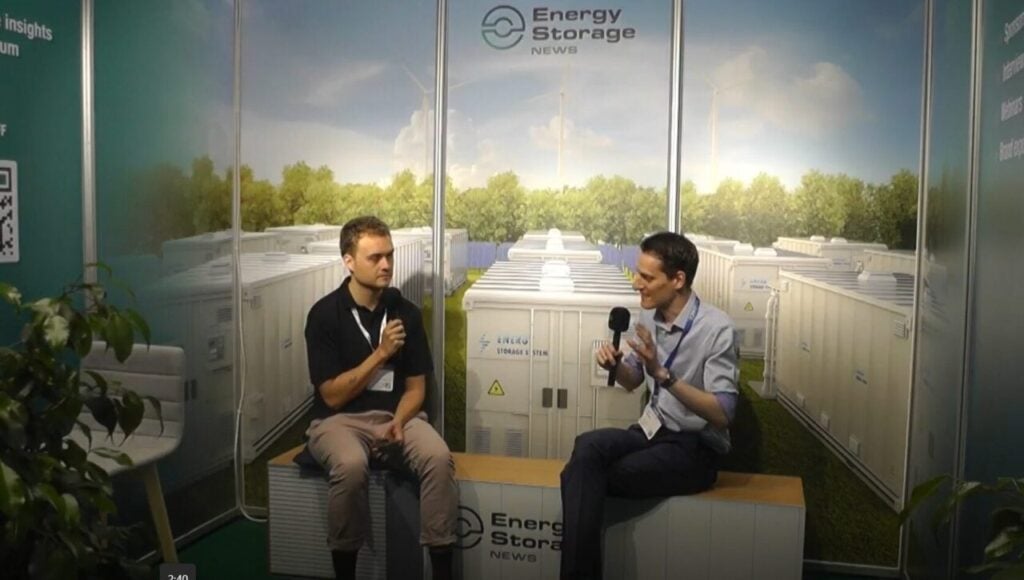
We sat down with Lars Stephan, EMEA director of marketing, policy and public affairs for system integrator Fluence, to discuss energy storage, data centres and cybersecurity at Intersolar last month.
The interview took place at the Smarter E Europe trade show in Munich, Germany, last month, colloquially known as Intersolar, which is actually the solar PV portion of the expo.
The battery and battery energy storage systems (BESS) industry meanwhile convened in the ees Europe section of the show, where Energy-Storage.news had a video interview booth: the full video interview and write-up of our discussion with Stephan is below.
BESS technology development
While Stephan focuses on market design, policy and regulation, we touched on battery energy storage system (BESS) technology developments too. Fluence unveiled a more energy-dense, 10MWh iteration of its Smartstack AC block solution at the event.
Try Premium for just $1
- Full premium access for the first month at only $1
- Converts to an annual rate after 30 days unless cancelled
- Cancel anytime during the trial period
Premium Benefits
- Expert industry analysis and interviews
- Digital access to PV Tech Power journal
- Exclusive event discounts
Or get the full Premium subscription right away
Or continue reading this article for free
New hardware, particularly around grid-forming and sodium-ion solutions, were a key theme over the three days. Sodium-ion especially was talk of the town, following big industry news in the space. Stephan said new technologies are always exciting, but that analytics and software are also hugely significant and less talked about.
“The cells are innovating, more energy density is driving cost declines and better performance, and that’s very exciting,” Stephan said. “And we can’t not talk about sodium-ion. We’re not quite there in terms of large-scale deployments in Europe or the US, but it’s definitely a technology that will bring benefits to more and more customers.”
“But also digital integration, especially analytics platforms, is a newer trend with external providers supporting many customers, and we’re integrating many of those. This AI-enabled digital element is a key trend we’re seeing.”
“It’s not headline-grabbing in the same way. If we’re ramping up availability from 98% to 99% because of this, or adding a year of lifetime to a project, that is not headline grabbing but on a project economics basis that still makes a huge difference.”
Data centres and BESS in Europe
Another big talking point at the event, as with any clean energy conference or trade show, was data centres. In Europe, the impact of this for BESS deployment has not yet been seen as much as in the US, where data centre-tied projects are increasingly becoming a big chunk of system integrator order books.
“The US is indeed a huge market and we haven’t yet seen that same kind of traction in Europe,” Stephan said. “But the political ambition to increase data centres in Europe is there and once we start to see projects emerging in Europe, they will have the same challenges as those in the US.”
Those challenges are around getting grid access in sufficient time and capacity, navigating limitations of flexible connection agreements (FCAs) and power quality in light of highly volatile load. In the US, those challenges are leading data centres to deploy vast quantities of generation (often not clean) and energy storage on-site.
“So the rationale and the use cases are similar and it’s actually an advantage that we have done a lot of this work in the US already, for example to for master supply agreements with hyperscalers, so we can now bring that into Europe as well, which is very exciting because we have the potential to leapfrog in Europe as the demand for data centre arises,” Stephan explained.
But, we then asked Stephan, what specifically does the opportunity look like for BESS regarding data centres in Europe? Is it co-location, PPAs or something else?
Stephan: “I think it’s different, depending on if it’s front-of-meter, behind-the-meter, are we talking about renewable firming or making renewables available to data centres, or is it more closer integration with data centres? Here at Intersolar we have had some exciting meetings around exactly that. Questions like where the battery should be located, how should it be integrated. And we’re getting to a stage where we have more standardised solutions.”
To that end, Fluence recently partnered with Siemens (one of its major shareholders) and computer chip manufacturer Nvidia to integrate its Smartstack into Siemens’ reference architecture purpose-built for Nvidia AI data centres.
“This blueprint is about having an integrated design where all those components come together. So now our data centre developer doesn’t have to pull in those elements themselves, but they can base their work on an existing blueprint where all the components are already integrated,” Stephan explained.
Cybersecurity
Cybersecurity, being a policy and regulatory discussion, is Stephan’s bread and butter. We asked him how the discussion around it, vis-à-vis energy, has developed in Europe in the last few years.
“It’s a very interesting topic because it hasn’t been emerging more and more and the last couple of years we have seen revisions and enactment of a number of cybersecurity laws,” he explained.
“And today we have a very comprehensive framework from the NIS 2 Directive, Network Code on Cybersecurity, the Cyber Resiliency Act, the Directive for Resilience of Critical Entities. These things address different players in the energy sector, some are for operators, some are more focused on manufacturers, some are for the grid operators.”
“So first of all, we see a stronger enforcement of those rules. The rules are becoming stricter at the European level, but then they’re more strictly enforced at the national level. And actually, I think what will drive enforcement even more is banks and insurance companies expecting certain standards which even go beyond what’s legally required.”
So the requirements have already been getting stronger, but something coming down the pipe could have even greater implications, particularly around supply chains.
“A very new development that we have seen now is the draft of the Cybersecurity Act published by the European Commission. And this introduces specific measures around the security of ICT supply chains, communication equipment, and it also refers to energy storage. So it’s really the question about what are the smart digital components and how do we need to secure those supply chains. And the focus here is on geopolitical risk,” Stephan explains.
“So we’re no longer talking about technical risk, but about non-technical risk, which is, frankly speaking, basically about equipment coming from China, which is perceived as creating a security risk to digital infrastructure deployed in Europe. So the Cybersecurity Act will probably have a huge impact or has the potential to have a large impact on the industry’s supply chain.”
On this topic, we also discussed the EU ban on funding solar or BESS projects with Chinese inverters, with both Stephan and Chinese firm REPT’s Andy Tang: see those comments in a separate article here, published during the event.
