VIDEO: Automation could reduce labour requirement of BESS manufacturing by c.85%, IPS says

LinkedIn
Twitter
Reddit
Facebook
Email

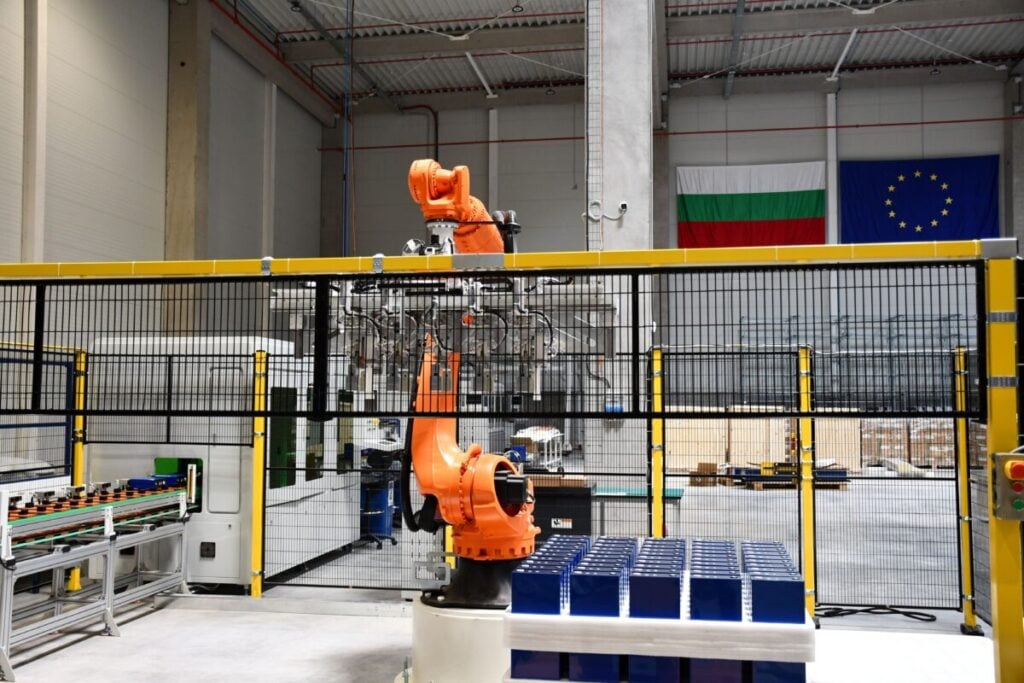
A new automated facility will need around 85% fewer employees per GWh of annual BESS manufacturing capacity, Bulgaria-based International Power Supply (IPS) said.

Talking to Energy-Storage.news in an interview for ESN Premium last week, IPS CEO Alexander Rangelov claimed the firm’s battery energy storage system (BESS) manufacturing in Bulgaria is the first ‘cell-to-system’ process in Europe.

Its capacity will reach 3GWh of capacity at the end of 2025 and then 4GWh once a new adjoining facility, which recently launched construction, is online. The firm is in the design phase of a larger, automated facility planned for 10GWh of capacity.

The current manufacturing processes requires around 30 employees per GWh of annual capacity. However, the planned 10GWh one will only require 45 employees in total, meaning an 85% reduction in the number of employees per GWh of capacity (from 30 to around 4.5).

This article requires Premium SubscriptionBasic (FREE) Subscription

Try Premium for just $1

  • Full premium access for the first month at only $1
  • Converts to an annual rate after 30 days unless cancelled
  • Cancel anytime during the trial period

Premium Benefits

  • Expert industry analysis and interviews
  • Digital access to PV Tech Power journal
  • Exclusive event discounts

Or get the full Premium subscription right away

Or continue reading this article for free

For the full 30-minute video interview and write-up, read our article on ESN Premium here.

Rangelov also explained that the majority of BESS assembly does not require a specialised workforce.

“The instructions and the workflow and the processes are designed in a simple way so that you you don’t need special mechanical engineers or electrical engineers,” he said.

“The only section or a zone where you need electrical engineering skills is for the final testing because it’s also related to to safety. Working with high voltages and high power always requires a higher grade of skills.”

15 September 2026
San Diego, USA
You can expect to meet and network with all the key industry players again in 2025 from major US asset owners, operators, RTOs and ISOs, optimizers, software and analytics providers, technical consultancies, O&M technology providers and more.
15 September 2026
Berlin, Germany
Launching September 2026 in Berlin, Energy Storage Summit Germany is a new standalone event dedicated to Germany’s energy storage market. Bringing together investors, developers, policymakers, TSOs, manufacturers and optimisation specialists, the Summit explores the regulatory shifts, revenue models, financing strategies and technology innovations shaping large-scale deployment. With Germany targeting 80% renewables by 2030, it offers a focused platform to connect with the decision-makers driving the Energiewende and the future of utility-scale storage.

Read Next

Premium
July 3, 2026
Energy-Storage.news Premium speaks with energy storage market experts Raafe Khan of Camelot Energy Group and Oliver Kerr of Aurora Energy Research on FERC’s recently issued show cause orders.
July 3, 2026
Australia’s 55 grid-scale BESS generated a combined AU$17.98 million in estimated gross energy and FCAS market revenue during June 2026.
July 3, 2026
AGL has delivered a solar and battery microgrid described as “one of the largest privately owned non-mining microgrids in Australia”.
July 2, 2026
US sodium-ion (Na-ion) battery startup Alsym Energy and consulting organisation for the mining and energy sectors, Erity, have signed a 9GWh strategic relationship agreement (SRA) for global mining use-cases.
July 2, 2026
Singapore-headquartered clean energy developer Vena Energy has raised AU$1.4 billion (US$970 million) in green finance to support 614MW of solar PV capacity and 1,141MWh of battery energy storage systems (BESS) in Australia.