In this US news roundup, CC Power signs an agreement with Hydrostor for 400MWh of its Willow Rock LDES project, PowerSecure builds microgrids in New Mexico, and ESS Inc acquires VoltStorage.
CC Power procures 400MWh of Hydrostor’s Willow Rock LDES project
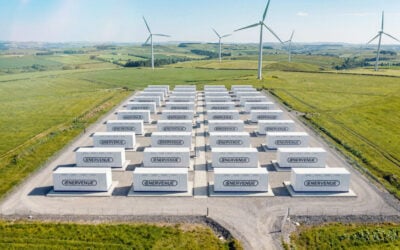
California Community Power (CC Power) and long-duration energy storage (LDES) developer-operator Hydrostor have signed an agreement for CC Power’s procurement of a 50MW/400MWh portion of Hydrostor’s Willow Rock LDES project in Kern County, California.
CC Power is a joint powers agency representing the interests of nine California community choice aggregators (CCAs).
Try Premium for just $1
- Full premium access for the first month at only $1
- Converts to an annual rate after 30 days unless cancelled
- Cancel anytime during the trial period
Premium Benefits
- Expert industry analysis and interviews
- Digital access to PV Tech Power journal
- Exclusive event discounts
Or get the full Premium subscription right away
Or continue reading this article for free
Willow Rock is an advanced compressed air energy storage (A-CAES) project. A-CAES technology operates by pressurising and directing air into a storage medium to load the system. During discharge, the stored air is released through a heating system to expand, driving a turbine generator.
A-CAES operates like traditional CAES but also captures heat from the compressor. This heat flows through heat exchangers and is stored in pressurised water. The water is kept in a reservoir and released into a cavern during discharge to displace air, a method known as hydrostatic compensation.
Hydrostor first signed a 200MW/1,600MWh power purchase agreement (PPA) for Willow Rock in 2022, with California CCA Central Coast Community Energy (3CE).
CC Power states that Willow Rock will assist its members in fulfilling the LDES requirements outlined in the California Public Utilities Commission’s (CPUC’s) Mid-Term Reliability procurement directives and will support their obligations for resource adequacy compliance.
Each participating member’s governing board will adhere to their local review and approval procedures for the contract and related agreements concerning the Willow Rock project.
In 2021, CPUC commissioners proposed and issued directives to address “mid-term reliability,” defined as ensuring sufficient electricity supply and reliability for the state from 2023 to 2026. Many stakeholders, including Hydrostor, provided comments and input during the process.
The agreement enables Hydrostor to incorporate Baker Hughes’ technology into its main design for its A-CAES solution. This includes orders for up to 1.4GW of Baker Hughes equipment for Hydrostor’s flagship projects, including compression, expander, motor, and generator technology.
PowerSecure to develop and construct microgrids in New Mexico
PowerSecure, a distributed infrastructure subsidiary of Southern Company, one of the US’s biggest utilities, is collaborating with New Mexico utility Kit Carson Electric Cooperative (KCEC) to develop and construct microgrid projects in Northern New Mexico.
The collaboration includes three microgrid projects incorporating BESS. The microgrid facilities will be constructed at Taos Ski Valley, El Rito West, and Penasco.
According to PowerSecure, the projects are designed to strengthen KCEC’s community readiness and improve resilience against the impacts of catastrophic events.
The company also notes that Northern New Mexico faces threats such as wildfires and extreme weather conditions.
Microgrids are autonomous energy systems capable of functioning independently or linking to the main grid. This flexibility allows a community or critical facilities like hospitals or emergency shelters to disconnect from the grid during outages.
The systems are frequently acknowledged for their resilience and capacity to connect with other renewable energy initiatives.
In 2025, Pacific Gas and Electric (PG&E) of California announced intentions to allocate up to US$43 million in grants to fund nine microgrid projects led by communities.
PowerSecure asserts that its microgrid infrastructure will enable critical loads to be sustained for longer periods during severe events, providing a dependable solution for local power requirements.
Construction is ongoing. The partnership is expected to increase KCEC’s energy capacity by adding 7.5MW/38.25MWh of BESS, allowing for public safety power shutoffs (PSPS) while preserving essential local power loads and services.
In January 2025, KCEC secured a US$231 million grant from the US Department of Agriculture (USDA) to develop hydrogen and solar facilities with LDES. This funding was part of the USDA’s broader US$6 billion investment through the Empowering Rural America (New ERA) and Powering Affordable Clean Energy (PACE) programmes, as was reported by our colleagues at PV-Tech.
ESS Tech Inc acquires VoltStorage GmbH
Iron flow battery company ESS Tech Inc (ESS Inc) has acquired the intellectual property and assets of VoltStorage GmbH, an iron-salt battery developer.
This acquisition expands ESS’s intellectual property by adding Germany-headquartered VoltStorage’s patents and technical development assets. Additionally, ESS gains access to VoltStorage GmbH personnel experienced in electrochemistry, materials science, and technology development.
According to ESS, the proposed solution will allow utilities, renewable developers, and industrial customers to discharge energy for longer periods. This aims to enhance grid reliability and maximise the value of intermittent renewable energy, providing the “industry’s lowest Levelised Cost of Energy (LCOE),” the company claimed.
Recently, the LDES leaderboard by research and consultancy firm Sightline Climate placed ESS Inc in the top five non-lithium companies.
In August 2025, the company expressed serious concerns about its prospects for surviving another year.
The company reported Q2 2025 revenue of US$2.4 million, marking a 578% increase year-on-year from just US$300,000 in Q2 2024 and a 294% rise from US$600,000 in Q1 of 2025.
Despite reducing GAAP cost of revenues by 15% since 2024 and GAAP operating expenses by 35% quarter-over-quarter, Q2 figures show US$7.5 million in costs of revenues and US$6.5 million in operating expenses. Still, ESS Inc posted a US$11.6 million loss from operations, a US$-7.8 million adjusted EBITDA, and a net loss of US$0.90 per share.
The company announced a shift to a new product line, Energy Base, designed to offer high-capacity LDES ranging from 12 to 14 hours. This product targets clients such as data centers and large-scale renewable energy operators. Simultaneously, the company is discontinuing its two legacy products, Energy Centre and Energy Warehouse, which were intended for applications requiring up to 12 hours of storage.
The Energy Storage Summit USA will be held from 24-25 March 2026, in Dallas, TX. It features keynote speeches and panel discussions on topics like FEOC challenges, power demand forecasting, and managing the BESS supply chain. ESN Premium subscribers can get an exclusive discount on ticket prices. For complete information, visit the Energy Storage Summit USA website.