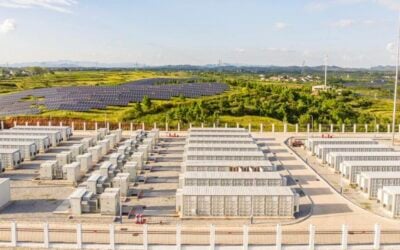
Developer Avantus has closed a financing package of over US$300 million for the 100MWac/130MWdc solar, 400MWh BESS Kitt Solar and Energy Storage Project in Pinal County, Arizona, US.
The financing package was closed with financial institutions Banco Bilbao Vizcaya Argentaria (BBVA) and Canadian Imperial Bank of Commerce, New York Branch (CIBC).
It includes construction funding, a tax equity bridge loan, and letters of credit. Currently under construction, Avantus claimed that Kitt is expected to create up to 500 construction jobs and reach commercial operation by the end of 2026.
The project has a signed power purchase agreement (PPA) with utility Arizona Public Service (APS). Avantus noted that the 400MWh battery energy storage system (BESS) will play an important role in grid resilience, storing solar energy during the day and dispatching it during evening peak demand hours and major weather events, as Arizona prepares for growing energy demand and hotter summers.
Try Premium for just $1
- Full premium access for the first month at only $1
- Converts to an annual rate after 30 days unless cancelled
- Cancel anytime during the trial period
Premium Benefits
- Expert industry analysis and interviews
- Digital access to PV Tech Power journal
- Exclusive event discounts
Or get the full Premium subscription right away
Or continue reading this article for free
The PPA for the solar portion of the project was signed in December 2024. During that same year, Arizona had a record streak of 113 consecutive days with temperatures above 100 degrees Fahrenheit (37.7 degrees Celsius), which also broke electricity demand records.
Once operational, Kitt is projected to produce more than US$25 million in local tax revenues, supporting services like schools, public safety, and infrastructure over its lifetime.
RES is providing the engineering, procurement and construction (EPC) services for the project, with energy storage technology provider Fluence providing its Gridstack Pro BESS solution.
Fluence unveiled the gridstack Pro in 2023. At that time, the company said the system offers customers enhanced performance and lower operating costs through improved state of charge (SOC) accuracy, string-level control, and pre-integrated asset performance management intelligence.
In October 2025, Fluence and IPP Torch Clean Energy announced the Winchester project, a solar-plus-storage facility being developed by Torch Clean Energy in Cochise County, Arizona, which will utilise Fluence’s Gridstak Pro 5000 solution.
In July 2025, Avantus secured over US$500 million in financing for its 200MW/500MWh Aratina 1 BESS project in Kern County, California. The package covered construction funding, a tax equity bridge loan, and letters of credit. Avantus stated that construction was underway, and the project is anticipated to be operational this year.
Currently, the company claims to have approximately 24GW of solar and 75GWh of energy storage under development across the Western US.
The Energy Storage Summit USA 2026 will be held from 24-25 March 2026, in Dallas, TX. It features keynote speeches and panel discussions on topics like FEOC challenges, power demand forecasting, and managing the BESS supply chain. ESN Premium subscribers can get an exclusive discount on ticket prices. For complete information, visit the Energy Storage Summit USA website.