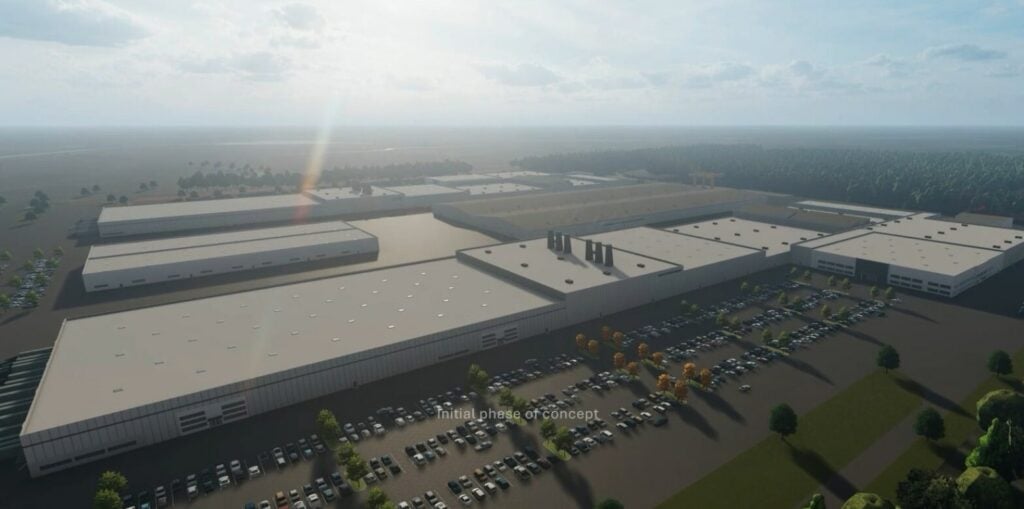
The US now has a larger pipeline of lithium-ion manufacturing gigafactory projects than Europe, according to Clean Energy Associates (CEA) and Benchmark Mineral Intelligence.
The two economic powerhouses are vying to challenge China’s dominance of the lithium-ion battery production market, where it currently holds a 79% share according to CEA.
Until early last year, Europe had a much more significant pipeline of manufacturing plants in progress, but the Inflation Reduction Act (IRA) changed everything and the US looks to have eclipsed Europe’s planned GWh of annual production for 2030. (Read all of our coverage of battery manufacturing and gigafactory projects here.)
According to CEA’s Energy Storage System (ESS) Supplier Market Intelligence Program (SMIP), “…North America’s planned capacity is forecasted to outpace Europe’s due to the IRA”, it said.
Try Premium for just $1
- Full premium access for the first month at only $1
- Converts to an annual rate after 30 days unless cancelled
- Cancel anytime during the trial period
Premium Benefits
- Expert industry analysis and interviews
- Digital access to PV Tech Power journal
- Exclusive event discounts
Or get the full Premium subscription right away
Or continue reading this article for free
Research firm Benchmark Mineral Intelligence confirmed to Energy-Storage.news that its data also shows the US – alone, excluding Canada – overtaking Europe for planned production capacity.
The firm’s data as of 31 May has the US production capacity at 1185.6GWh in 2030, ahead of Europe’s 1177.2GWh. For all of North America, the figure is 1260.6GWh annual production capacity in 2030.
Both firm’s figures only include lithium-ion battery chemistry, so would exclude gigafactory projects from iron-air battery firm Form Energy and metal-hydrogen battery company Enervenue.
The milestone for the US has been coming, with studies recently showing significant risk of delays or cancellation to swathes of Europe’s pipeline and Energy-Storage.news hearing from gigafactory project designers that some firms have been pivoting across the Atlantic to capture the IRA’s benefits.
CEA noted that Korean and Japanese-based lithium-ion battery cell suppliers account for most of the planned manufacturing capacity to 2025 outside of China.
It also forecasts that the market share of Tier 1 suppliers will fall in the years to 2030 as more new Tier 2 and 3 companies enter the market.