United Airlines has become an investor in Natron Energy, a US-based manufacturer of sodium-ion chemistry batteries, as the world’s first sodium-ion gigafactory is opened in China.
Sodium-ion is considered a potential alternative or complementary technology to lithium-ion, particularly for applications that don’t require as high energy density, which could include shorter range electric vehicles (EVs) and stationary battery energy storage systems (BESS).
With the world’s biggest lithium battery maker CATL among those putting time and money into developing and commercialising the technology, manufacturers are in a race to see who can overcome the limitations of sodium-ion and capture market share.
Research analyst Max Reid at Wood Mackenzie Power & Renewables recently told this site that it already expects between 5GWh and 10GWh of sodium-ion battery production capacity to come online by 2025.
Try Premium for just $1
- Full premium access for the first month at only $1
- Converts to an annual rate after 30 days unless cancelled
- Cancel anytime during the trial period
Premium Benefits
- Expert industry analysis and interviews
- Digital access to PV Tech Power journal
- Exclusive event discounts
Or get the full Premium subscription right away
Or continue reading this article for free
Materials for making sodium-ion batteries appear to be abundant and non-flammable and operate well in colder temperatures. However, the problem to date has been that sodium-ion batteries can’t be cycled as aggressively or frequently as lithium-ion, which academics and industry have been looking to solve.
United Airlines (UA) said last week that it has made a strategic equity investment in Natron Energy, with a view to using the battery technologies to electrify its ground operations. UA has more than 12,000 pieces of motorised ground equipment, including tractors and gate operations, and only about a third of that fleet today is electrified.
California-based Natron claims to be the only company in the market shipping UL-listed sodium-ion battery products. The company said it has overcome the problem of cycling with a “breakthrough” electrode material that allows full charge and discharge in minutes for many thousands of cycles.
In October, manufacturing firm Arxada signed a long-term supply deal with Natron for battery grade Prussian blue dye, one of the key ingredients of its electrodes. Natron aims to open a manufacturing facility in 2023 with up to 600MW annual production capacity in Michigan.
The airline made its investment through United Airlines Ventures, which was set up to invest in innovative and emissions-reducing technology companies. While its other investments to date have been focused on efforts to power low-carbon aviation, the equity investment in Natron is its first to identify opportunities to electrify and decarbonise ground operations.
“Out of the gate, we primarily focused on technology designed to help reduce carbon emissions from our airplanes,” United Airlines Ventures president Michael Leskinen said.
“Natron’s cutting-edge sodium-ion batteries presented an ideal opportunity to both potentially expand our sustainability investment portfolio to our ground operations, and to help make our airport operations more resilient.”
Natron Energy CEO Colin Wessels said the batteries could “provide the high power over short distances that ground service equipment needs,” while being non-flammable and safe to deploy for ground ops.
The undisclosed investment would be used towards expanding Natron’s Michigan facilities ahead of the start of mass production, Natron said.
Gigawatt-hour sodium-ion production line opens in China
Chinese state-owned power company China Three Gorges Corporation said that in late November, the first gigawatt-hour sodium-ion production line in the world opened for business.
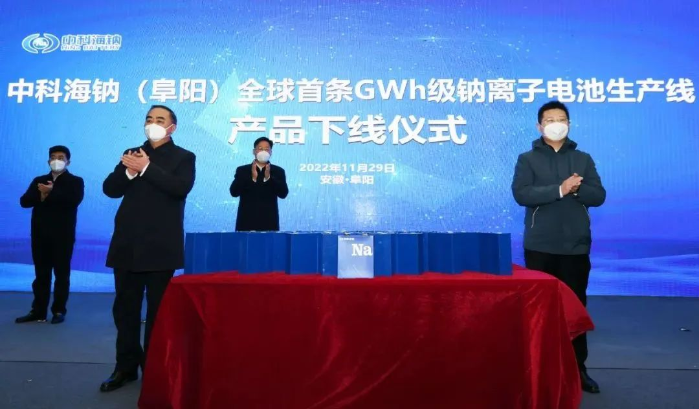
A launch ceremony was held in Fuyang City in China’s Anhui Province on 29 November for the factory, built in cooperation between the Three Gorges Corporation’s Three Gorges Energy and Three Gorges Capital, together with local authorities and battery manufacturer HiNa Battery Technology.
Three Gorges called the opening of the first ‘gigafactory’ a milestone in the industrial development of sodium-ion batteries.
It came together in a short timeframe, from agreements to build the facility being signed a year ago in December 2021.
Elsewhere, AMTE, a UK-based manufacturer, has claimed that it could have commercial sodium-ion batteries rolling off production lines to customers within months, while in India, a subsidiary of major holding company Reliance Industries has acquired another UK-based sodium-ion tech firm, Faradion.