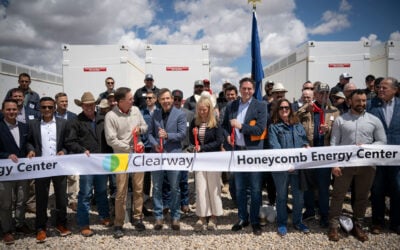
Angus MacDonald (left of stage), and Thierry Lepercq (far right), in the panel discussion at the Solar Finance and Investment Conference 2016 in London. Image: David Pratt / Solar Media.
The UK solar industry is moving towards a market led by power purchase agreements (PPAs) and wider use of storage technology in the wake of subsidy cuts.
That was one of the conclusions of a panel discussion held yesterday at the Solar Finance and Investment event in London, hosted by Energy Storage News’ publisher Solar Media, which saw figures from the UK and beyond discuss the importance of adopting new business models to survive in a post subsidy market.
Among them was Angus MacDonald, chief executive of British Solar Renewables (BSR), who claimed that due to the rising costs of energy, corporate firms were becoming increasingly concerned about their supplies.
“They want security of supply, they are nervous about supply in the UK. They think the cost of energy is going to go up, they are also very aware of the fact that grid transmission costs are rising,” he said.
Try Premium for just $1
- Full premium access for the first month at only $1
- Converts to an annual rate after 30 days unless cancelled
- Cancel anytime during the trial period
Premium Benefits
- Expert industry analysis and interviews
- Digital access to PV Tech Power journal
- Exclusive event discounts
Or get the full Premium subscription right away
Or continue reading this article for free
“If you’re doing a direct behind the meter solution, you’re cutting out all those costs which they can forecast are going up. It’s these key points that are really driving them to want to have their own energy source.”
Due the expectation of increasing energy costs to UK businesses, the panel believed that firms will be seeking to make agreements to provide them with energy sources at a fixed rate, avoiding fluctuations in national energy prices. As Otto von Troschke, chief information officer at SUSI Capital Partners, said: “We’re more moving towards PPAs.”
This change in the market is likely to lead to wider take-up of storage technologies as companies seek to lock in their energy supply – from the generation plant to on-site use – as it was widely agreed that this would lead to reduced costs.
MacDonald continued: “We need to be focusing on at the moment the only way we see making money in the UK which is combining the expertise we have in solar with storage and doing a direct supply of energy to the customers. Ideally you’re focusing on large commercial customers who have locations that allow us to build solar parks with storage nearby so we can go straight in. Its then down to PPA and this is the crunch point for us because that’s what drives the cost of capital for the investors.
“Our focus is to drive down cost, get the right PPA, supply the energy direct and get rid of all the overheads that come out of having to take it through the grid.”
However, there were some concerns that behind the meter solutions may not provide the full savings companies are expecting unless taken to its fullest extent.
Behind the meter solar can’t ‘bypass grid rules’
Thierry Lepercq, chief executive of SolaireDirect, joined the panel after delivering the day’s keynote speech and said: “Behind the meter is an interesting subject; we think it’s an extremely risky business. If you’re building something and think you avoid grid costs or taxes etc. because you’re behind the meter, a regulator will still come along. Even if you’re just on your site, you’re still connected to the grid. You’re impacting voltage, you’re impacting frequency so you need to be regulated.
“We think ultimately if you’re fully away from the grid, cut it 100% and deal with it in the dark days of the European winter, and good luck. Or if you need the grid, even for just one day, you need to play by the rules and this idea that solar can bypass these rules is something we think is going no-where. You’re part of the system so you have to live with it.”
Despite these concerns, there is also a belief that the wider take-up of PPAs and storage will affect energy prices, making the latter more affordable in the short-term.
“Storage is going to be such an important part of the future because you’re storing what you produce and therefore you’re getting a much more level cost of energy throughout the day. I think ultimately we’ll get to the stage where energy costs are about the same throughout the day,” MacDonald added.
This potential is likely to see storage develop far quicker than the UK solar industry did with government support. The discussion’s chair, Duncan Byatt of Alexia Capital, claimed: “It’s an area of regulation that is going to need rapid thought. These things will be installed before the regulatory framework is sorted out.”
Speaking to Energy Storage News on Monday, Byatt said: “The costs of storage will come down, that’s very clearly definitely going to happen. As it does, it will become more interesting in the UK. It’s not that the UK is ex-growth and uninterested full stop; it will grow and it will happen.”
This picture of a new industry connected to solar growing on its own without the need for government support is a welcome view as the industry moves from the post-subsidy era.
“We’ve had the governments supporting us and allowing us to build projects with enough subsidy to make a decent margin out of it. We have to wean ourselves off that scenario,” MacDonald added.
Energy Storage News’ publisher, Solar Media, will be hosting the Energy Storage Summit at Twickenham Rugby Stadium, London on 28 April.