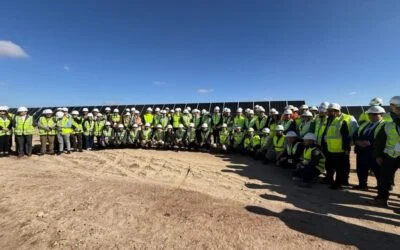
The FiT was not considered an appropriate mechanism to incentivise energy storage. Pictured is minister Amber Rudd at utility-scale storage demonstration project, the Big Battery in southern England. Image: Younicos.
A document setting out new policy directions on solar support says the UK government has recognised the potential of energy storage but has decided the feed-in tariff would not be an appropriate mechanism to incentivise uptake.
A long-awaited consultation on the UK’s support schemes for solar was officially released today, with PV Tech Storage’s sister site Solar Power Portal reporting on the announcement and reactions from in and around the industry on an ongoing basis from early this morning.
The solar FiT was expected to be cut very heavily but in the event initial reaction appears to be that a domestic tariff rate of 4.39p/kWh for systems up to 10kW ranging up to 0.87p/kWh for large-scale. Cuts to domestic of around 87% had been expected but instead the figure was closer to around 64%.
Initial reactions appeared to display a measure of relief from the UK industry that cuts were not as bad as expected, with the government modelling the revised support levels to aim to allow a return on investment of around 4.8%. However, other factors including a recent ruling to remove sales tax exempt status from PV products mean the cuts are still likely to impact deployment.
Try Premium for just $1
- Full premium access for the first month at only $1
- Converts to an annual rate after 30 days unless cancelled
- Cancel anytime during the trial period
Premium Benefits
- Expert industry analysis and interviews
- Digital access to PV Tech Power journal
- Exclusive event discounts
Or get the full Premium subscription right away
Or continue reading this article for free
The UK government has repeatedly said it has been looking into energy storage for some time, including the recent formation of a dedicated office in the Department of Energy and Climate Change (DECC) to look at the issues. However, while the government recognised the ability of storage to aid both integration of renewables and benefit the electricity network, it would not introduce a FiT to stimulate deployment.
“Government is supportive of cost effective energy storage at all scales and using all technologies,” the consultation said.
“Government recognises the potential system benefits of storage deployed in combination with intermittent renewables. However, it does not consider that FITs is the appropriate mechanism for providing support for energy storage. DECC is currently engaging closely with [regulator] Ofgem and stakeholders to identify barriers to the deployment of storage and are considering potential remedial actions.”
Although it will not be included in the FiT, the document stated that the government “plans to consult on this work in spring 2016”, which some have interpreted to mean that interim measures could be enacted.
Similarly, PV Tech Storage has learned that National Grid and other stakeholders in the network including the UK’s distribution network operators (DNOs) are working on removing regulatory barriers to grid-scale storage. However, it could be a lengthy process to revise the necessary codes and to determine an asset class for storage, and according to some sources, there could also be interim measures implemented to stimulate activity in areas including a still-in-development market for frequency regulation of the grid.
Subsidies for energy storage have not been widely expected in the UK solar or storage industries, with the government unlikely to favour putting any further burden on the public purse. Furthermore, as with Germany and other territories, the energy storage industry has confidently stated that it needs market redesign to fairly recognise the value of storage and the value it can add to PV and other renewables, rather than ‘artificially’ stimulating growth through handouts and subsidies.