Tonga’s first utility-scale battery energy storage system (BESS) project was officially opened today at an event attended by the South Pacific Kingdom’s prime minister.
Prime Minister Siaosio Sovaleni, known also by the chiefly title he holds, Honourable Huákavameiliku, was the Guest of Honour as the two systems, delivered with support from groups including the Asian Development Bank (ADB) and the UN Green Climate Fund, were unveiled.
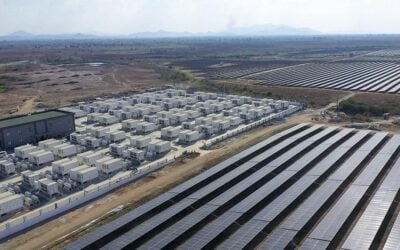
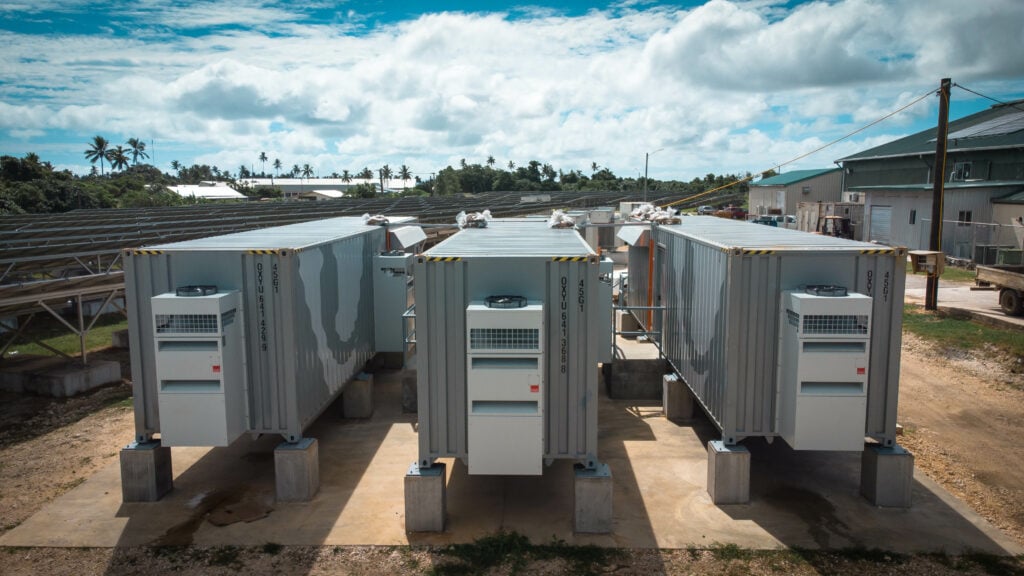
The systems were commissioned in May this year, as reported by Energy-Storage.news at the time. Located on Tonga’s biggest island, Tongatapu, there is a short-duration system of 9.3MW/5.3MWh (7.2MW/3.8MWh usable) designed for grid stability applications, and a 3.3-hour duration system of 7.2MW/23.9MWh (6MW/20.88MWh usable) for renewable load shift applications.
They were built as part of the multilaterally funded Tonga Renewable Energy Project (TREP). In addition to the BESS, renewable power projects and grid upgrades and energy management technologies will be deployed at various locations, including some of the country’s outer islands.
Try Premium for just $1
- Full premium access for the first month at only $1
- Converts to an annual rate after 30 days unless cancelled
- Cancel anytime during the trial period
Premium Benefits
- Expert industry analysis and interviews
- Digital access to PV Tech Power journal
- Exclusive event discounts
Or get the full Premium subscription right away
Or continue reading this article for free
These include two hybrid solar-plus-storage projects featuring batteries, which are aimed for completion in November this year on two outer islands, Vavaú and Éua.
The battery systems connect to the grid of Tonga Power, Tonga’s sole electric utility, which announced the inauguration event today via a sponsored post in local news outlet Matangi Tonga Online.
Installation and commissioning work was carried out by contractor Akuo, which supplied containerised BESS solutions. It all took place during the two-year pandemic enforced closure of Tonga’s borders and Akuo Asia-Pacific CEO Jean Ballandras thanked fellow stakeholders for their cooperation in making it happen.
In May, it was noted that the addition of the two systems immediately enabled Tonga to double its use of renewable energy together with the completion of a 6MW solar PV power plant, taking it to 20%.
The country has recently brought forward its target for renewables adoption, from a previously set 70% goal by 2030, to 70% by the end of 2025. The target is part of its National Determined Contribution (NDA) climate action plan.
The BESS projects cost around US$16.7 million of investment, with the wider TREP project costing just over US$50 million. It is jointly funded by the Asian Development Bank, UN Green Climate Fund and the Australian government. Tonga Power said it was assisted in implementing the project by its own national government.