
Liam Critchley examines a selection of third-party providers and their technologies for preventing thermal runaway events in battery storage systems.
Safety is, and should be, the biggest priority of any industry. This is no different for the technology providers, suppliers, contractors, developers, investors and other stakeholders in grid-scale battery storage projects.
Today, battery energy storage systems (BESS) are safer than ever. Statistical analysis has shown that the incidences of system failures are becoming rarer relative to the huge growth in the installed base of assets worldwide.
This success is due to technological progress and industry best practice, combined with the evolution of codes and standards and a rise in stakeholder education.
Try Premium for just $1
- Full premium access for the first month at only $1
- Converts to an annual rate after 30 days unless cancelled
- Cancel anytime during the trial period
Premium Benefits
- Expert industry analysis and interviews
- Digital access to PV Tech Power journal
- Exclusive event discounts
Or get the full Premium subscription right away
Or continue reading this article for free
For example, the 300MW system at Moss Landing in California that caught fire and was destroyed is now considered a legacy project: it used the more volatile nickel manganese cobalt (NMC) lithium-ion (Li-ion) battery chemistry, and it was housed in a repurposed existing building that allowed fire to spread between battery containers.
Today, nearly all grid-scale Li-ion systems use lithium iron phosphate (LFP) cells, which have a much higher tolerance to thermal and mechanical variations than NMC cells. BESS enclosures are also placed outdoors and designed so that even if a fire were to start inside a unit, the heat and flames do not propagate to neighbouring containers or other equipment.
However, as with any energy technology, fire risk cannot be eliminated entirely. It must therefore be mitigated and managed.
Indeed, codes and standards such as NFPA 855 and UL9540A now mandate large-scale fire testing (LSFT), in which a BESS unit is set on fire with all fire suppression systems disabled and allowed to burn out. Other BESS containers will typically be placed adjacent to the ignited unit at minimum clearance distances, giving a clear picture of what might happen in a worst-case scenario incident.
In other words, if a thermal incident cannot be prevented entirely, the strategy is that, if it occurs, it does not cause catastrophic damage to an entire system or project, but instead can be contained to the affected enclosure.
Thermal runaway, which is the primary cause of fires originating in lithium-ion battery cells, can be triggered by overcharging, internal short circuits, mechanical stress, malfunctioning components, errors in the battery management system (BMS) and high environmental temperatures.
While the above strategies call for mitigation and containment in a worst-case scenario, many BESS designs include layers of protection to detect and prevent thermal runaway. There may also be settings, such as more densely populated areas or commercial buildings and facilities, where even allowing one unit to burn out is an outcome that the technology provider or end-customer must avoid.
Furthermore, some older projects may not have been equipped with the same level of initial protection as newer systems, and asset owners or authorities having jurisdiction (AHJs) may want to enhance their safety capabilities.
Some manufacturers will develop those technologies in-house, but there are also a number of third-party specialist technology providers that offer solutions, some more novel than others, for preventing or dealing with thermal runaway at cell, module or system level.
This article details a selection of those third-party solutions, with a caveat that we will focus here on hardware solutions, rather than advanced detection using software such as data analytics, which rely on telemetry and artificial intelligence (AI) algorithms to measure, calculate and estimate metrics around battery state of health (SoH) and other variables to create a picture of safety for asset operators.
Introduction by Andy Colthorpe.
Early detection and prevention
Before a thermal runaway fire breaks out, pre-emptively identifying the warning signs before issues arise is critical for early intervention and to ensure the fire doesn’t get out of control.
Off-gas detection
Off-gas detection uses highly sensitive gas sensors to identify thermal runaway before smoke or fire occurs. These sensors measure battery electrolyte vapours, as well as hydrogen, carbon monoxide, and flammable hydrocarbons inside the battery to detect when thermal runaway is about to occur and allows a response to be mounted before critical failure.
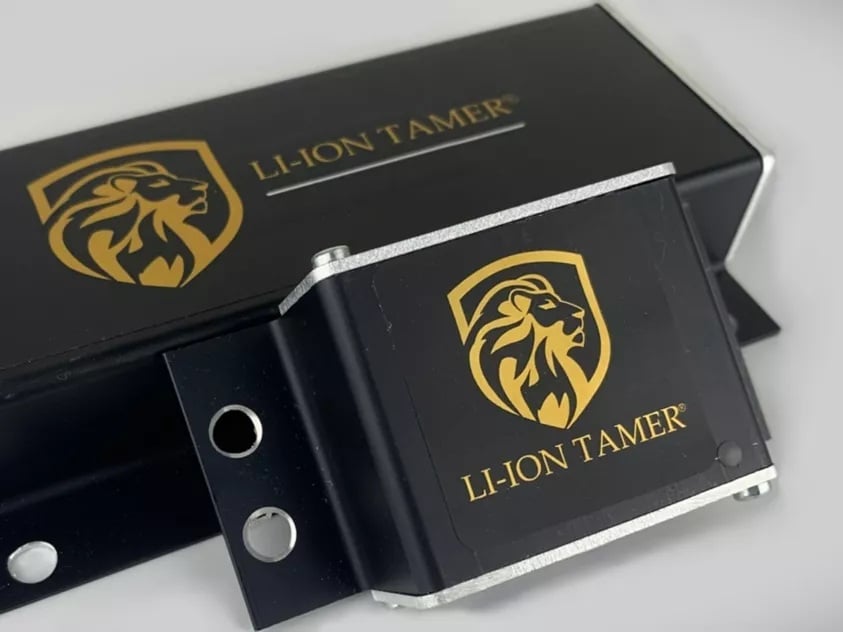
Xtralis and Honeywell have developed the Li-ion Tamer sensor (which is now in its third generation) that detects volatile organic compounds (VOCs) released during off-gassing events in Li-ion batteries used in BESS.
Off-gassing occurs due to electrical, thermal or mechanical abuse and results in the electrolyte vaporising into a gas. The formation of gas inside the cell significantly increases its internal pressure. The increased pressure and temperature cause the separator to melt, and the solvent ignites, causing a fire. As the gases are released, they get vented from the batteries into the battery racks, and this is how they are detected.
The Li-ion Tamer off-gas detection system comprises five main components: sensors, a hub, power switch, network switch, and a controller. Each sensing node contains an off-gas sensor, a temperature sensor, and a humidity sensor, which are coupled to advanced algorithms for detecting VOCs and are cell-agnostic, i.e., compatible with Li-ion chemistries and form factors. These nodes are installed at the battery racks, downstream of the convective airstreams, and are connected to the controller via hubs and switches, which in turn connect to the BMS.
According to the technical specifications, the Li-ion Tamer has up to 100 sensors per controller and a lifetime of at least 10 years. The addition of temperature and humidity sensors allows the sensors to measure temperatures between -40 to 125°C with a measurement accuracy of ± 0.4°C between 5-60°C, and non-condensing relative humidity (RH) between 0-100% RH with a measurement accuracy of ± 2.0% RH between 20 to 80% RH.
Dielectric liquid immersion
Aside from detecting when a thermal runaway event might occur, another preventative measure is to fully immerse the battery cells in a non-conductive (dielectric) fluid that can dissipate heat. This is a direct approach that tries to address the root cause of thermal runaway―large amounts of heat at the cell level―and the dielectric nature of the fluid prevents electrical shorts. This is a more advanced and efficient type of cooling than air-cooling cells.
EticaAG has developed a dielectric liquid coolant that can prevent overheating in Li-ion BESS. The coolant both absorbs heat and prevents electrical conduction. When cells are immersed in the fluid, direct contact between the fluid and the cells eliminates the risk of hotspots forming and improves heat distribution. Both these properties prevent the heat from spreading to adjacent cells and stop the progression of thermal runaway through the battery racks and modules inside BESS containers.
The immersion cooling system from EticaAG is also a cooling circulation system. The coolant liquid absorbs heat from the battery cells, then flows to a reservoir to remove heat from strained areas in the BESS, where it is dissipated. The coolant is pumped around to circulate the liquid, preventing thermal gradients that can lower the effectiveness of the cooling fluid. The coolant circulation is controlled by the BMS and prevents the heat from travelling to adjacent cells, and stops larger thermal runaway events from manifesting.
EticaAG claims that its immersion cooling circulation system is usable across different BESS use cases and sizes, including BESS used as data centre backup, utility-scale renewable energy storage, and EV charging station storage.
Active fire suppression
Sometimes it’s not possible to stop thermal runaway, so when a fire does occur, robust active fire suppression methods must be implemented to contain it and mitigate potential risks.
Aerosol fire suppression
StatX has developed an aerosol fire suppression system that released fine particulate matter to interrupt the combustion of the cell. The condensed aerosol units produced by StatX act as a total-flooding system and are an extinguishing agent for Class A, Class B, and Class C fires. They are small self-contained suppression units that don’t use any external piping, so one of the main benefits of this particular system is that it can be retrofitted into existing BESS installations.
The fire suppression units can be activated in two different ways. On one hand, they can be directly connected to smoke detectors, and as soon as the detector detects smoke, a signal is sent to the unit, and the aerosol is discharged. The second way is that the aerosol suppression unit can be built with an integrated thermal detection and activation system (mounted on top) that discharges the aerosol when the heat recorded by the sensor exceeds a certain threshold.
In either case, when the system is activated, an ultra-fine aerosol suspension of highly ionised potassium particles is released to suppress the fire. The thermal runaway combustion process generates free radicals that act as energetic drivers, fuelling the fire and helping it spread. The aerosol particles bind with the free radicals, negating their fire-fuelling effect in the fire’s chemical chain reaction, suppressing the fire in the process. The particles in StatX’s suppression systems are between 1-2 microns and remain airborne for long time periods to prevent the fire from re-igniting after the initial suppression phase.
While the suppression systems can be used in BESS to protect against thermal runaway, they can also be installed in other energy infrastructure that is often connected to BESS. This includes being installed in medium-voltage transformers (MVT) rooms to protect transformer equipment and EV charging stations, where EV fires can rapidly get out of control if left unchecked.
Inert gas systems
Another suppression approach that works similarly to aerosol suppression is to use inert gases, such as nitrogen and argon, which reduce the concentration of oxygen near the fire, actively suppressing it (as any fire needs oxygen as a fuel). Siemens has developed a nitrogen-based active suppression system, Sinorix NXN N2, for Li-ion BESS.
The system has been designed to leave behind no residue (which would require cleaning), and contain only a few components, making them simple suppression systems. One advantage of gas-based suppression over other active suppression systems is that, once discharged, the system can be refilled by changing the cylinder that holds the gas. These suppression systems can also be integrated with early-warning smoke detectors that detect smoke directly and eject gas if smoke is detected.
Cell-level thermal mitigation
While a lot of the thermal runaway mitigation systems―be it preventative or suppression―are installed within the BESS units, the other way to reduce thermal runaway in BESS is by factoring in built-in suppression materials at the cell level.
Integrating thermally conductive materials by design at the cell and pack level can help dissipate heat at the most fundamental level and act as another layer of safety on top of the rack-, module-, and container-level prevention systems.
Tecman has developed different thermal runaway cell barriers at the cell/pack level that dissipate heat, called framed anti-thermal propagation (ATP) pads and encapsulated ATP pads. Cell barriers need to prevent thermal energy transfer between cells during thermal runaway to prevent its propagation. There also needs to be some space for these cell interface barriers to contract and expand, and the barriers need to be mechanically robust.
Tecman has developed these ATP pads using manufacturing methods that can be integrated/retrofitted into existing battery production lines and can be used with a range of battery cell sizes.
The framed ATP pads are a cell barrier with a physical built-in spacer layer that enables enough space between cells for expansion. The ATP pad contains thermally insulating materials that prevent thermal propagation during a thermal runaway event and provide resistance to the cell wall during thermal expansion. The spacer frame optimises the space between the cells, while adhesive tapes bond the pad to the cells during assembly.
The encapsulated ATP version is similar to the framed ATP, but the main difference is that the ATP is encapsulated in a film that provides improved dielectric breakdown resistance and reduces the risk of debris affecting the pad.
Conclusion
Overall, there are a number of different ways to prevent thermal runaway fires from manifesting, but if a thermal runaway event does occur, then there are different active suppression and containment processes to prevent the fire from spreading. Budgets and installation setups will determine which method(s) are best implemented for different BESS projects. However, in some cases, where the container is isolated from other containers or systems, the easiest best practice approach can be to just let the container burn out and replace it.
