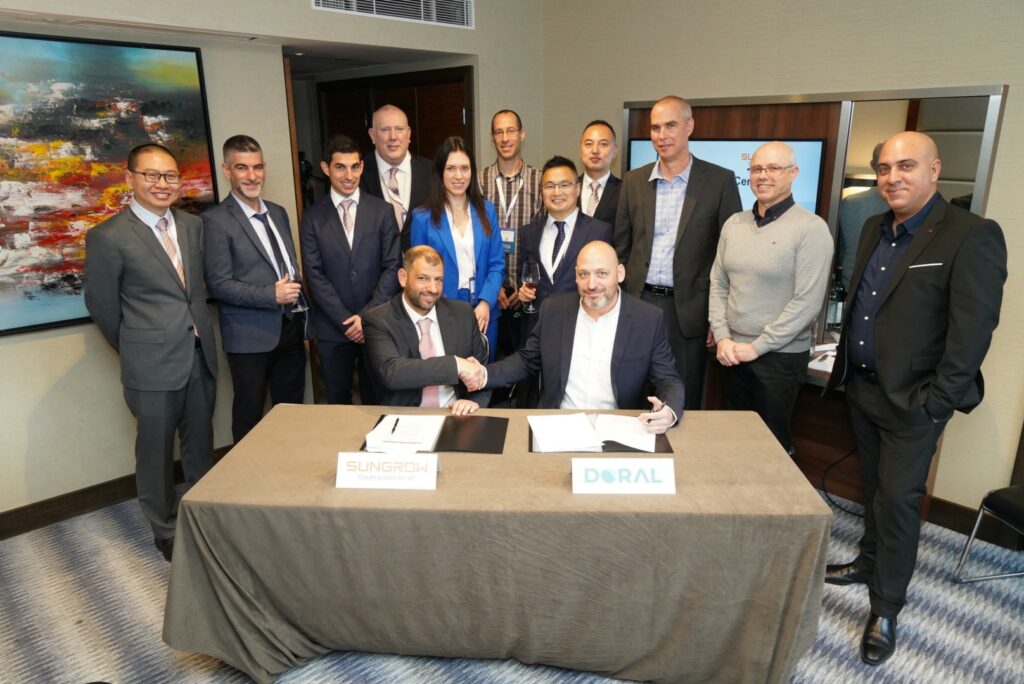
Sungrow has signed another battery storage supply deal with renewable energy and sustainable infrastructure developer Doral for projects in Israel.
The contract for the supply of an unspecified “several hundred MWh” of DC-coupled or AC-coupled battery energy storage system (BESS) technology was signed at the Energy Storage Summit EU, hosted in London last week by our publisher Solar Media.
China-headquartered solar PV inverter and battery storage manufacturer Sungrow said the deal with Doral Renewable Energy Resources Group covers equipment for projects set to be delivered from the middle of 2023 and through 2024 for connection to the grid by the end of next year.
As regular readers of Energy-Storage.news may recall, Israel is considered a rapidly growing market for large-scale batteries. This is driven by a combination of renewable energy and decarbonisation policy goals and the uptake of solar PV in particular, coupled with the Israeli grid’s lack of interconnection with neighbouring countries.
Try Premium for just $1
- Full premium access for the first month at only $1
- Converts to an annual rate after 30 days unless cancelled
- Cancel anytime during the trial period
Premium Benefits
- Expert industry analysis and interviews
- Digital access to PV Tech Power journal
- Exclusive event discounts
Or get the full Premium subscription right away
Or continue reading this article for free
The country’s policy target to source 30% of its energy from renewable sources by 2030 equates to about 12GW of solar PV capacity – about 26% of the whole, with 4% from other sources.
In a November 2020 webinar with Energy-Storage.news and consultancy Clean Horizon, Israeli Electricity Authority (PUA) regulatory department head Yossi Sokoler said that integrating that big increase in solar would require about 2GW/8GWh of energy storage.
That means the country will be leaning quite heavily on solar-plus-storage hybrid resources, an area Sungrow is well acquainted with. Both it and Doral are carving out a market share in Israel largely as a consequence of government tenders for such projects hosted by PUA.
Doral has got a pipeline of 1.4GWh in those Solar Storage I & II tenders, through which a total 777MW of PV and 3,072MWh were procured, and the deal with Sungrow adds to a 66MW/253MWh supply contract between the two companies signed in April 2022.
Sungrow signed deals with two other Israel-based developers last year: a 64MWh contract with infrastructure solutions provider Afcon for a BESS system to be installed at a natural gas power plant as well as a 430MWh order from Enlight Renewable Energy, which like Doral is a project developer.
Sungrow officially launched its latest range of liquid cooled lithium-ion BESS solutions late last year, the ST2752UX for AC-coupled and DC-coupled utility-scale applications, and ST500CP-250HV, for the commercial and industrial (C&I) market segment.