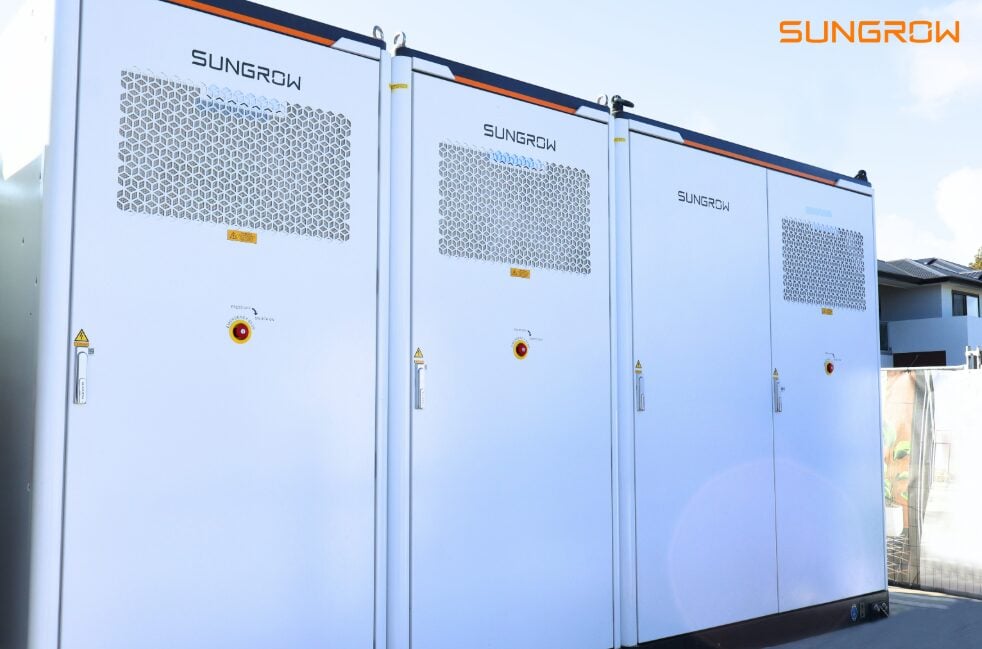
Chinese solar PV inverter and energy storage provider Sungrow has deployed two commercial and industrial (C&I) community batteries, marking the first in South Australia to undergo Common Smart Inverter Profile for Australia (CSIP-AUS) testing.
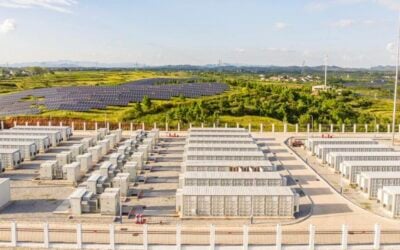
The installations at Living Choice retirement villages in Flagstaff Hill and Fullarton feature Sungrow’s PowerStack 200CS (ST225kWh-110kW-2h) BESS units and 455CS (ST455kWh-110kW-4h) BESS.
The projects are designed to ensure power supply reliability while generating revenue through energy arbitrage and Frequency Control Ancillary Services (FCAS).
This dual-purpose approach enables the retirement communities to reduce operational costs while actively participating in the National Electricity Market (NEM), which spans Australia’s southern and eastern states.
Try Premium for just $1
- Full premium access for the first month at only $1
- Converts to an annual rate after 30 days unless cancelled
- Cancel anytime during the trial period
Premium Benefits
- Expert industry analysis and interviews
- Digital access to PV Tech Power journal
- Exclusive event discounts
Or get the full Premium subscription right away
Or continue reading this article for free
The CSIP-AUS testing aspect of these deployments is particularly significant for the country’s energy transition. As an Australian implementation guide for the IEEE 2030.5 protocol, CSIP-AUS enhances security, configurability, and remote command execution capabilities for distributed energy resources.
The protocol enables dynamic export, emergency backstop mechanisms and load control capabilities that help grid operators maintain stability as renewable energy penetration increases.
South Australia continues to lead Australia’s energy transition with high renewable energy penetration rates, making advanced grid integration protocols like CSIP-AUS essential for maintaining system reliability.
Reliability is increasingly under the spotlight in several Australian states, namely those with high uptake of renewable energy generation. The Australian Energy Market Commission (AEMC) predicts South Australia and New South Wales could experience reliability gaps from 2026-27 and 2027-28, respectively.
Since this report was released in June 2025, each respective state has announced plans to launch firming tenders to secure energy storage capacity to mitigate grid reliability concerns.
New South Wales intends to secure 500MW, while South Australia is seeking long-duration energy storage (LDES) sites with a minimum output of 30MW and at least 8-hour storage duration.
Community batteries in Australia
The Sungrow projects join a growing network of community batteries deployed across Australia.
In Western Australia, a recent government initiative has seen five new community batteries commissioned by state-owned utility Western Power in Perth.
Meanwhile, in South Australia, AGL announced in July plans to build 11.2MW and operate 11.5MW of community batteries across the state as part of its AGL Community Power initiative.
The federal Community Batteries for Household Solar programme aims to install 400 batteries nationwide to provide shared storage for households across Australia, further accelerating the adoption of community-scale energy storage solutions.
Larger community batteries have become popular across the country, combining multiple residential areas to pool household renewable energy generation through rooftop solar PV. This has captured the attention of industry heavyweights, such as the Australian Renewable Energy Agency (ARENA), which last year allocated AU$143 million in financial backing to build 370 community assets across Australia.
Under the organisation’s Community Battery Funding Round 1 initiative, Queensland and New South Wales will receive the most community batteries, with 69 and 95, respectively, followed by Victoria with 37 batteries, Western Australia with 28, South Australia with 24, the Northern Territory with 16, and Tasmania with six.
The state of Victoria also has a community battery scheme dubbed the ‘100 Neighbourhood Batteries Program’, which aims to provide communities with the benefits collective solar PV can grant.
Our publisher, Solar Media, will host the Energy Storage Summit Asia 2025 on 7-8 October 2025 in Manila, the Philippines. You can receive 20% off your ticket using the code ESN20 at checkout.