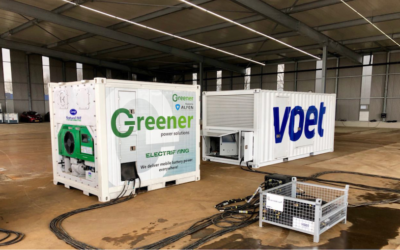
Batteries are increasingly widely used in grid balancing, but there are many more applications where a battery can play an important role. With electric grids requiring periodic maintenance, batteries can stand in for the grid during downtime in order to reduce the impact on industry and households, writes Dieter Castelein.
NGEN, a developer based in Slovenia, has celebrated the installation of a 22MWh grid-scale battery energy storage system (ESS) supplied by Tesla in what is thought to be the product’s first deployment in the Balkans.
Major US utility company Duke Energy has announced the first grid-scale battery energy storage project to be built in the service territory of Duke Carolinas, in Anderson County, South Carolina.
Updated: Germany-headquartered renewables developer Baywa r.e. will deploy a solar-plus-storage solution for a goldmine in Mali that will include 13.5MWh of battery storage and reduce the mine’s dependence on heavy fuel oil during the daytime.
Distributed renewables and energy storage are now the cheapest form of baseload power and if Western Australia’s remote areas can benefit from that, we can all benefit, argues David Martin, founder of energy trading platform provider Power Ledger.
British battery storage system manufacturer Powervault is backing a recent agreement with energy tech platform Kaluza to help expand its reach in its home market.
Australian technology firm Power Ledger is to launch an eight-month pilot project of its peer-to-peer energy trading technology after penning an agreement with Malaysia’s Sustainable Energy Development Authority (SEDA).
A 6MW / 48MWh battery energy storage system paired to a 15MW diesel generator has gone online on Nantucket, in what has been described by project owner National Grid as the biggest system in New England to date.
New technologies and designs aimed at driving down the cost of energy storage facilities are currently the focus of intense industry R&D. Sara Verbruggen reports on DC coupling, an emerging system architecture that many believe will soon become the industry standard.
Reports of Eos’ aqueous zinc battery being paired with small modular nuclear reactors (SMNRs) in a joint venture (JV) with Holtec appear to have been greatly exaggerated, according to an Eos representative.