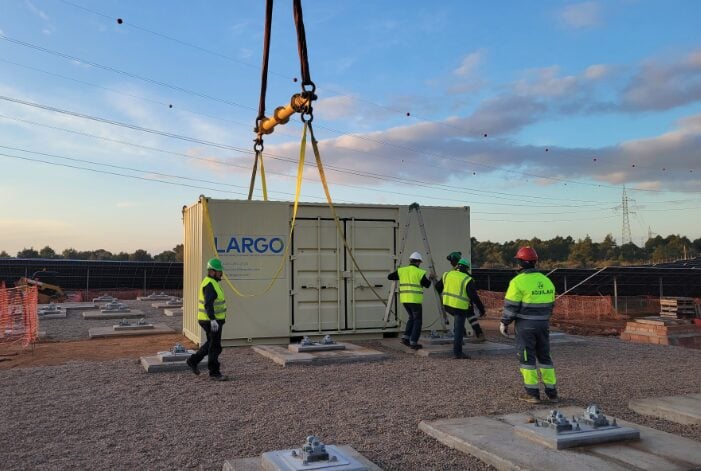
Largo has announced the successful closing of the previously announced transaction between its subsidiary, Largo Clean Energy Corp. and Stryten Critical E-Storage to establish joint venture Storion Energy.
Stryten Critical E-Storage and Largo Clean Energy Corp. (LCE) announced the formation of Storion on 19 December, 2024, which seeks to combine access to vanadium from the only vanadium mine in the western hemisphere with US electrolyte production to create a vertical supply chain for utility-scale long-duration energy storage (LDES) flow batteries.
Vanadium redox flow batteries (VRFB) use liquid electrolytes stored in tanks circulated through a membrane to create an electrochemical reaction and generate electricity. Proponents of the technology argue that it has a longer life cycle than lithium-ion (Li-ion) batteries, more scalability, and better fire safety record, among other positives. Vanadium is the most expensive part of a VRFB system, but the company aims to provide a solution for this issue.
Storion calls its vertical supply chain strategy the ‘Earth to Energy’ model and claims that it will be able to deliver vanadium electrolyte at less than US$0.02/kWh. The company says this would accomplish the DOE’s goal of reducing the levelised cost of storage (LCOS) for LDES to US$0.05/kWh immediately.
Try Premium for just $1
- Full premium access for the first month at only $1
- Converts to an annual rate after 30 days unless cancelled
- Cancel anytime during the trial period
Premium Benefits
- Expert industry analysis and interviews
- Digital access to PV Tech Power journal
- Exclusive event discounts
Or get the full Premium subscription right away
Or continue reading this article for free
LCE has a unique vanadium leasing model, ‘Largo Physical Vanadium’ (LPV), which allows investors to invest in vanadium assets while they are stored in VRFBs. Storion will have exclusive rights to offer LPV to the market in the form of vanadium electrolyte.
Francesco D’Alessio, President of Largo Clean Energy said of the transaction:
“The closing of this transaction represents a transformational step for Largo as we advance our investment strategy of integrating into the fast-growing vanadium flow battery market. Storion Energy now provides a direct channel for Largo’s high-quality vanadium products into the long duration energy storage sector, reinforcing our position as a leading and reliable supplier of vanadium.”
VRFB have seen an increase in announced projects and funding in recent years.
South Korea-based H2, Inc will deploy a 1.1MW/8.8MWh vanadium flow battery (VFB) in a project commissioned by the government energy research institute, CIUDEN, as part of a programme funded by the Ministry for Ecological Transition and Demographic Challenge of Spain.
H2 is also working on what it claims is the US’ largest VFB project, a 20MWh system located in California it started work on in December 2021, although has not provided an update since.
Announced on 6 December 2024, technology provider Rongke Power completed a 175MW/700MWh VRFB project in China, the largest of its type in the world.
Last November, Western Australia revealed a long-duration VFB pilot in the town of Kununurra exploring the use of the technology in microgrids and off-grid power systems.
The 78kW/220kWh battery energy storage system (BESS), supplied by VSUN Energy, a subsidiary of Australian Vanadium, is being used to explore the usage of long-duration energy storage (LDES) technology in the state with the support of state energy provider Horizon Power.
In 2023, Pacific Northwest National Laboratory (PNNL) and technology provider Invinity Energy Systems announced that a VRFB with a 24-hour discharge duration would be built and tested at PNNL’s Richland Campus in Washington state, US.
Recently, researchers at PNNL developed the EZBattery Model, a simulation tool for predicting the performance of VRFB systems. The physics-based simulation tool takes less than a second to predict the performance of redox flow batteries.