Renewable energy group Statkraft is not taking the same bullish approach to Germany’s standalone utility-scale battery energy storage market as others, according to the company’s head of wind & solar Germany.
“We currently do not see a commercial case for standalone utility-scale storage in Germany. There was a short time when these projects were commercially viable in primary reserve, but since this is such a small segment of the market which got exploited quickly, this opportunity doesn’t exist anymore,” Claus Urbanke told Energy-Storage.news at ees Europe / Intersolar Munich in mid-May.
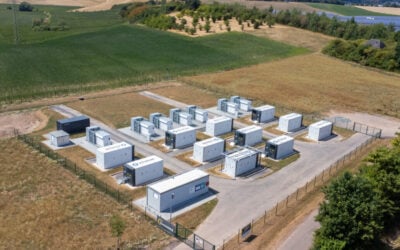
Companies developing standalone battery energy storage system (BESS) that Energy-Storage.news has interviewed unsurprisingly have a very different view. Georg Gallmetzer, managing director of developer ECO STOR, also an exhibitor at the event, said the business case had improved recently despite several headwinds.
Florian Mayr, partner at clean energy finance and strategy consultancy Apricum, active in energy storage since 2014 and in Germany’s clean energy market since 2008, said his company was being approached by many companies wishing to enter the German market.
Try Premium for just $1
- Full premium access for the first month at only $1
- Converts to an annual rate after 30 days unless cancelled
- Cancel anytime during the trial period
Premium Benefits
- Expert industry analysis and interviews
- Digital access to PV Tech Power journal
- Exclusive event discounts
Or get the full Premium subscription right away
Or continue reading this article for free
“Everyone is seeing that the strong fundamentals are now in place, with the Easter package, all these plans for renewables expansion, all of which is being accelerated by the Russian invasion of Ukraine. It’s a perfect storm. [They are saying] ‘the market is boiling and we want to be there early,'” he said.
Echoing Gallmetzer’s comments, Mayr said there is a growing opportunity for arbitrage. Mayr noted that according to one of his company’s clients, a major renewable energy and energy storage player, by 2025, it was likely that all new PV projects in the country would have storage attached.
Germany strategy
Statkraft is Europe’s largest generator of renewable energy. While that is primarily hydropower in Norway, the company also has a large wind, solar and gas power portfolio across 19 countries. Statkraft does have a 3MW BESS at a hydropower facility in Germany, with plans to develop at least two solar PV-colocated ones.
“Our focus for future storage projects in Germany will be on co-location. It brings certain benefits to co-locate storage with solar or wind parks, like shared infrastructure – e. g. grid connection,” Urbanke said.
One of the two German projects will be through the Innovation Tender, where federal network agency Bundesnetzagentur offered an income stream for projects combining two or more low carbon technologies, though Urbanke said its requirement for the storage to only charge from the generation asset was not the most optimal solution, something echoed by the California grid operator.
On the use cases for storage in the German market and the changing revenue stack, Urbanke said: “Primary reserve is the market segment that still makes most sense for storage projects in Germany. There are other niche applications, like industrial customers who have storages in use to shave their peak consumption pattern and as a back-up solution. But generally, primary reserve is the main application.”
“It is a bit difficult to foresee how the situation will develop in the next few years. In principle, we do not see a very large need for short-term storage capacity in the European power system. However, there is a certain push by policymakers to incentivise these solutions, for instance through the German Innovation Tender.”
Broader energy storage strategy for Statkraft
Speaking about Statkraft’s wider approach to energy storage across countries, Urbanke said that it is open to standalone storage projects where commercial opportunities arise.
“We are looking at several storage projects in different countries where the setup is either standalone or co-location. The technology is typically lithium-ion for short-term storage and optimised in the wholesale market – either as grid service or also in the short-term trading markets,” Urbanke said.
“This is the field in which Statkraft has a real competitive edge, as we are among the largest short-term energy traders in Europe with a large renewable portfolio, but also with a lot of flexible generation capacities which we optimise in our virtual power plant (VPP).”
“We are well positioned to develop storage projects and we do so in those markets where we see the biggest commercial opportunities come up.”
The company is owned by the Norwegian state and is responsible for the majority of Norway’s hydropower assets.
This article has been amended post-publication to more accurately reflect the quotes and context from Florian Mayr’s interview.