

Liam Critchley takes a deep dive into battery state of health (SoH), one of the most important metrics for battery storage operational and lifecycle management, in this ESN Premium explainer article.
This is a companion article to Liam’s previous piece, Calculating state of charge (SOC) in BESS.
The health of a battery is fundamental to any advanced technology application, be it in smartphones, EVs or large-scale battery energy storage systems (BESS). The state of health (SoH) of a battery is the amount of charged capacity remaining in the battery cells when fully charged. SoH is expressed as a percentage of the battery’s current capacity relative to its nameplate (original) capacity.
For example, all new cells in a BESS start at 100% and drop over time as both cyclic and calendar ageing reduce the total amount of capacity the batteries can hold. However, if a cell were very old and had been cycled frequently, it might have a 70% SoH. This means the cell can only hold 70% of the original capacity once it’s been fully charged. So, if the cells used are 280Ah nameplate, at 70% SoH, they will only have a capacity of 196Ah.
Try Premium for just $1
- Full premium access for the first month at only $1
- Converts to an annual rate after 30 days unless cancelled
- Cancel anytime during the trial period
Premium Benefits
- Expert industry analysis and interviews
- Digital access to PV Tech Power journal
- Exclusive event discounts
Or get the full Premium subscription right away
Or continue reading this article for free
SOH is closely linked to both state of charge (SoC) and battery degradation. The battery management system (BMS) predicts battery degradation, and a lower SoH is directly correlated with it, as degradation commonly manifests as reduced capacity and/or safety issues.
As detailed in a previous article in this series, the SoC is the current charge in a battery when it is in use, charging, or idle. It is also expressed as a percentage compared to the theoretical charge it can possess, so if the SoH is low, then the SoC of a battery will also be affected.
The SoH is also related to the internal resistance, which is a direct result of cell ageing, and can be compared with the original internal resistance to see how much the battery has aged. As a battery ages and the SOH is reduced, the internal resistance increases, meaning that less current is delivered at a defined voltage.
Therefore, SoH is not only critical for seeing what the maximum capacity of a BESS installation is, it is also a key indicator into how much ageing has occurred, as excessive wear can affect electrode structures and the ability for cells to work safely.
If the SoH is too low and ageing is too high, BESS operators know it’s time to replace some cells before thermal runaway or other battery hazards occur (which would mean many more cells and containers would need to be replaced if a fire broke out). Therefore, having an accurate understanding of the SoH can help BESS operators save money on Opex, avoid costly and damaging thermal events and maintain the operational efficiency and availability of their asset.
Operational factors that impact SoH
While the cells in a BESS might start at 100% SoH, the longer they are in operation, the more they will degrade. However, how the BESS is used also significantly contributes to battery ageing and a loss of SoH.
For example, high C-rates (charging and discharging), high temperatures, regular deep cycles/high depth of discharge (DOD) and a poor/inefficient BMS can all accelerate ageing. This means that the SoH might be lower than expected for its current calendar of cycle age if it has been in more operationally abusive conditions. For BESS with slower discharge and 20-80% operations, they will retain a higher SoH for longer.
So, there’s no one-size-fits-all battery health for a BESS installation, which is why understanding the true SoH of the cells in a BESS is important.
The SoH is also important for knowing when to replace cells in a BESS. In many cases, whole containers won’t need to be changed, only cells that have accelerated ageing and are starting to fall below favourable thresholds. For example, so long as the cells have an SOH above 90%, those cells still retain an ‘almost new’ performance. Once it drops to 80-90% there is some battery degradation, but normal operations are not affected. Once the SoH hits 70-80%, there is notable performance degradation, and many asset owners involved in more demanding applications will start to think about replacing cells.
As the SoH goes below 70%, the end-of-life (EoL) has been reached for more demanding use cases, as well as those which want to make money (energy trading) and want to provide a high level of grid support (frequency regulation etc). Many BESS operators replace the cells at this threshold. However, not all cells need to be replaced at this level, and some BESS cells can be easily and safely operated down to 50% SoH if they are used in less demanding applications, such as renewable energy time-shifting.
Some BESS even use second life batteries from EVs that have an SoH of 70-80% when installed that are no longer suitable for the high-performance requirements of EVs but are feasible for less demanding BESS use cases.
Calculating SoH and the challenges
Accurately calculating the SoH gives assets owners a better understanding of their systems to maximise profits, minimise losses, and ensure both a high safety and performance during everyday operations. BMS are typically used to measure and monitor the SoH of the cells in a BESS. However, estimating and accurately calculating the SoH is difficult because not only do environmental factors play a part, but the ageing characteristics also varies between different cell chemistries and from manufacturer to manufacturer. Every cell is going to be different.
There can often be a discrepancy between the true SoH and the measured SoH, as some BMS use linear, cycle-based estimation and don’t account for the DOD, thermal conditions, and other factors that cause accelerated degradation. So, some degradation can become masked by the BMS, leading to inaccurate SoH assessments.
There are also other technical challenges that contribute to inaccurate SoH and SoC estimations. There are often inconsistencies at the pack level because there are thousands of cells in series and parallel, manufactured with different tolerances. This can lead to non-uniform ageing across the BESS, which makes it harder to accurately track SoH. This also means there are often weaker links in the BESS, but even if just one cell is much more degraded than the others, it can limit the whole BESS and make the SOH inaccurate. Additionally, because many BESS cells today use lithium iron phosphate (LFP) sub-chemistry, it makes estimating SoH a lot more difficult than other battery chemistries because LFP cells have a flat open circuit voltage (OCV) curve and suffer from hysteresis where the charge and discharge curves do not match.
This is not an issue for every BMS, though. Some BMS today are more advanced and robust, helping make SoH estimation much more accurate and improving both BESS safety and profitability. Some of the smart algorithms used in these BMS include Coulomb counting, voltage-based estimation, and Kalman filtering.
A good BMS with advanced algorithms will continually manage different parameters in individual cells and battery modules, measuring the cell voltage (to prevent over-charging and over-discharging), tracking the current flow, and measuring the internal temperature for hotspot detection. Managing these degradation factors not only helps prevent ageing and detect changes in internal resistance, but it also helps to better estimate the SoH as the operating conditions are not as erratic. These smarter algorithms and BMS can quantify the SoH in non-linear degradation scenarios where the degradation mechanisms are complex.
In terms of the quantification of the SoH, the equation is simple, it’s the analysis of the relevant parameters to work out the current SoH that’s the challenge. Because the SoH (as a percentage) is simply the current capacity divided by the nameplate capacity, multiplied by 100. This is expressed as:
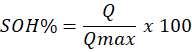
Where Q = the current maximum capacity and Qmax is the original nameplate capacity. The equation can also be rearranged to find the exact capacity in mAh if the SoH is known as a percentage.
Data-driven methods improving SoH accuracy
With advanced BMS being needed to quantify the many parameters that can affect the SoH, and estimate a true SoH reliably and accurately, data-driven methods are being used more to help with these estimations.
Machine learning is being used to better understand how the cells are wearing out over time to predict the future performance and SoH based on the data captured by the BMS. Machine learning can identify complex patterns and deduce how a combination of temperature, charging speed, DOD, and age are wearing the battery, and can adapt this analysis to the changing conditions that the BESS operates in. By understanding these behaviours inside the cells of the BESS, the BMS can better predict the true SoH.
There is also growing market availability of advanced battery data analytics solutions that layer on top of the BMS and, using telemetric sensors placed at critical positions around cells and the system, measure metrics that can impact SoH, SoC, and thermal behaviour. The cloud-based data collected is analysed and used to provide, according to the providers of these third-party (non-OEM) software-based solutions, a much higher degree of estimation accuracy.
SoH is a critical metric for determining the remaining life of cells in a BESS, and it helps with maintenance schedules and replacement decisions. More importantly for site operators and asset owners, it is a metric that can cause the financial losses if the values are inaccurate but can help asset owners to maximise profits if they know their true capacity capabilities. Likewise, knowing the SOH makes the BESS more reliable for long-time periods which benefits both the asset owners and the grid, especially if the installation is involved with grid services.
