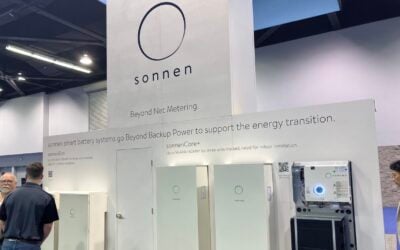
Lux reseach analyst Christopher Robinson said the cost would be aorund US$1700/kWh. Credit: Sonnen
German energy storage hardware and services provider Sonnen has released a new residential solar battery system including self-learning software and grid-tied functions.
The sonnenBatterie eco compact is designed to increase household solar self-consumption, help managing time-of-use and support grid services, but it does not include backup power.
Sonnen claims the 4kWh battery systems are available for up to 40% of the cost of its other storage offerings at US$5,950. The price includes inverter, battery modules with a 10,000 cycle lifetime, smart energy manager and measurement technology, but not installation.
Christopher Robinson, research associate at Lux Research, told Energy-Storage.News: “The system cost is cheaper than Sonnen’s previous systems, but on a US$/kWh basis this is still not quite competitive with others such as Tesla.
Try Premium for just $1
- Full premium access for the first month at only $1
- Converts to an annual rate after 30 days unless cancelled
- Cancel anytime during the trial period
Premium Benefits
- Expert industry analysis and interviews
- Digital access to PV Tech Power journal
- Exclusive event discounts
Or get the full Premium subscription right away
Or continue reading this article for free
“Tesla’s kWh battery retails for US$3,000, but with installation and power electronics the price is closer to US$6,200. Adding installation costs to Sonnen’s system, it will only achieve US$1700/kWh compared to Tesla’s US$1,000/kWh. “
Due to its modular design, the battery can be scaled up in 4kWh additions up to 16kWh in one unit.
The battery helps to store solar energy generated during the day and to reduce use of energy from the grid during peak times.
Robinson said it was not unusual for the backup function to be removed since many developers had included this functionality to residential storage units and consumers reacted with very little interest.
He added: “Tesla originally announced a 10kWh backup unit, but cancelled it due to low orders. In many target markets for stationary storage, such as the US and Europe, there are too few power outages to make backup power enough of a benefit.”
The eco compact batteries are now available for pre-order with products due to ship by the end of 2016.
Boris von Bormann, chief executive of sonnen, said: “We’ve seen increasing demand from our installation partners for a lower cost energy storage product that enables homeowners to use more of the power generated by rooftop solar systems.
“With the sonnenBatterie eco compact we are providing a simple, cost-effective version of our proven energy management technology that enables more solar-powered homeowners to supply up to 100% of their own power needs. As a result we expect to see a dramatic increase in the installation of storage across the country”.