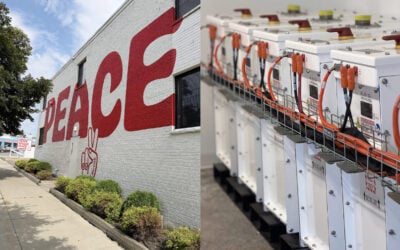
Sonnen’s German CEO Christoph Ostermann launches and explaining the sonnenCommunity concept in Berlin last week. Image: Andy Colthorpe.
The eligibility of energy storage systems for a programme financing energy efficiency and renewables through property tax assessment shows that the technology is maturing rapidly, according to the CEO of the North American arm of Sonnenbatterie.
The energy storage provider, now branded as Sonnen, launched into the US earlier this year, racing Tesla to establish a presence in the residential market and also services commercial businesses which want to reduce peak demand charges.
The company said its storage systems met the criteria for approval in the HERO programme this month. Under the US government’s property assessed clean energy (PACE) financing scheme, HERO allows homeowners a tax rebate for installing solar, energy efficient water pumps and other clean technologies like storage on their properties.
“The financing comes through property tax – it’s on the property tax bill that you get every year, the financing is dealt through that. It’s a very interesting interest rate for the homeowner,” Boris von Bormann, Sonnen’s North America chief said, citing expected rates of between 3% and 8%, based on metrics such as value of the home and customer credit rating.
Try Premium for just $1
- Full premium access for the first month at only $1
- Converts to an annual rate after 30 days unless cancelled
- Cancel anytime during the trial period
Premium Benefits
- Expert industry analysis and interviews
- Digital access to PV Tech Power journal
- Exclusive event discounts
Or get the full Premium subscription right away
Or continue reading this article for free
“So the homeowner has to finance their storage system through their property tax bill. It’s a reduced amount of interest, given through the government and recuperation comes every year, it’s just added to your bill, so you don’t have to think about it a lot, it’s a very easy financing mechanism.
“It’s not going to show up on your credit rating, which is nice for the homeowners. It makes the purchase a lot easier for the homeowner.”
Prices of energy storage systems, particularly lithium-ion based ones such as Sonnen’s, have fallen considerably due in no small part to a fall in battery prices of around 50% since 2009 according to research firm IHS. However unlike solar PV, the technology has so far for the most part not been recognised for long term funding mechanisms of the type that drove the rooftop leasing market in the US, for example. Another aspect of HERO being touted as one of its strengths is the fact that it is a way to help finance clean energy technologies without calling for direct subsidies from the public purse.
Von Bormann said the inclusion of storage in PACE and HERO appeared to be a sign that this picture is changing and said this transformative change might even be happening faster than it did in solar. It showed that financing companies were now comfortable accepting the level of risk that battery storage systems presented, he said.
“I think it’s a very good first step and I think it’s a definite first sign that storage has a bigger value and has longer term approval already than when solar first started I think.
“You spread the risk out to the financing company as well, we have to go through a vetting process to be approved for HERO and PACE financing so it’s kind of an assurance to the end customer too that the product has been approved by them, so there’s a quality product that’s behind it and it’s vetted by an independent authority that provides financing against it, so that’s a seal of approval and a quality stamp on there.”
Energy as a service vs the commoditisation of batteries
Von Bormann was speaking with PV Tech Storage at the launch of Sonnen’s new sonnenCommunity energy trading scheme in Germany last week. The company’s customers and non-customers can join the subscription service to trade surplus PV power via the grid at rates Sonnen said will comfortably undercut German utility retail rates of power, claiming it will cost around €0.23 per kWh LCOE. Indeed, the company is even banking on not making money from the sales of energy in kilowatt-hours from sonnenCommunity but instead from hardware and subscriptions.
At last Wednesday’s launch, CEO Christoph Ostermann from Sonnen’s German head offices said that the company hoped this kind of differentiation, providing energy as a service and tool of energy self-sufficiency for customers could give the company an edge in a market for batteries that many are predicting could rapidly commoditise. In such an instance, a race to the bottom where customers recognise only price competitiveness could make it a tough market for hardware providers.
“This is exactly where we think the future is in our business. To provide hardware is nice, to provide intelligent hardware, hardware-plus-software is even nicer, but in the long run the aim is to provide intelligent services, to empower our customers,” Ostermann said.
“This is also a reason why we changed name from Sonnenbatterie to Sonnen, because Sonnenbatterie is too narrow, it focuses on the hardware. When we started and launched in the German market, nobody really knew what a storage system is. We thought Sonnenbatterie (‘Sun Battery’) is a good name because everyone would understand what it is. So in the beginning it was a perfect name, when it was something of a new technology for end-customers, to explain what this device is – it stores solar power. We see our destiny in the service provision.
“Battery sales are commoditising more and more, already it is a commodity. Nobody knows where the whole journey is going to. What will be the right technology for storage in five years or 10 years may not even be lithium-ion! We are happy this is commoditising because we can make the technology accessible for more people because it’s cheaper,” he added.
“So this is good news, but again, the hardware is a necessary vehicle which we need in order to be able to offer services, but at the end of the day what we really want is to be a service provider.”
Sonnen, formerly Sonnenbatterie, is actively pleased to see the commoditisation of batteries, Ostermann said. Image: Sonnen.