Software for modelling technical and economic performance, seismic activity certification for flow batteries and underwriting for BESS projects, in this edition of news in brief from around the world in energy storage.
HOMER Front modelling software gets ancillary service upgrade
UL Solutions has added new modelling capabilities for its HOMER Front 1.0 software suite for utility-scale battery energy storage system (BESS) resources.
HOMER Front is a tool to enable project owners, designers, and investors to evaluate the technical and economic performance they can expect from their BESS in a range of available market opportunities.
That means the software can be used to make decisions around battery system sizing, managing augmentation strategies and modelling revenues while accounting for changing values of things like energy market prices.
Try Premium for just $1
- Full premium access for the first month at only $1
- Converts to an annual rate after 30 days unless cancelled
- Cancel anytime during the trial period
Premium Benefits
- Expert industry analysis and interviews
- Digital access to PV Tech Power journal
- Exclusive event discounts
Or get the full Premium subscription right away
Or continue reading this article for free
While it can be applied to solar PV and wind as well as batteries and hybrid resources that combine storage with renewables, the newly added modelling is for applications that are best served by batteries, including frequency regulation, capacity markets, and power purchase agreements (PPAs) with specific obligations to deliver energy at certain times.
“Developers told us they needed a way to perform quick, easy, but detailed modeling of frequency regulation as a revenue stream, and spreadsheets are not adequate,” UL Solutions renewables director Chakradhar Byreddy said.
Instead, the software can do those “complex” calculations and create forecasts.
“The user decides at what price it’s worth participating in frequency regulation services and can run a sensitivity analysis to find the right price point to maximise revenue potential,” Byreddy said.
The HOMER Front web-based software platform is licensable and was launched by UL Solutions in 2022, after originally being developed at the US National Renewable Energy Laboratory (NREL).
ESS Inc gets seismic activity certification
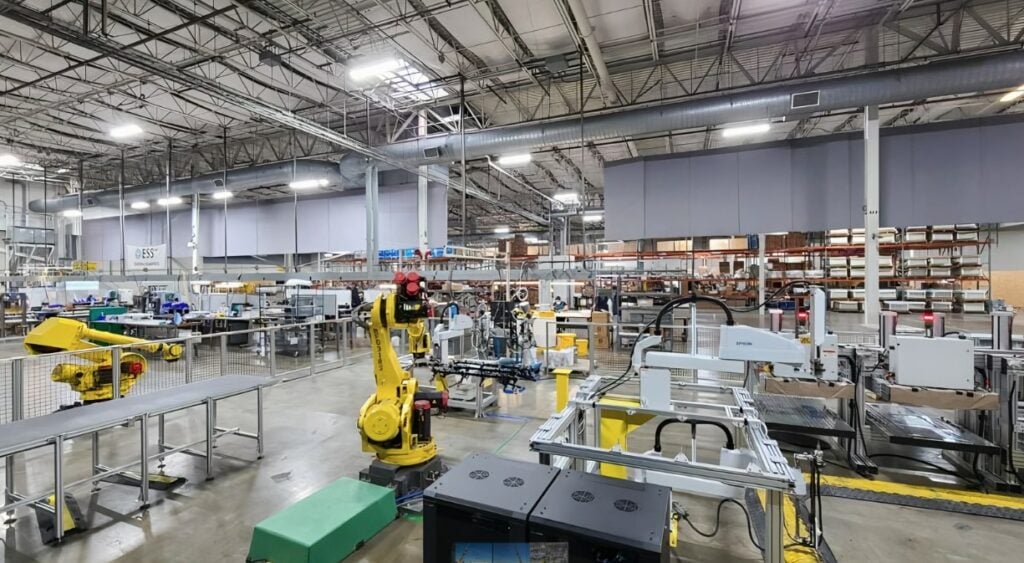
ESS Inc. has received certification for its Energy Center iron electrolyte flow battery system to withstand seismic activity to the highest rating of the IEEE 693 standard.
The company, which holds the IP for the long-duration energy storage (LDES) technology and licenses it to other manufacturers as well as producing its own systems, claimed this means the flow battery can be deployed as critical energy infrastructure to provide resilience against seismic events.
The Energy Center is configurable to provide different durations of storage, with each unit having a nameplate output of 145kWdc and 1,160kWh capacity. It is aimed at utility-scale and large industrial applications.
The product was tested at the University of California, Berkeley, Pacific Earthquake Engineering Research Center. It underwent shake table testing as well as an evaluation of its design and the company claimed Energy Center is the first non-lithium, LDES technology to receive the certification.
The company’s commercial and industrial (C&I) product Energy Warehouse is already certified to UL9540 while its core technology has received UL1973 certification and underwent UL9540A testing. Energy Center is in the process of testing for UL9540.
On a related note, a Guest Blog from ESS Inc. CEO Eric Dresselhuys was published earlier today on Energy-Storage.news, on how LDES technologies such as his company’s should be considered a more effective tool for global energy security than liquefied natural gas (LNG).
NARDAC offers US$50 million BESS underwriting service to global projects
NARDAC, a UK-headquartered specialty insurance underwriter to the energy and infrastructure industries, has begun offering underwriting services for BESS projects.
The company said yesterday (26 March) that it can offer US$50 million in underwriting capacity to BESS developers and operators through their insurance brokers, for projects worldwide.
According to NARDAC, the fast pace of project development and the risk profile of emerging energy technologies means that operators may find themselves unable to access sufficient insurance capacity for new projects.
Meanwhile, older projects, which are typically smaller in size than the ones springing up in mature markets like the UK and US, are being deprioritised, the company claimed.
Eight triple-A rated syndicates in the Lloyds insurance marketplace are backing the new service which NARDAC is providing in its capacity as a Managing General Agency (MGA). The underwriter claimed it is armed with detailed knowledge of the technologies and nuances of the global market.
“We noticed projects increasingly being fully funded by lenders in the anticipation of reliability and comprehensive risk management and recognised that there was an emerging gap in critical risk cover that was not being met by the incumbent markets,” NARDAC partner Tom Harries said.