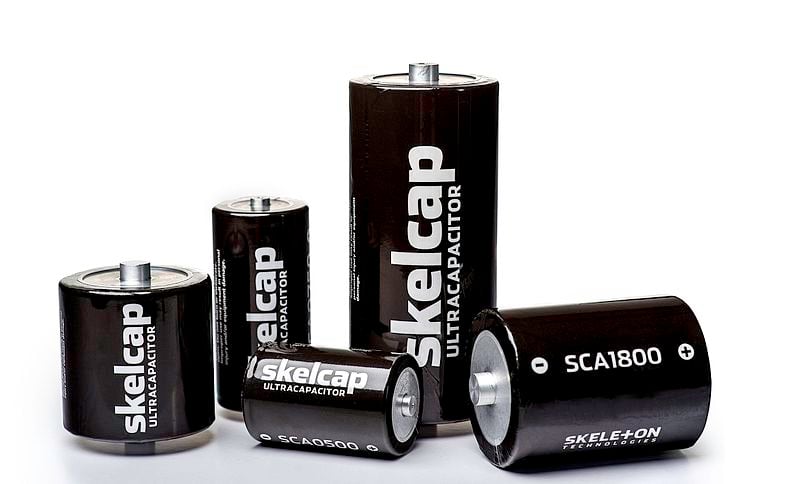
Large wind turbines have blades that need to be angled correctly in order to capture the optimum generation opportunity, and ultracapacitor maker Skeleton Technologies believes it has developed the answer with its new 17V module.
The European manufacturer has been developing its super and ultracapacitor devices for a range of applications in the renewable energy and grid power sectors for some time, including using them in tandem with lithium-ion batteries and other solutions, as a blog for this site from the company’s then-product engineer Olivier Chabilan explained back in 2018.
The company is now launching an ultracapacitor module that is specifically developed for wind turbine pitch control and for UPS (uninterruptible power supply) applications. Changing the angle of blades helps to regulate the speed of wind turbines’ motion, without which turbine blades can rotate too fast in high winds, generating power at an unusable range or worse, causing structural or electrical damage.
In other words, as Skeleton Technologies outlined in an email sent to Energy-Storage.news, pitch control means turning the blades towards a neutral angle in heavy winds. The complication, however, “is that pitch control must work and supply power to turn the blades, even if the main power for the blade pitch control fails,” the company said.
Try Premium for just $1
- Full premium access for the first month at only $1
- Converts to an annual rate after 30 days unless cancelled
- Cancel anytime during the trial period
Premium Benefits
- Expert industry analysis and interviews
- Digital access to PV Tech Power journal
- Exclusive event discounts
Or get the full Premium subscription right away
Or continue reading this article for free
This control has long been done with either hydraulic or lead acid battery systems that can either involve heavy mechanical components and engineering or complex maintenance with associated downtime. Ultracapacitors, Skeleton Technologies claimed, require little maintenance over a 15+ year expected lifetime and react extremely quickly – in a matter of milliseconds as required – to fluctuations in power and production.
The company believes that with wind power as a perfect example of variable renewable generation, ultracapacitors that store electrical energy and can discharge in high power bursts, can fill gaps to create reliable grid, or grid-like power.
“Wind energy tends to be intermittent and fluctuates according to the weather conditions. It can cause spikes in energy production,” Skeleton Technologies’ policy and communications director Arnaud Castaignet said.
“Ultracapacitors provide the solution for many issues, such as levelling the electrical power load and providing fill-in power when it is temporarily underperforming such as when wind speed drops, and storing energy during [times of] optimal renewable conditions for later use”.
“Ultracapacitors as an energy storage medium can provide big benefits such as instant response to demand surge and improved energy delivery quality,” the Skeleton Tech spokesman said, reinforcing the view that this can be done in complement to lithium-ion batteries and a range of other technologies.
“For grid stability, we usually complement batteries by covering the peak loads and reducing the stress on the batteries, enabling a smaller footprint and significantly longer life-times. Ultracapacitors fill the gap between base and peak loads”.
Hybrid renewable energy – including wind, solar and energy storage – is the theme of the cover feature in the latest edition of PV Tech Power (Vol.22), available for download from the PV Tech Store now.
This article has been amended from its original form to remove accidental references to a project – given by the company in error – not intended for public knowledge at this stage.