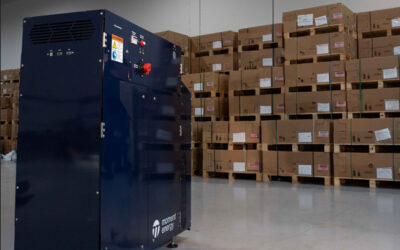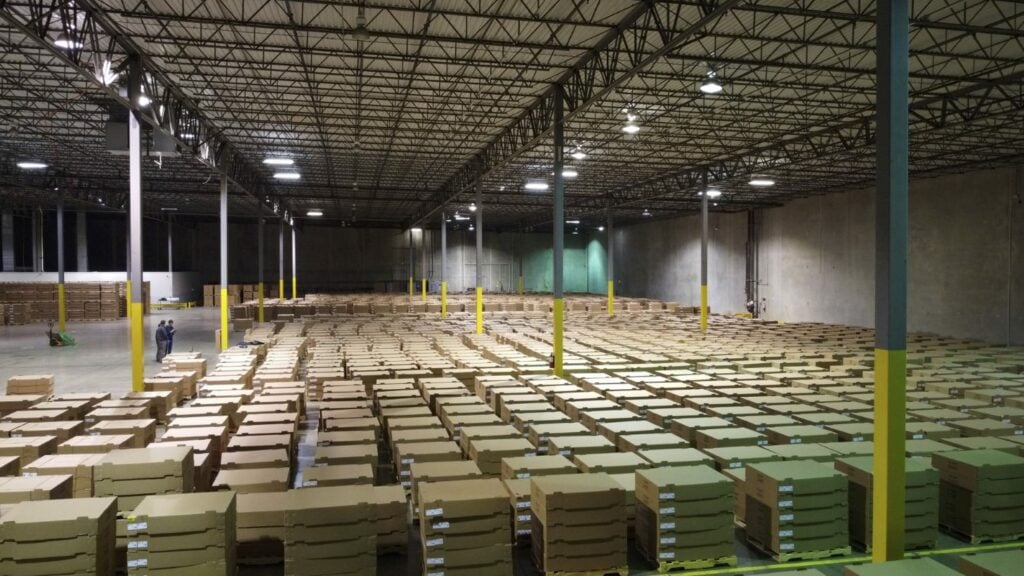
Element Energy’s large stock of batteries for second life energy storage are mostly LG batteries recalled from EVs in the last few years due to fire safety concerns, a source told Energy-Storage.news.
California-based Element Energy did not deny the claim when asked for a response. A spokesperson for the firm said: “The sources of the batteries that Element Energy will start deploying this year is not information that we have or will share publicly. Element’s adaptive BMS (battery management system) is for every battery.”
Element Energy revealed in December 2022 it had secured 2.5GWh of battery modules to deploy into second life energy storage solutions. Second life energy storage means the repurposing of EV batteries into stationary energy storage systems (ESS) once they are no longer suitable for use in an EV.
That procurement, along with targeted 100-400MWh project sizes this year onwards, meant Element was claiming to have scaled far beyond what any other second life energy storage company has done. The 2.5GWh figure even goes beyond what Mercedes-Benz Energy CEO Gordon Gassmann implied the major automotive OEM’s second life-focused subsidiary has to work with.
Try Premium for just $1
- Full premium access for the first month at only $1
- Converts to an annual rate after 30 days unless cancelled
- Cancel anytime during the trial period
Premium Benefits
- Expert industry analysis and interviews
- Digital access to PV Tech Power journal
- Exclusive event discounts
Or get the full Premium subscription right away
Or continue reading this article for free
Energy-Storage.news’ source, speaking anonymously, said that Element Energy has been able to do this by using batteries from LG which had to be recalled over 2020, 2021 and 2022. The South Korea-headquartered firm had to recall hundreds of thousands of its battery packs from EVs and home energy storage during the period due to fire safety concerns.
A big chunk of the LG batteries involved in recalls were in Chevrolet Bolts and Hyundai vehicles. LG Chem had to pay US$1.9 billion to Chevrolet owner General Motors alone as a result.
Our source added that the provenance of Element’s second life batteries is why the company is keen to emphasise the benefits of its proprietary BMS.
CEO Tony Stratakos discussed its BMS at length in an interview on this site shortly after the procurement was announced and, as alluded to in the company’s response, the BMS is a decade in the making and is claimed to have benefits that go far beyond fire safety.
Stratakos wouldn’t give any details on where the batteries came from at the time and said that Element Energy wasn’t even focused on the second life energy storage space until recently.
The firm has offices in Menlo Park, California, and in South Korea.