NEC ES names former Li-ion startup exec as new CEO
Steve Fludder, a former Samsung engineer and GE Renewable Energy China executive, has been named as the new CEO of NEC Energy Solutions.
The US-headquartered energy storage system integrator and technology provider, a subsidiary of Japan’s NEC Corporation, appointed a temporary CEO and president, Michihiro ‘Hiro’ Ezawa, in May this year to replace Budd Collins. Collins was in charge of the company from its inception in May 2014, when startup A123 systems was bought out and rebranded as NEC’s Energy Solutions business.
Steve Fludder has been in the power, energy and infrastructure sectors for over 30 years, with previous roles including senior executive officer for sales and marketing at Samsung Engineering, having begun his career with General Electric as an aircraft engineer. While at GE, he became president and CEO of GE Energy China. Most recently, Fludder was CEO at lithium battery startup Alpha-En Corporation.
“When you combine NEC’s global reach and industry leading technology with our end-to-end energy storage solutions including concept, design, installation, commissioning and servicing to ensure maximum return on investment, you have an unbeatable offering well-positioned to capitalize on this unprecedented market growth,” Fludder said, adding that it was an “exciting time” to join the company.
Try Premium for just $1
- Full premium access for the first month at only $1
- Converts to an annual rate after 30 days unless cancelled
- Cancel anytime during the trial period
Premium Benefits
- Expert industry analysis and interviews
- Digital access to PV Tech Power journal
- Exclusive event discounts
Or get the full Premium subscription right away
Or continue reading this article for free
Leclanché delivering system to battery-thermal storage hybrid
Leclanché has received an order for a 15MWh energy storage system in Germany worth around €5 million.
Swb, a utility which in addition to energy also provides households and towns with drinking water and telecommunications infrastructure, placed the order with the Swiss battery and energy storage system provider, Leclanché revealed today.
Swb, which is a subsidiary of major utility EWE, is developing a “hybrid solution” project, combining six containerised energy storage systems from Leclanché with thermal energy storage, which swb hopes will be able to deliver grid services more cost-effectively than either technology alone. The heating portion of the project will be used to charge the battery cheaply and effectively, with commissioning expected to take place in March 2018.
The awarding of the project “endorses our software and system integration capability and experience of delivering similar projects around the world, and further solidifies our 2018 business outlook and path to EBITDA breakeven,” Leclanché CEO Anil Srivastava said.
In August, analysts at investment bank Cantor Fitzgerald Europe agreed with Leclanché’s assertion that the company is on track to regain profitability – although claiming this could be achieved by 2019, not 2018 as Leclanché’s management has forecast.
Narada claims China first with modular system
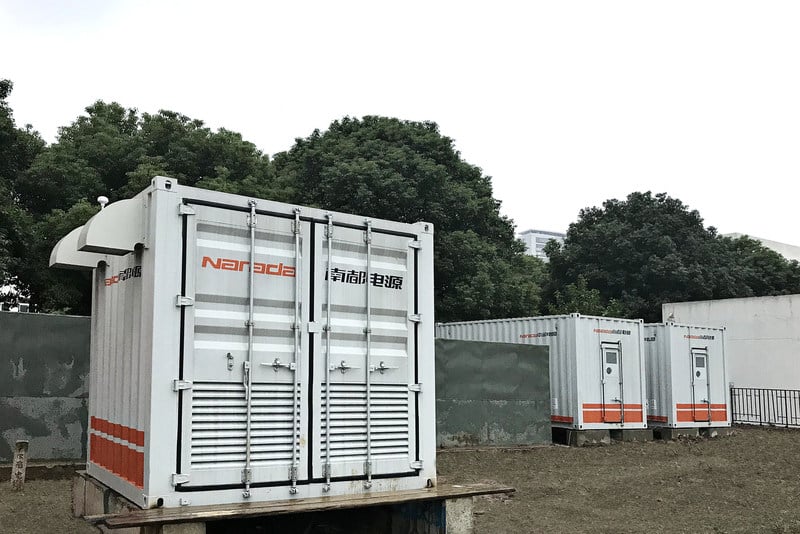
Narada Power claims it has delivered China’s first “modular pre-installed energy storage station” in Suzhou, a city west of Shanghai.
The project has been installed and commissioned at a factory belonging to Four Seas (Suzhou) Food Co, a maker of food and drink products. The project, which has an expected 10-year lifetime, is a 250kW / 1MWh system.
According to Narada Power, which uses different battery types including lead acid and lithium iron phosphate for its projects, the Suzhou Food Co system was designed and constructed using prefabricated parts including a foundation module and the 20ft container housing the battery system.
The company claims this modular method of construction can be quicker and allows for better quality control of construction, alongside other advantages. Narada said that after it was designed, construction, including hoisting and putting the container in place, took no longer than a week. The system will be used for peak demand management, discharging to the grid at peak times and optimising power utilisation rates at non-peak periods by using those windows to charge the battery.