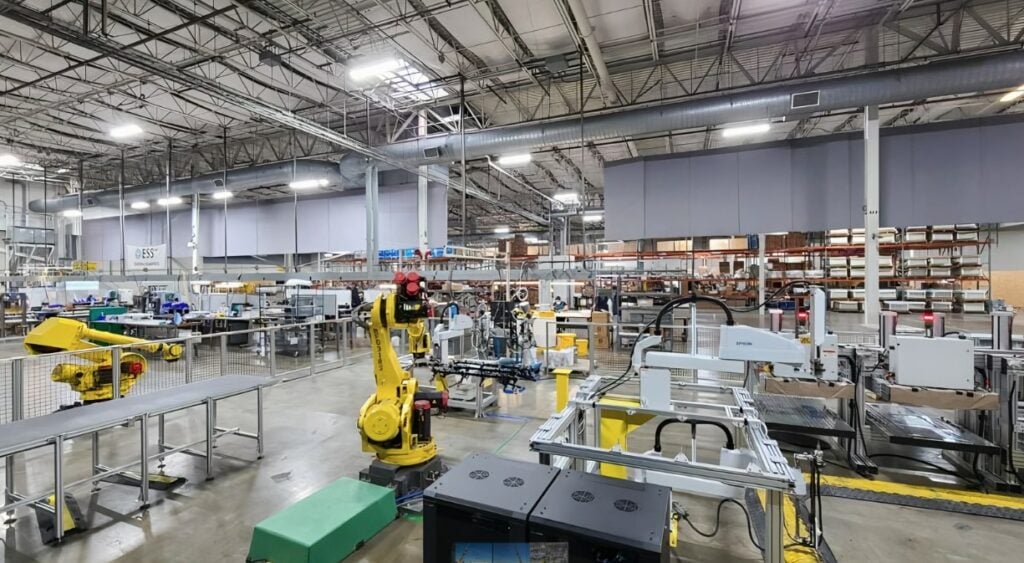
The government of Queensland has committed to investing in a factory in the Australian state that will make flow batteries based on iron electrolyte technology.
In a joint statement this morning, Queensland’s deputy premier and energy ministers said that the state will invest AU$25 million (US$17.12 million) in the factory, already under construction by Energy Storage Industries – Asia-Pacific (ESI), headquartered locally.
ESI has licensed the flow battery technology, claimed to be non-toxic, non-flammable and suitable for applications requiring up to 14-hour duration, from US technology company and IP holder ESS Inc.
The long-duration energy storage (LDES) factory is planned to have an initial 200MW/1,600MWh annual production capacity when it comes online in late 2026. It can then be ramped up to 400MW/3,600MWh annual capacity by the end of 2029, according to ESI.
Try Premium for just $1
- Full premium access for the first month at only $1
- Converts to an annual rate after 30 days unless cancelled
- Cancel anytime during the trial period
Premium Benefits
- Expert industry analysis and interviews
- Digital access to PV Tech Power journal
- Exclusive event discounts
Or get the full Premium subscription right away
Or continue reading this article for free
In addition to manufacturing the products, ESI also intends to install, maintain and finance battery energy storage solutions.
The state government’s debt and equity investment has attracted a further AU$40 million from an undisclosed UK-based investment fund, ministers Cameron Dick and Mick de Brenni said.
“By partnering with local industry and attracting private capital, Queensland is well-placed to seize the incredible opportunities presented by the world’s decarbonisation. Our investment in ESI is part of our commitment to firmly establish a new battery manufacturing industry right here in Queensland,” Dick, deputy premier and treasurer and minister for trade and investment said.
Energy and clean economy jobs minister de Brenni said the Queensland government’s Energy and Jobs Plan policies, introduced by former premier Annastacia Palaszczuk and currently carried by incumbent Steven Miles’ continued Australian Labor Party administration, mean “investors are buying into Queensland’s clean energy future.”
Queensland Energy and Jobs Plan guiding investments
The AU$62 billion Clean Energy and Jobs Plan package underpins a target to reach 70% renewable energy in the state by 2032, retire coal assets and convert them into clean energy hubs and support pumped hydro and transmission system buildout. At the same time, the government is throwing its support behind local clean energy industries, including lithium-ion (Li-ion) and flow battery manufacturing and upstream resources value chains.
It also published a statewide Battery Strategy in February this year, aimed at enabling AU$570 million (US$375.29 million) investment into energy storage manufacturing from AU$100 million of government investment.
For many, flow batteries are synonymous with vanadium pentoxide electrolyte in vanadium redox flow batteries (VRFBs). Queensland is a major holder of vanadium deposits, potentially positioning itto support that technology.
While it is supporting a VRFB factory under construction by locally headquartered manufacturer Vecco Group, the government has also recognised the potential of ESS Inc-ESI’s iron flow batteries and the zinc-bromine hybrid flow systems made by Queensland-headquartered Redflow.
The government announced support for pilot projects featuring each of the latter two technologies in August 2023. However, Redflow went into voluntary administration, with all its assets up for sale, in August as it was unable to find private investment to match state government funding for a factory of its own in Queensland.
One of the administrators told Energy-Storage.news Premium last month that there had been an “encouraging” level of interest shown from prospective buyers or investors even a few days into the process.
Meanwhile, in forming a strategic relationship with ESI back in 2022, Oregon-headquartered ESS Inc said the partnership could result in 12GWh of total deployments in the Asia-Pacific region.
At that time, construction on ESI’s factory had already begun a couple of months earlier, prior to the pair officially announcing ESS Inc’s involvement. It had been initialled planned for a 400MW ramp up by 2026, although this timeline appears to have been rolled back.
The iron flow battery’s first deployment in Australia is underway through a partnership between ESI and Queensland government-owned energy company Stanwell Corporation. A 1MW/10MWh system is being trialled at a Stanwell energy innovation hub, with installation underway since late last year.