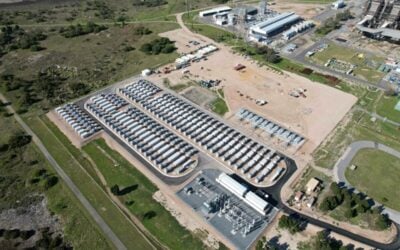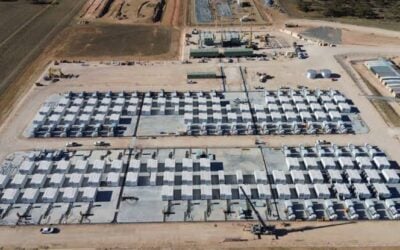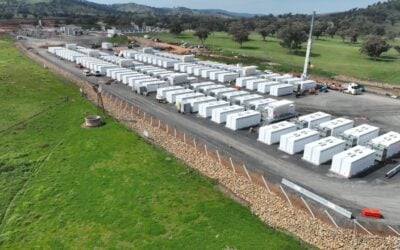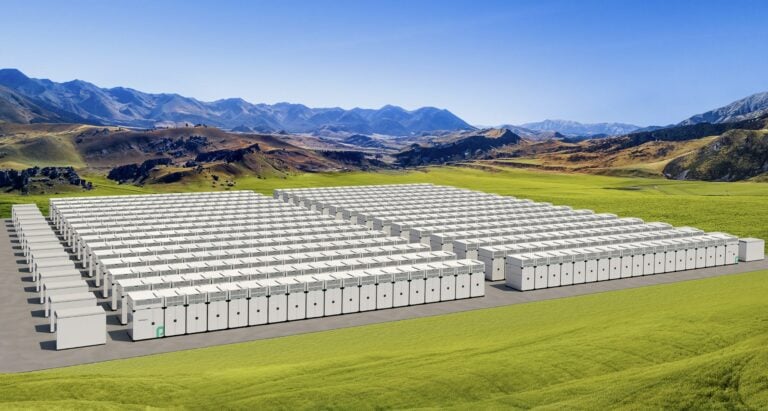
Powin Energy has entered a partnership with developer Akaysha Energy to deploy battery storage systems in Australia.
Announced yesterday, Powin said the framework agreement covers the deployment of more than 1.7GWh of systems over a two-year period, marking the US-headquartered energy storage system manufacturer and integrator’s first moves into the Australian market.
Akaysha Energy is currently developing nine battery energy storage system (BESS) projects that it wants to put into the Australian National Electricity Market (NEM), totaling about a gigawatt of power output and 3GWh of capacity.
Just a fortnight ago, Energy-Storage.news reported that BlackRock Real Assets, which manages more than US$60 billion of funds worldwide, has acquired Akaysha and committed to investing a billion Australian Dollars (US$700 million) to progress the developer’s project pipeline.
Try Premium for just $1
- Full premium access for the first month at only $1
- Converts to an annual rate after 30 days unless cancelled
- Cancel anytime during the trial period
Premium Benefits
- Expert industry analysis and interviews
- Digital access to PV Tech Power journal
- Exclusive event discounts
Or get the full Premium subscription right away
Or continue reading this article for free
Although described in general terms as a developer of renewable energy and energy storage, Akaysha Energy’s managing director Nick Carter said he identified a gap in the market for a “fully integrated development business focused primarily on storage,” hinting that the wider Asia-Pacific region is also a potential target market.
The developer has selected Powin Energy’s Stack BESS products and Stack OS control system, including advanced power plant controller. Powin said it has been working with Akaysha to advance the grid interconnection process for its projects for several months.
One aspect of that has been making sure they meet the Generator Interconnection Standard mandated by the grid operator for energy resources to enter the market and connect to the grid.
“It is critical to have a diverse competitive landscape in the Australian ESS market. Powin’s vertically integrated and flexible business model reduces project cost and risk by having multiple trusted cell suppliers, proprietary software, and an in-house power plant controller,” Carter said on the agreement.
Developer’s proposed projects include eight-hour duration BESS for NSW
Projects Akaysha has announced publicly include Ulinda Park, a large-scale BESS connected to a substation in Queensland’s Western Downs region – where the state’s biggest BESS to date has just been connected, but a need has been identified for plenty more.
The first phase of Ulinda Park would see a 150MW/300MWh lithium iron phosphate (LFP) BESS deployed to support rapid expansion of wind and solar PV in the area while leveraging existing grid infrastructure. Ulinda Park has received development approval from local authorities in the Western Downs.
Another project is the proposed Palmerston BESS in Tasmania. The island state, off the southeast coast of Australia, is targeting producing twice as much renewable energy as its total electricity consumption requires and storing and transporting it to the mainland.
Akaysha Energy’s Palmerston project would be batteries equipped with advanced inverter technology which can provide synchronous inertia to support the grid in a way that traditional thermal generation has done in the past. It’s an application for batteries the Australian government, via the national renewable energy agency (ARENA), has been keen to support.
However, the company’s biggest publicly announced project is Orana BESS, proposed for construction in central-west New South Wales which could be a large-scale project with up to eight hours battery storage duration.
Proposed output would be between 200MW to 400MW and the capacity up to 1,600MWh built in two phases. Orana is at an earlier stage of development, with the developer in consultation with local communities and carrying out environmental assessment, according to its website.
Latest new market for Powin Energy
The deal marks the latest new international market for Powin. The company has deployed more than 2.5GWh of BESS in eight countries to date and is contracted to supply more than 10GWh over the next three years.
It recently formed a partnership with power producer O2 Power to enter the Indian market and has signed a supply deal with an undisclosed customer in Taiwan, where it already has some projects in operation, while other notable recent deals in its US homeland include a 2.5GWh multi-year agreement with smart energy company Ameresco and a contract to supply 120MW/524MWh for the first utility-scale BESS projects in the state of Idaho.
In July, Powin raised US$135 million from investors including Singaporean sovereign wealth fund GIC, a few weeks after the integrator sold a minority stake to Samsung Venture Investment Corporation (SVIC). The company’s products are manufactured in Taiwan, China and Mexico.
In an interview with this site in May, Powin Energy CEO Geoff Brown talked in depth about the company’s strategy, approach to technologies and battery selection, evolution of software and the current opportunities and challenges the industry faces.