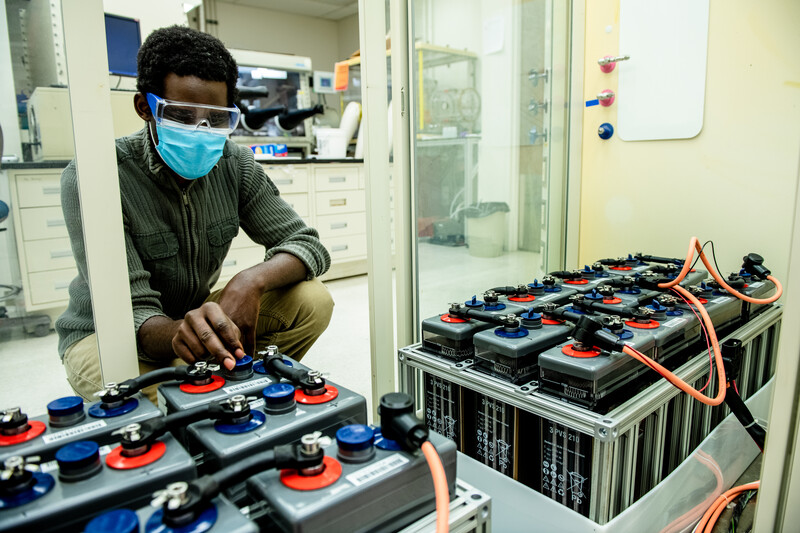
The US Department of Energy’s Pacific Northwest National Lab (PNNL) has made a third semi-exclusive commercial licence for vanadium redox flow battery technology available.
The national laboratory has already partnered with two companies for the long-duration storage technology and this third licence is its final one for vanadium redox, PNNL said.
In addition to the commercial licence, PNNL has also developed a high-performance mixed-acid electrolyte compatible with vanadium redox batteries which it says can store more energy than many other technologies over a range of temperatures. The electrolyte is available on a non-exclusive basis.
“This emerging grid-scale storage technology has great commercial and energy security potential. We are eager to partner with additional industry partners to bring this technology to market and to support expanded use of renewable energies on the grid,” said Allan Tuan, commercialisation manager for energy, grid and advanced fuel research at PNNL.
Try Premium for just $1
- Full premium access for the first month at only $1
- Converts to an annual rate after 30 days unless cancelled
- Cancel anytime during the trial period
Premium Benefits
- Expert industry analysis and interviews
- Digital access to PV Tech Power journal
- Exclusive event discounts
Or get the full Premium subscription right away
Or continue reading this article for free
In an interview last year with our quarterly journal PV Tech Power, Prof Maria Skyllas-Kazacos, one of the inventors of the vanadium flow battery nearly 40 years ago at the University of New South Wales in Australia talked about how the patents expired for key aspects of the technology from 2006.
This opened up the opportunity for companies and research groups to get involved, Prof Skyllas-Kazacos said, but it took a while longer for the wider energy sector to take an interest in its long-duration storage potential.
“It took quite a long time, but once they started observing huge issues with grid stability, they realised the grid isn’t so good at stabilising all these renewable energies,” Skyllas-Kazacos said.
“People have realised that for the sort of energy storage we need for renewables, you really need long duration. And that’s why flow batteries have been attracting a lot of attention.”
The US government has identified long-duration storage as a key pillar in its move to de-carbonise its energy sector with the Secretary of Energy tweeting that flow batteries are “good for grid storage”. Over the past year, it has announced nearly US$100 million in funding for long-duration energy storage research and support.
US$17.9 million went to four flow battery manufacturing research & development (R&D) projects, while US$75 million is being spent on a long-duration energy storage research centre at PNNL, expected to open in 2025.
The UK government has dedicated £68 million (US$90 million) to long-duration storage through a competitive funding opportunity, making the first £6.7 million of awards public last week, with funding going to 24 separate projects across a range of technologies.
In Europe meanwhile a group of national and continental trade associations recently urged the European Union to support long-duration storage in the European Green Deal package.
California’s state government recently announced US$380 million in support for long-duration energy storage projects across two years, the biggest example of such funding to date.