Premium

Over 10GWh of grid-scale BESS deployed globally in February, Europe’s contribution increases

LinkedIn
Twitter
Reddit
Facebook
Email

February 2025 saw around 4.5GW/10.5GWh of grid-scale BESS deployments globally, with China continuing to account for the majority but Europe increasing its share from January.

The figure comes from market intelligence firm Rho Motion’s Battery Energy Stationary Storage Monthly Database, and is almost double (+97%) the number from February 2024.

Global grid-scale BESS deployments in February 2025

The 4,487MW/10,473MWh of grid-scale battery energy storage system (BESS) capacity deployed in February was down by about one-fifth from the previous month, when 5,090MW/13,219MWh came online (Rho Motion’s data for January has been tweaked by about 2.5% since).

China led deployments with just over two-thirds of the total installed there: 3,306MW/7,883MWh came online. It accounted for a little over two-thirds in January too. The remaining 1,181MW/2,590MWh came mainly from Europe, North America, South and Central America and Australia.

This article requires Premium SubscriptionBasic (FREE) Subscription

Try Premium for just $1

  • Full premium access for the first month at only $1
  • Converts to an annual rate after 30 days unless cancelled
  • Cancel anytime during the trial period

Premium Benefits

  • Expert industry analysis and interviews
  • Digital access to PV Tech Power journal
  • Exclusive event discounts

Or get the full Premium subscription right away

Or continue reading this article for free

“The largest project to come online this month was the 200MW/800MWh Henshui Wuyixian Wuyizhen Project in China – a further three projects over 500MWh entered operation this month, one in Chile (the Oasis de Atacama Phase 1 BESS Project) and the remaining two in China,” Rho Motion said.

Europe saw 587MW/1,225MWh of grid-scale BESS projects come online in February, more than double the previous month, contributing 12% to the global figure, versus just a few percent in January.

The largest project in Europe to come online was the first, 200MW/400MWh phase of the Blackhillock BESS in Scotland, which brought the UK’s capacity to 6,280MW/8,889MWh, according to Solar Media’s in-house figures. Those in-house figures indicate the UK accounted for around three-quarters of the total in Europe that came online in February.

North America meanwhile deployed 194MW/344MWh of grid-scale BESS with South and Central America deploying 124MW/620MWh, the latter most likely driven by the Oasis de Atacama project in Chile.

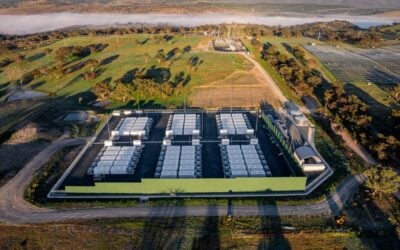
In Australia, Edify Energy’s 185MW/370MWh Koorangie BESS coming online accounted for the whole of the Oceania region’s deployments in February, according to Rho Motion’s data (the project is pictured above).

February’s deployments bring global installed BESS base to 154.6GW/358GWh

The installations seen last month mean there is now 154.6GW/358.7GWh of grid-scale BESS online globally, around two-thirds in China and around one-fifth in North America.

The two regions have 102.2GW/229.4GWh and 28.8GW/84.8GWh of grid-scale BESS online respectively, Rho Motion said. The next largest region is Europe, with 10.7GW/17.5GWh online.

2 December 2026
Italy
Battery Asset Management Summit Europe is the annual meeting for owners, operators, investors, and optimisation specialists working with operational BESS assets across the continent. The Summit focuses on how to maximise performance and revenue, manage degradation, integrate advanced optimisation software, navigate evolving market and regulatory frameworks, and plan for repowering or end-of-life strategies. With insights from Europe’s most active storage markets, it equips attendees with practical guidance to run resilient, profitable battery portfolios as the sector scales.
2 February 2027
The Tower Hotel, London, UK
Solar & Storage Finance Europe Summit brings together the developers, investors and lenders financing European solar and storage projects. As grid constraints, curtailment and weaker capture prices put pressure on returns, the summit explores what makes projects bankable, how co-located storage changes the revenue case and where capital providers see investable opportunities. Attendees can compare how their peers structure projects and meet people who could help them move their own projects or investments forward.
22 February 2027
InterContinental London - The O2, London, UK
The Future of Energy Storage Starts Here Three days in London where developers, IPPs, investors, utilities and the manufacturers building the technology come to close deals, not swap business cards. If you need to be in the room with the people deploying capital into European storage, this is that room.
20 April 2027
Renaissance Dallas at Plano Legacy West Hotel, Dallas, Texas, Dallas
Policy, Procurement and Power Demand: Defining the Next Chapter for Energy Storage. Two days in Dallas where developers, IPPs, investors, utilities and the manufacturers building the technology come to close deals, not swap business cards. If you need to be in the room with the people deploying capital into US storage, this is that room.

Read Next

November 20, 2026
Sodium-ion (Na-ion) is continuing to gain traction as a legitimate “major chemistry” — with CATL, BYD, and GM all committing to it — some developers, within and outside the US Na-ion space have argued that greater policy support should be directed toward advancing the technology.
November 20, 2026
Large-scale BESS projects in Germany have been progressed towards construction by Elements Green, Voltwise, EnBW, Green Flexibility, Flower and Dispatch totalling over 4GWh of capacity.
November 20, 2026
Another BESS Industry Buzz, looking at what people are discussing in the industry plus some of the most notable quotes from the RE+ trade show, which concluded yesterday.
November 20, 2026
EDF power solutions Australia has acquired the 250MW Holloway BESS project in New South Wales (NSW) from developer SynCo Global.
November 20, 2026
Australia committed a record 2.4GW of renewable energy projects to construction in the third quarter of 2026, while battery energy storage systems (BESS) committed in the quarter covered 13% of the new storage capacity needed by 2030.