Large-scale long-duration energy storage (LDES) projects have been launched near Cyprus and in the UK, using technologies from BaroMar and RheEnergise that are an iteration of established LDES technologies.
BaroMar appoints Jacobs to design first large-scale project
LDES technology BaroMar has enlisted consultancy Jacobs to develop the preliminary design for an underwater, large-scale pilot project with 4MWh of energy storage capacity using its technology off the coast of Cyprus.
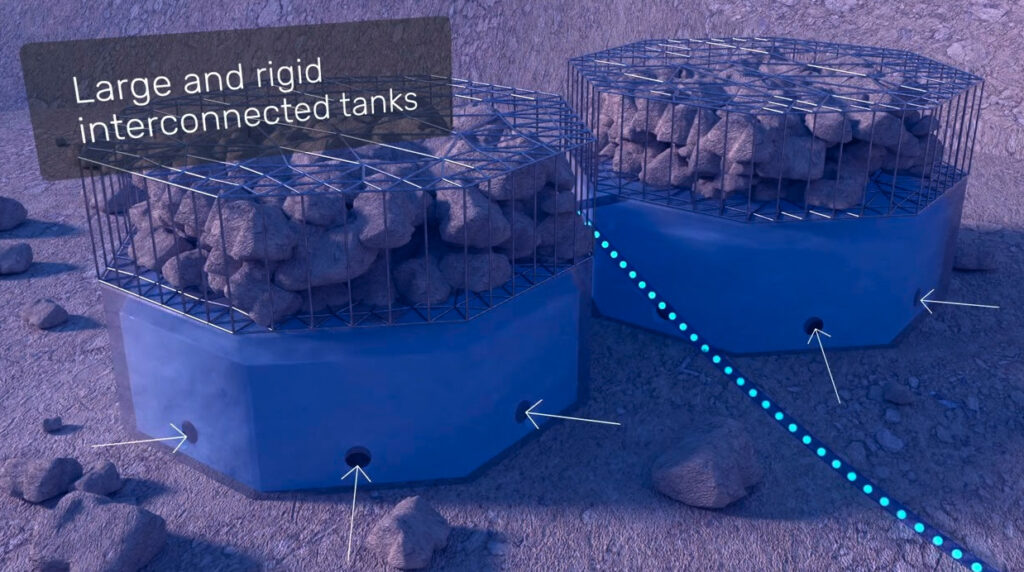
The 4MWh project would store compressed air in large rigid tanks ballasted on the seabed, making it a form of compressed air energy storage (CAES), one of the more commercial mature LDES technologies.
BaroMar claims that the underwater nature of its solution gets around the main regulatory and geographical constraints of conventional CAES on land.
Try Premium for just $1
- Full premium access for the first month at only $1
- Converts to an annual rate after 30 days unless cancelled
- Cancel anytime during the trial period
Premium Benefits
- Expert industry analysis and interviews
- Digital access to PV Tech Power journal
- Exclusive event discounts
Or get the full Premium subscription right away
Or continue reading this article for free
‘Unmatchable low construction costs’ can be achieved by BaroMar’s solution thanks to the negligible difference in relative pressure between the compressed air and the surrounding water, the use of traditional machine construction and installation methods, and a design that almost eliminates the need for underwater maintenance, it said.
“This project requires extensive geophysical, geotechnical and bathymetric surveying, investigation, feasibility studying and permitting for tank installation at deep depths for onshore mechanical and electrical equipment needs,” says Jacobs VP Fiachra Ó Cléirigh.
RheEnergise launching first large-scale LDES project, in UK
Long-duration ‘hydro-energy storage’ developer RheEnergise has agreed to build its first-of-a-kind system demonstrator at Sibelco’s mining operations at Cornwood, near Plymouth.
Mining company Sibelco’s Cornwood site produces kaolin, mainly for sanitary ware, ceramics, tiles and industrial applications. RheEnergise’s 500kW so-called ‘high-density’ pumped hydro energy storage (PHES) project will support the organisation in decarbonising its operation.
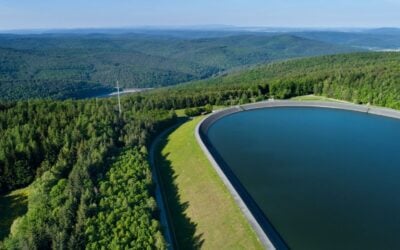
PHES is the most commercially mature LDES technology, having been deployed at scale for decades globally.
It is worth noting that Stephen Crosher, chief executive of RheEnergise, aims to have the “first 10MW grid-scale project in operation within two years”.
RheEnergise has developed a hydro-energy storage solution that can operate on low hills rather than just mountains, which creates an opportunity an order of magnitude greater than traditional pumped hydro.
Key to the solution is the use of the company’s High-Density Fluid R-19, which is 2.5x denser than water. Because of the fluid’s high density, projects can not only be constructed in areas with less elevation but can also be up to 2.5 times smaller than traditional pumped hydro projects for the same energy, the company claimed.
The project is being supported via the UK government’s Longer Duration Energy Storage (official acronym LODES) Demonstration Programme, and Devon County Council has provided permission for its development.
See the original, full version of the RheEnergise section of this article on our sister site Current.