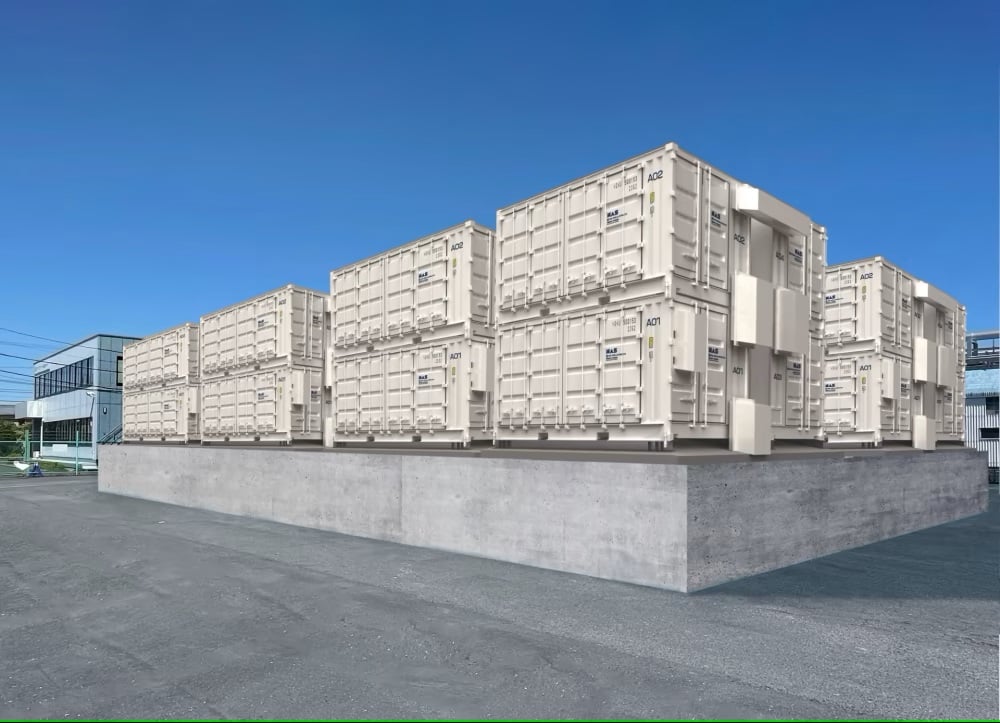
NGK Insulators will provide 72 containerised sodium-sulfur (NAS) battery storage units to a green hydrogen production plant in Germany.
The Japanese technology company’s proprietary NAS batteries will be used at the project on the Baltic Shore of northern Germany to store electricity generated from wind and solar PV, which will then be used in hydrogen electrolysis.
The order has been placed by BASF Stationary Energy Storage, which is a subsidiary of the German chemicals company BASF. BASF and NGK have been partnered on efforts to promote, distribute, and market the high-temperature NAS battery technology since 2019, marking the chemicals giant’s entry into the energy market.
NGK noted that the project is still in the planning stage. The order comprises NAS batteries with a maximum output of 18MW and 104.4MWh capacity (5.8-hour duration). It forms the first batch of a supply deal anticipated to total 230MWh.
Try Premium for just $1
- Full premium access for the first month at only $1
- Converts to an annual rate after 30 days unless cancelled
- Cancel anytime during the trial period
Premium Benefits
- Expert industry analysis and interviews
- Digital access to PV Tech Power journal
- Exclusive event discounts
Or get the full Premium subscription right away
Or continue reading this article for free
The NAS battery technology has been on the market for over 20 years. It is aimed at energy storage applications requiring durations of between four – eight hours, operating at temperatures of about 290°C – 360°C, with an intended lifetime of about 20 years, equivalent to around 7,300 cycles.
Each 20-ft containerised unit can discharge 250kW output with a capacity of up to 1,450kWh, stacking individual 1.2kWh battery cells. According to NGK, around 5GWh of NAS battery systems are in operation worldwide.
The batteries have been deployed for a wide variety of use cases, including renewable energy integration and backup power supply. In 2020, BASF and NGK partnered with South Korean power-to-gas company G-Philos to use the NAS technology in green hydrogen production with an initial 19.2MWh order volume.
Familiar name leads customer HH2E
The hydrogen plant in northern Germany is in development by HH2E, which specialises in CO2-free hydrogen production using low-cost renewable energy produced at off-peak times. It claims its hydrogen, usable for heat, storage, transportation fuel or electricity generation, is always offered at a fixed price.
According to the company’s website, it has two large-scale projects currently in development, including the Baltic Sea project at the town of Lubmin in the German state of Mecklenburg-Vorpommern. There, it will aim to leverage offshore wind resources, existing electricity infrastructure, and demand from nearby industrial park facilities.
Perhaps of interest to long-time readers of Energy-Storage.news is that HH2E was founded by managing director Alex Voigt, who began his career in the solar industry before becoming CEO of energy storage pioneers Younicos.
After some time in other roles, including founding and leading thermal energy storage startup Lumenion, Voigt founded the hydrogen company in 2021. Younicos, meanwhile, was bought by Scottish generator and mobile power solutions company Aggreko in 2017.
At the recent Green Hydrogen Summit Europe, hosted by our publisher Solar Media in Lisbon, Portugal, the audience heard that while hydrogen could be a useful tool for decarbonisation in the European Union (EU), particularly in industrial applications, the market requires “rewiring” for adoption to take off.
“The market for solar and wind is somewhat similar; hydrogen requires us to rewire the market to support and implement projects,” Sara di Mario, founder of energy transition advisory Hazel New Energy said.